Archive for April, 2015


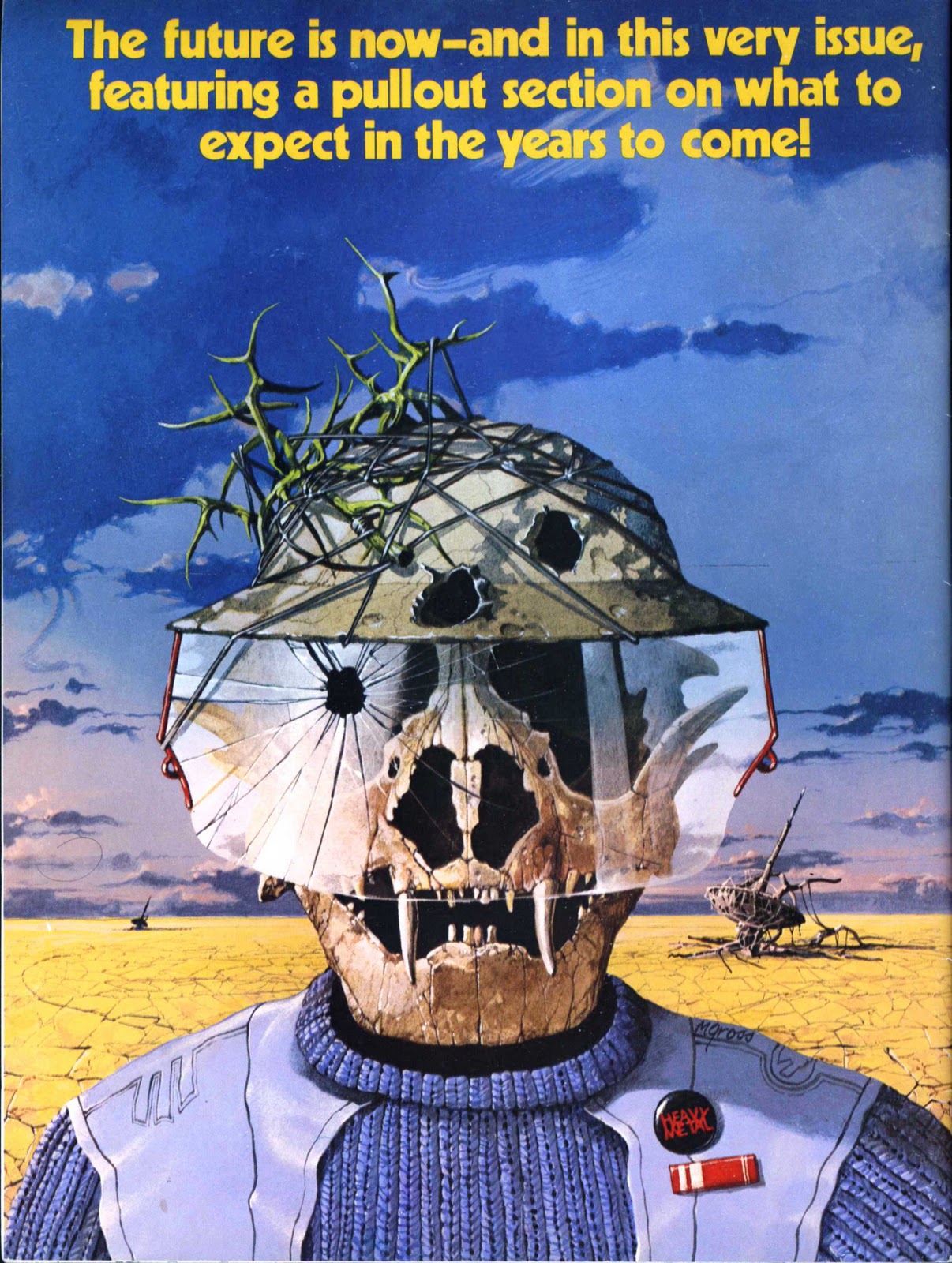
Michael Gross Back Cover Art for Heavy Metal (January, 1982)

Heavy Metal 1982 Michael Gross

Compare to the Angus McKie art seen here. The skeleton in a spacesuit, representing the long dead astronaut, is a very powerful sci-fi trope that’s been around since the dawn of the genre. The decomposing explorer is often buried in sand and surrounded by a dead world. The attempt to colonize space, especially as a a result of escalating social upheaval or widespread devastation (i.e. a nuclear war) on Earth, is a deeply troubling idea to many and dates all the way back to the myth of Icarus.

The image is a warning against the hubris of flying too high, of crossing thresholds we were not meant to cross, of challenging God. Ray Bradbury’s The Martian Chronicles (1950) is a famous example of the theme, as are the early sci-fi films Rocketship X-M (1950) and Flight to Mars (1951), to name just a few examples.

I can’t find much information on Michael Gross. He has entries at the Internet Speculative Fiction Database under both Mike Gross and Michael Gross, for a combined ten cover works. Heavy Metal is not mentioned, but I know he did more than one cover for the magazine.

(Image via The Por Por Books Blog)

Richard Corben Cover Art: Anthology of Slow Death (Last Gasp, 1975)

SD 1975-1

SD 1975-2

The ecocentric Slow Death Funnies (“Funnies” was dropped after issue #1) was Last Gasp’s first series, published to coincide with the inaugural  Earth Day (April 22, 1970). There were 10 issues published between 1970 and 1979, with an 11th and final issue appearing in 1992. See a full history and issue by issue breakdown at Comixjoint.

Corben’s colors, like the figures surrounding the loathsome pig-king, seethe with decadence and despair. I get the feeling that the paper itself burns to the touch. Ellison’s description of Slow Death‘s message—“that tomorrow will be much worse than today”—is an apt motto for the underground comix movement as a whole.

In Search of the Lost Chord by The Moody Blues (Deram, 1968)

Lost Chord 1968-1

Lost Chord 1968-2

Psychedelic music is intrinsically navel-gazey because it expresses the individual’s inner journey, the mystical expedition. Often, the effort is too pretentious and silly to bear, and laughter ensues. Sometimes the opposite occurs, and you get the feeling that you’ve been lifted to a higher plane. I’m not a great Moody Blues fan, and In Search of the Lost Chord is no Fifth Dimension, but I really like the album: it’s lush and soft, not particularly ground-breaking but particularly dreamy and pleasant.

Why am I writing about psychedelic music? Because I dig it, and because it’s intimately related to the explosion of the fantasy and sci-fi scene in the late ’60s, not to mention surging interest in the occult (or “metaphysics”) and mythology, all of which inform early geek culture.

The LP cover art is by Phil Travers, who recounts the experience—“the band wanted me primarily to illustrate the concept of meditation”—at Rock Pop Gallery.

Music from ‘In Search of…’ by the ‘In Search of’ Orchestra (AVI Records, 1977)

In Search 1977-1

In Search 1977-2

As far as I can tell, none of the cuts on the album made it onto the show, at least not in the version heard here. That’s why it’s billed as “music themes from and inspired by the series,” I guess, instead of a proper soundtrack. Lauren Rinder and W. Michael Lewis were prominently associated with the disco scene, which is obvious upon first listen. Even the instantly recognizable main theme is much more upbeat and funky than what you remember.

Very little of the spooky incidental music is here, unfortunately, although it’s a fun listen throughout, and an interesting fringe relic (filed under both the Disco and Occult/Supernatural categories!). According to Nimoy, Rinder and Lewis “added their unique talents to the mysteries we were exploring,” and they are credited with all music used on the first season. Good enough.


Pages

Archives

Categories

Donate Button

Join 1,118 other subscribers