Archive for the 'D&D' Category


Dungeons & Dragons Sweatshirt and Sweatpants, Circa 1985

D&D Sweatsuit 1983

D&D Sweatsuit 1983-2

D&D Sweatsuit 1983-3

D&D Sweatsuit 1983-4

The Dungeons & Dragons animated series was released in Spain in 1985, and didn’t debut in France and the U.K. until 1987. Spain also released some rather strange PVC figures of all the major characters in the cartoon.

Has anyone else seen a D&D sweatsuit before?


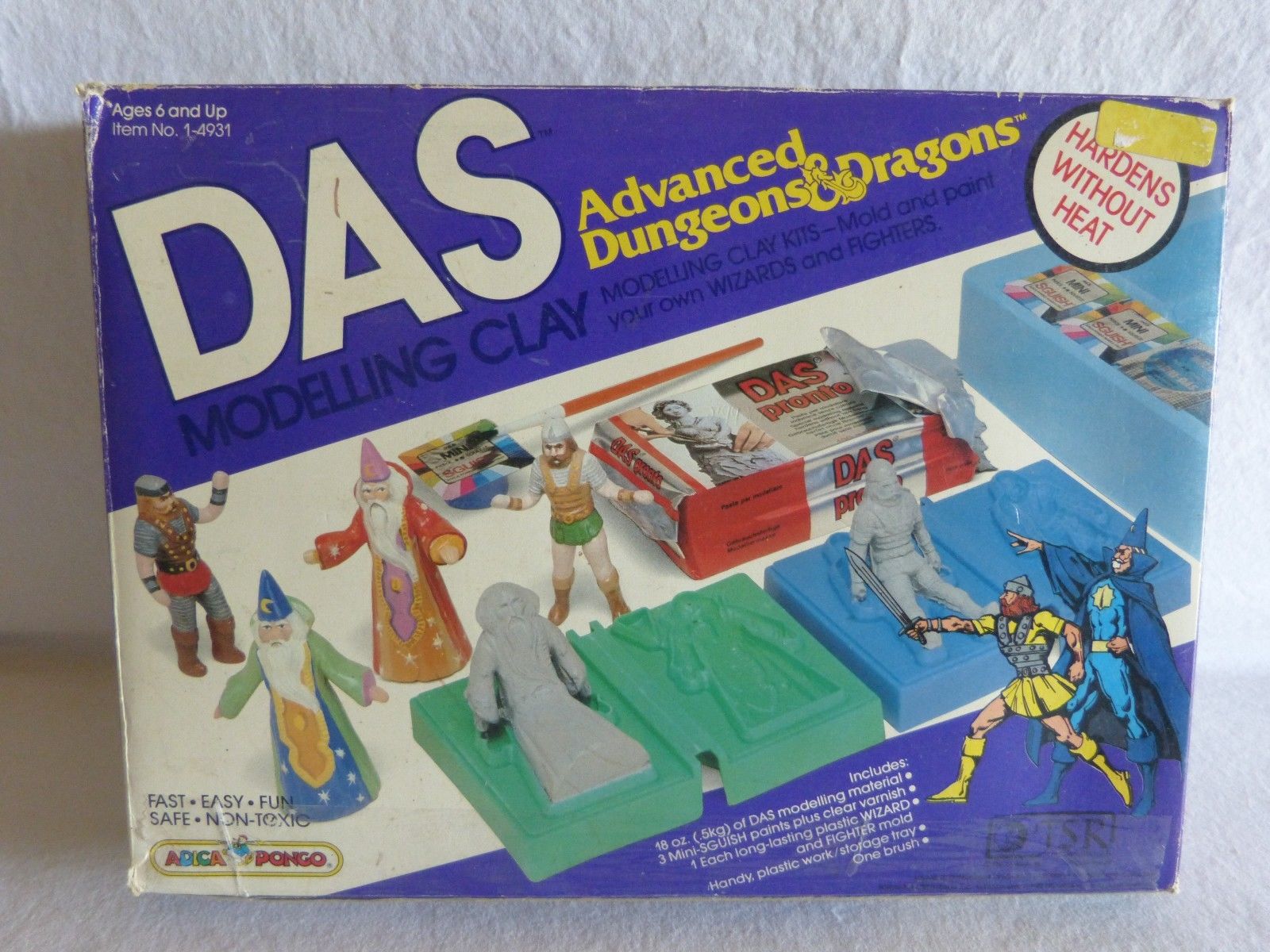
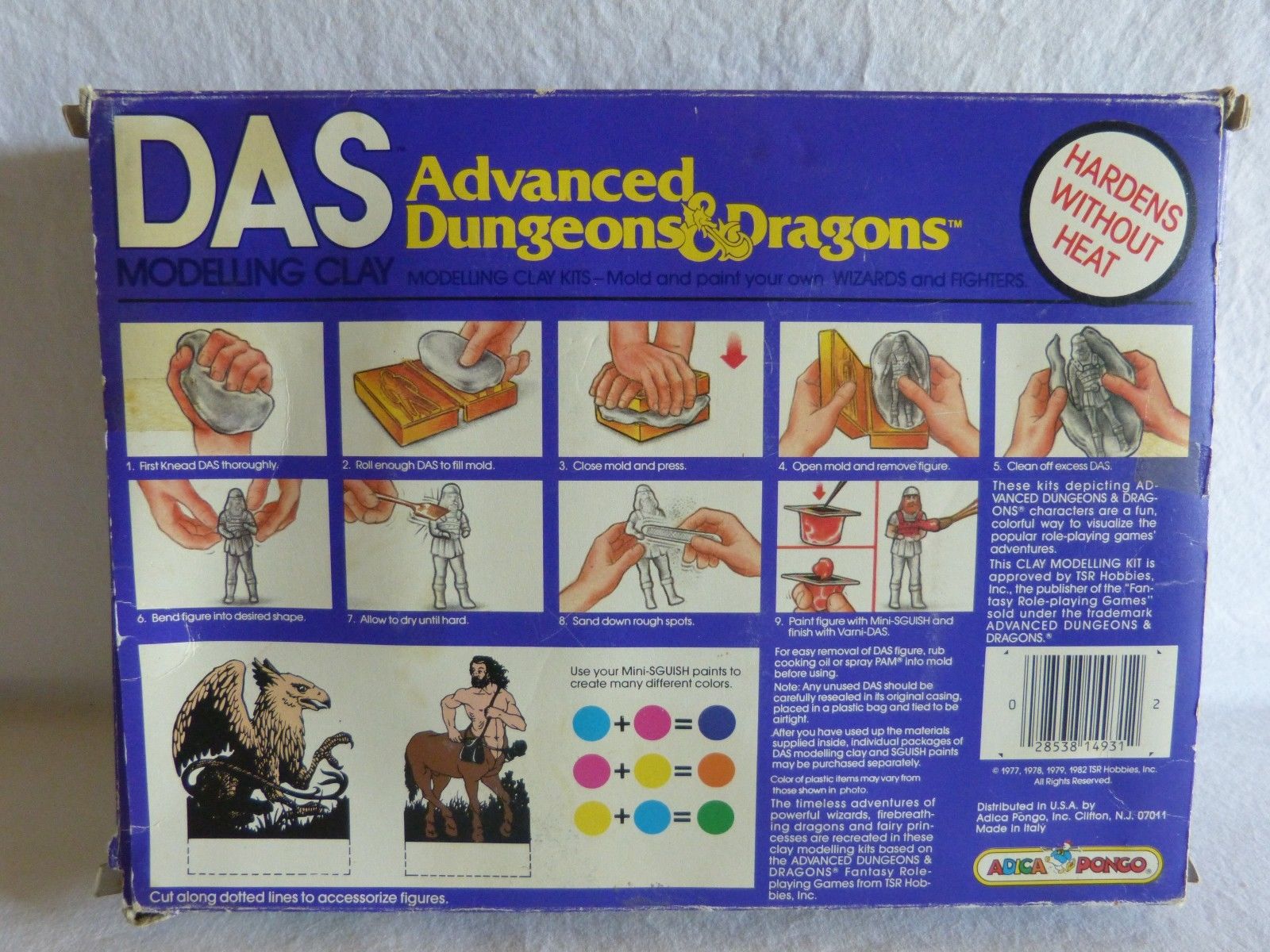
Advanced Dungeons & Dragons Modelling Clay: ‘Wizards and Fighters’ (DAS, 1982)

AD&D Modelling 1982

AD&D Modelling 1982-2

DAS, still around today, had many licenses at the time, including the Smurfs. The D&D licensing boom of ’82-’83 was aimed at the younger kids who didn’t really understand role-playing yet, but who knew the brand from the older kids, from placement, and, in 1983, from the cartoon and action figures.

The clay figures here were not meant as a game supplement, in other words, like the hundreds of metal miniatures found in every hobby shop. The back of the box makes it very clear: “These kits depicting Advanced Dungeons & Dragons characters are a fun, colorful way to visualize the popular role-playing games’ [sic] adventures.”

And again: “The timeless adventures of powerful wizards, firebreathing dragons and fairy princesses are recreated in these clay modelling kits…”

Not a supplement, but a replacement.

DAS put out at least one more AD&D modelling clay kit, with a pink box, featuring “Goblins and Dragons.”

(Images via Vintage Odds N Ends/eBay)

Dungeons & Dragons Club, 1984

D&D Club 1984

You can’t hide from me, Greyhawk Grognard! Every time a portrait of old school D&D geeks appears on the internets, a little alarm goes off on my aging laptop and I spring into action (i.e. I click on my Google homepage and type in a couple of keywords).

All hail the Pingry School Dungeons and Dragons Club of 1984! They can’t beat you on the football field, but they will, if you cross them, destroy you and your cheerleading lapdogs with various applications of black magic, telekinesis, and Lankhmarian-made rapiers.

How many polo animal mascots can you spot?

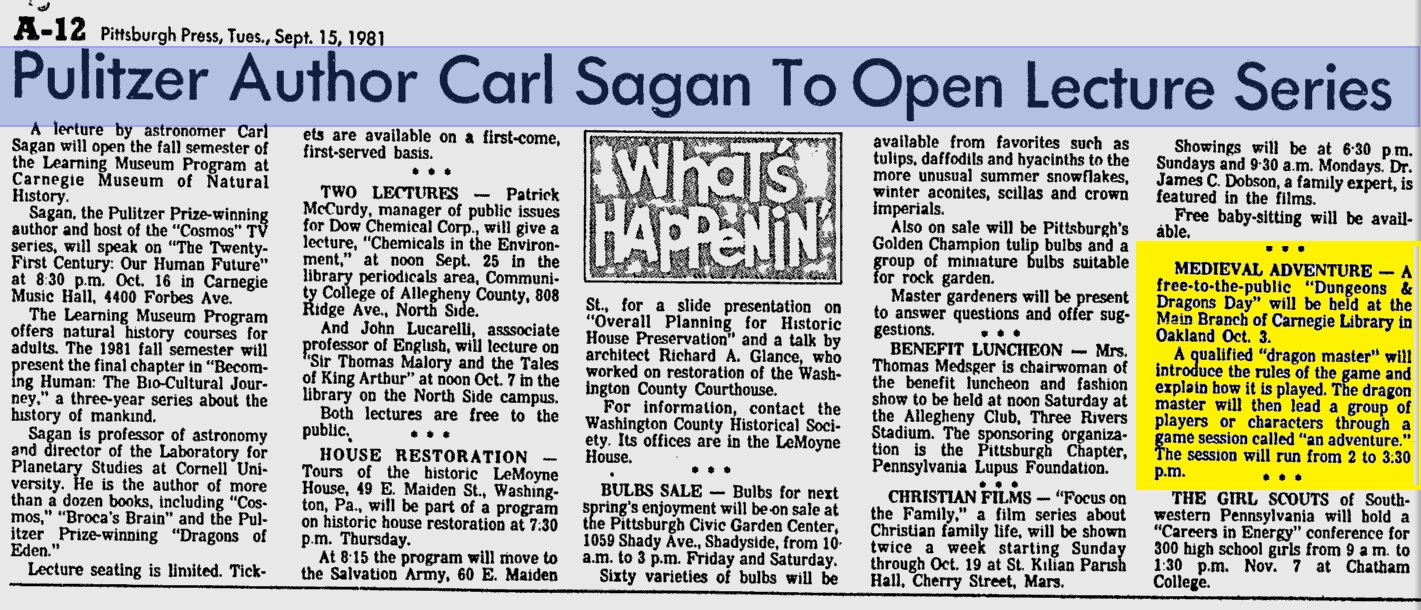
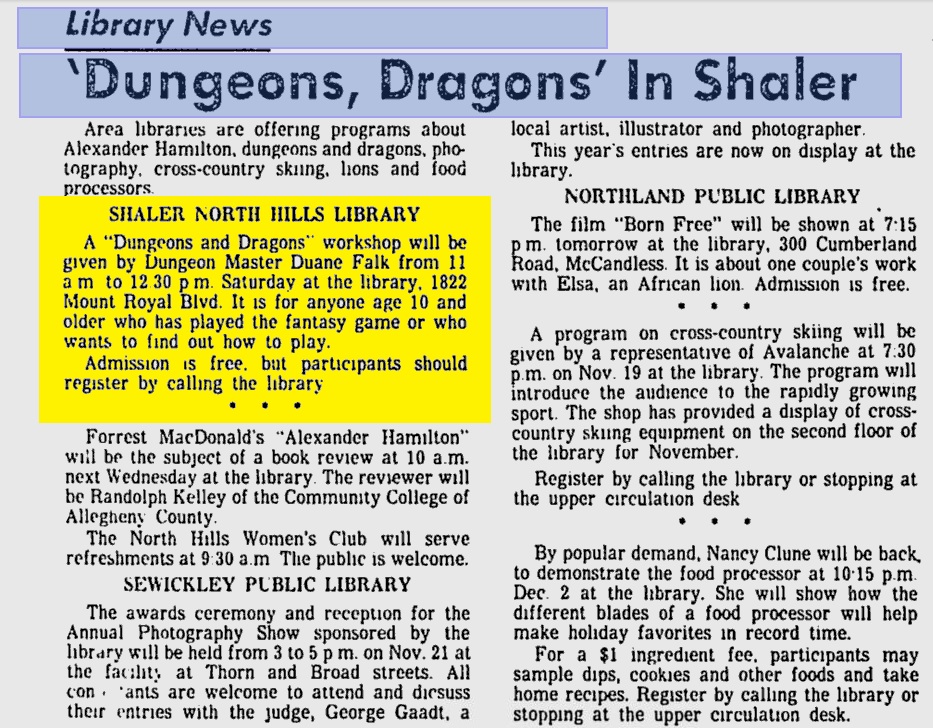
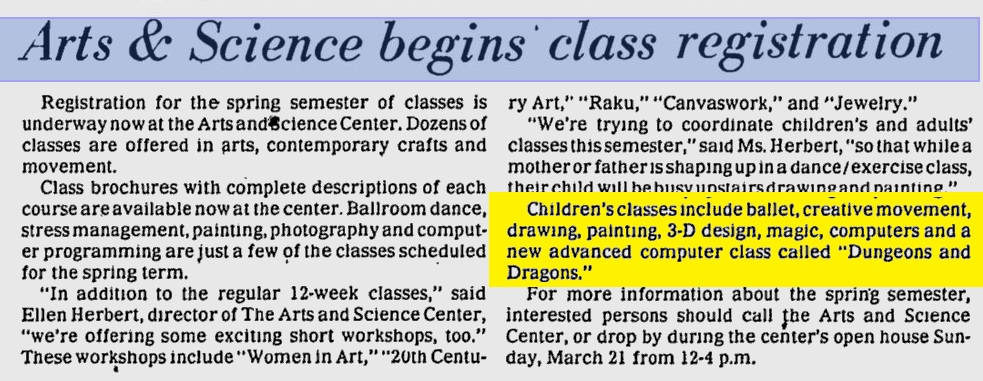
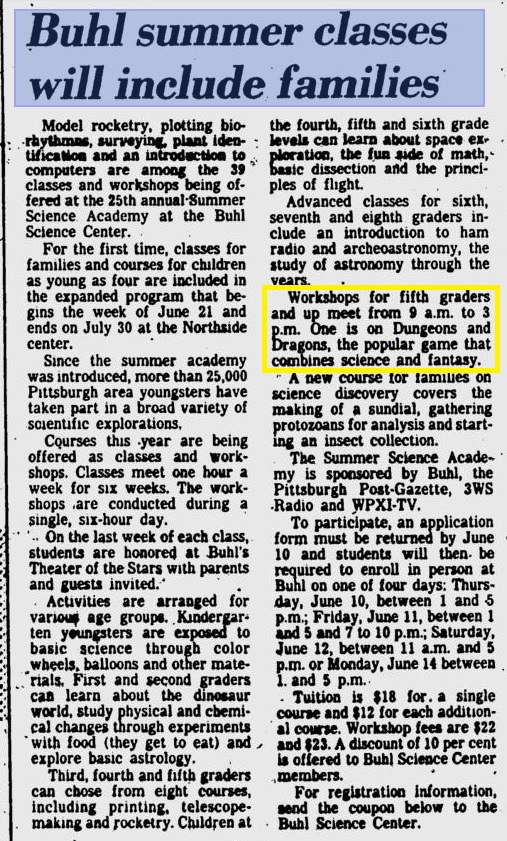
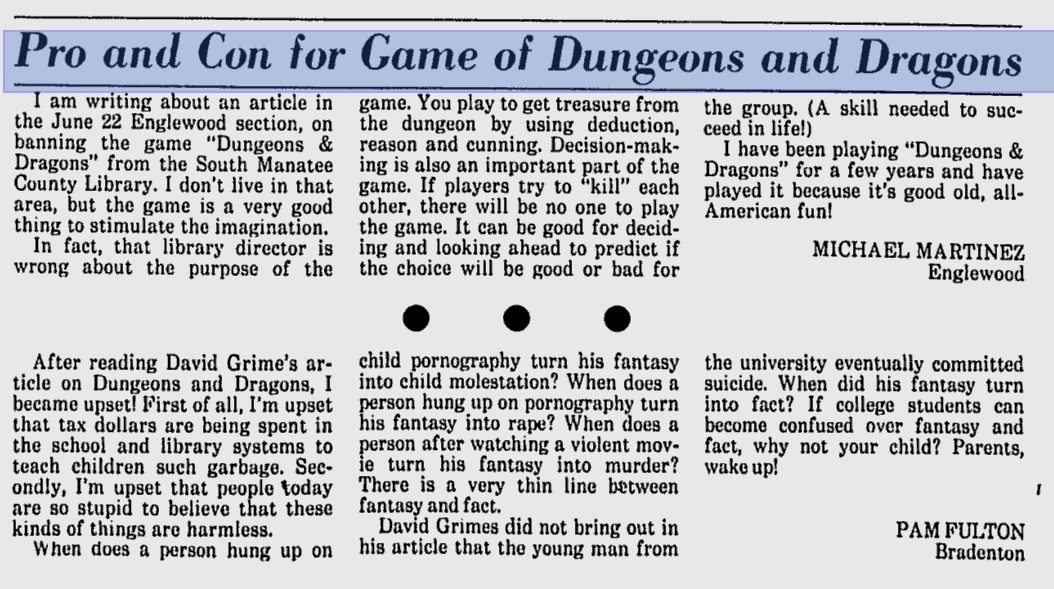
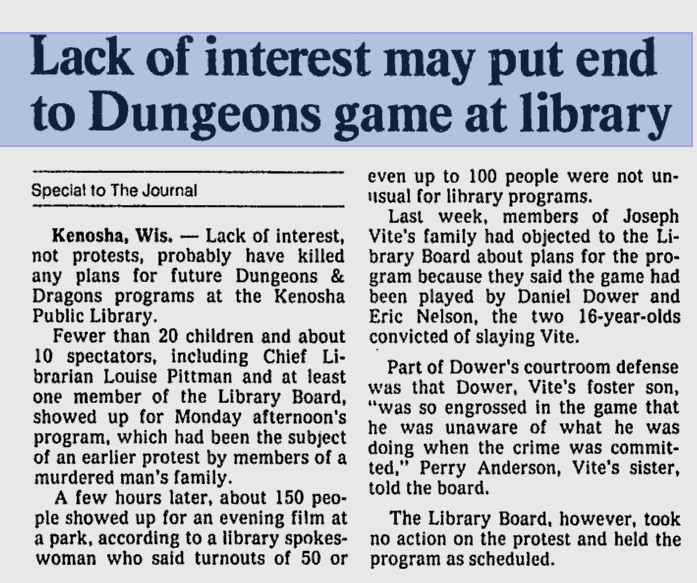
`Dungeons & Dragons Day’ at the Public Library, 1981 – 1985

D&D 9-15-81

D&D 11-10-81

D&D 3-12-82

D&D 5-15-82

D&D 9-29-83

D&D 7-1-84

D&D 7-16-85

The clippings are from (top to bottom) The Pittsburgh Press (9/15/81), The Pittsburgh Press (11/10/81), New Hampshire’s Nashua Telegraph (3/12/82), Pittsburgh Post-Gazette (5/15/82), Utah’s Deseret News (9/29/83), Florida’s Sarasota Herald-Tribune (7/1/84), and The Milwaukee Journal (7/16/85).

Certainly not an exhaustive list of ongoing D&D events sponsored by public institutions, but the narrative told in just these few cases is interesting enough. (I’ve mentioned D&D in science museums here and here). In the midst of all the nonsense spouted about the game, most adults managed to keep an even head about it. My parents didn’t understand how it worked or why I found it so enthralling, but they trusted me enough to let me play, and, if I felt it was necessary, to stop playing.

That’s what’s changed. It wasn’t the Religious Right that killed all the quality, kid-friendly events and institutions of the ’70s and ’80s (arcades, youth centers, public playgrounds, roller rinks, summer camp, etc.), it was helicopter parents and their distrust (overprotection is a form of distrust) of their own children. If kids aren’t allowed to hang out by themselves with other kids, then all the fun places for kids get shut down, and they’re left thinking Angry Birds and Facebook are as good as it gets.

We need more places—more physical spaces—for kids to inhabit so that they can develop their own communities, languages, ideas, and rules. Otherwise, they’re never going to grow up. And they’re never going to understand what fun really is.


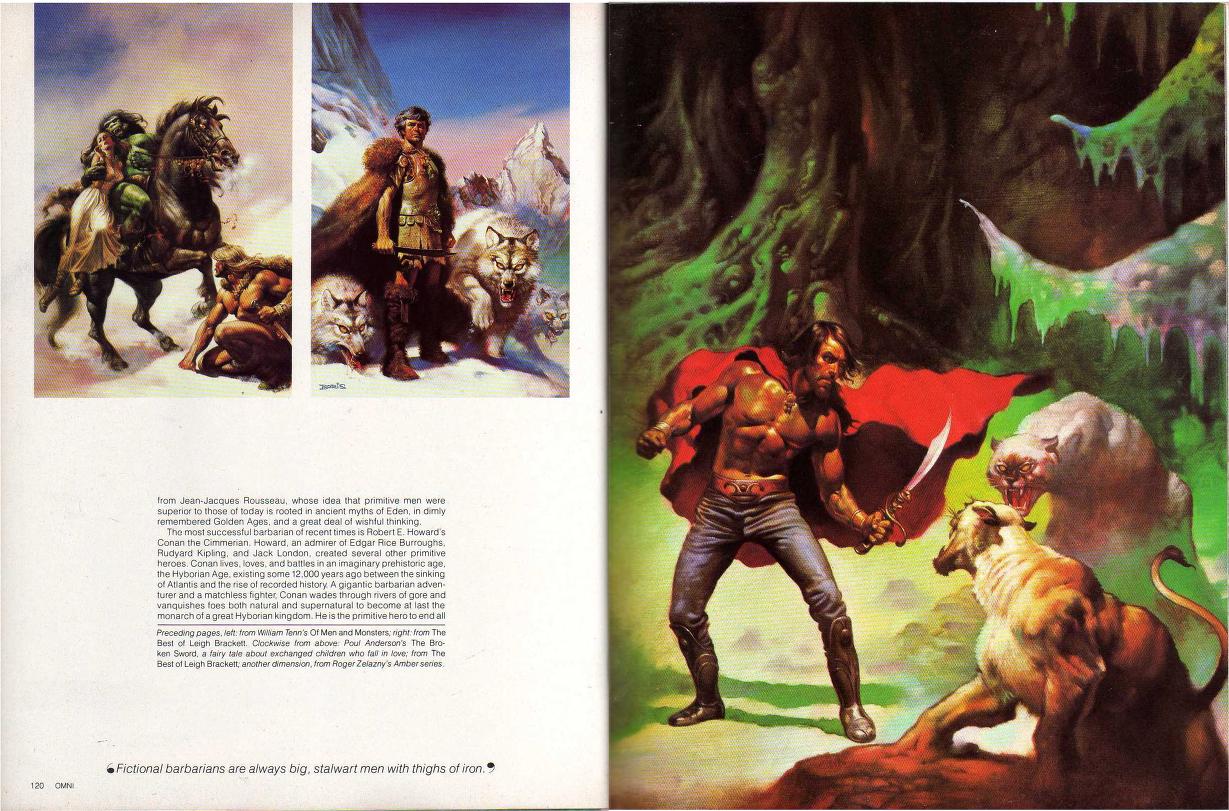
Omni Magazine (October, 1980): L. Sprague de Camp and Dungeons & Dragons

Omni 10-80 pg. 118-119

Omni 10-80 pg. 120-121

Omni 10-80 pg. 122-123

L. Sprague de Camp (1907 – 2000) was a prolific writer and popularizer of the fantasy genre, an engineer by trade, and something of a self-taught history and Classics scholar. (I just read his excellent, still relevant debunking of the Atlantis myth, Lost Continents). He edited the very first heroic fantasy or sword and sorcery anthology called Swords & Sorcery (Pyramid, 1963), which I’ll talk about in a later post. The phrase `heroic fantasy’ was coined by de Camp in 1963 (OED citation here); ‘sword and sorcery’ was coined by Fritz Leiber in 1961 (OED citation here).

His unsentimental grounding of the genre is right on, I think—from a traditional male perspective, anyway:

Heroic fantasy is alive and flourishing. The more complex, cerebral, and restrained the civilization, the more men’s minds return to a dream of earlier times, when issues of good and evil were clear-cut and a man could venture out with his sword, conquer his enemies, and win a kingdom and a beautiful woman. The idea is compelling, even though such an age probably never existed.

Here’s de Camp’s slightly less sexist description from the 1967 Ace edition of Conan:

Such a story combines the color and dash of the historical costume romance with the atavistic supernatural thrills of the weird, occult, or ghost story. When well done, it provides the purest fun of fiction of any kind. It is escape fiction wherein one escapes clear out of the real world into one where all men are strong, all women beautiful, all life adventurous, and all problems simple, and nobody even mentions the income tax or the dropout problem or socialized medicine.

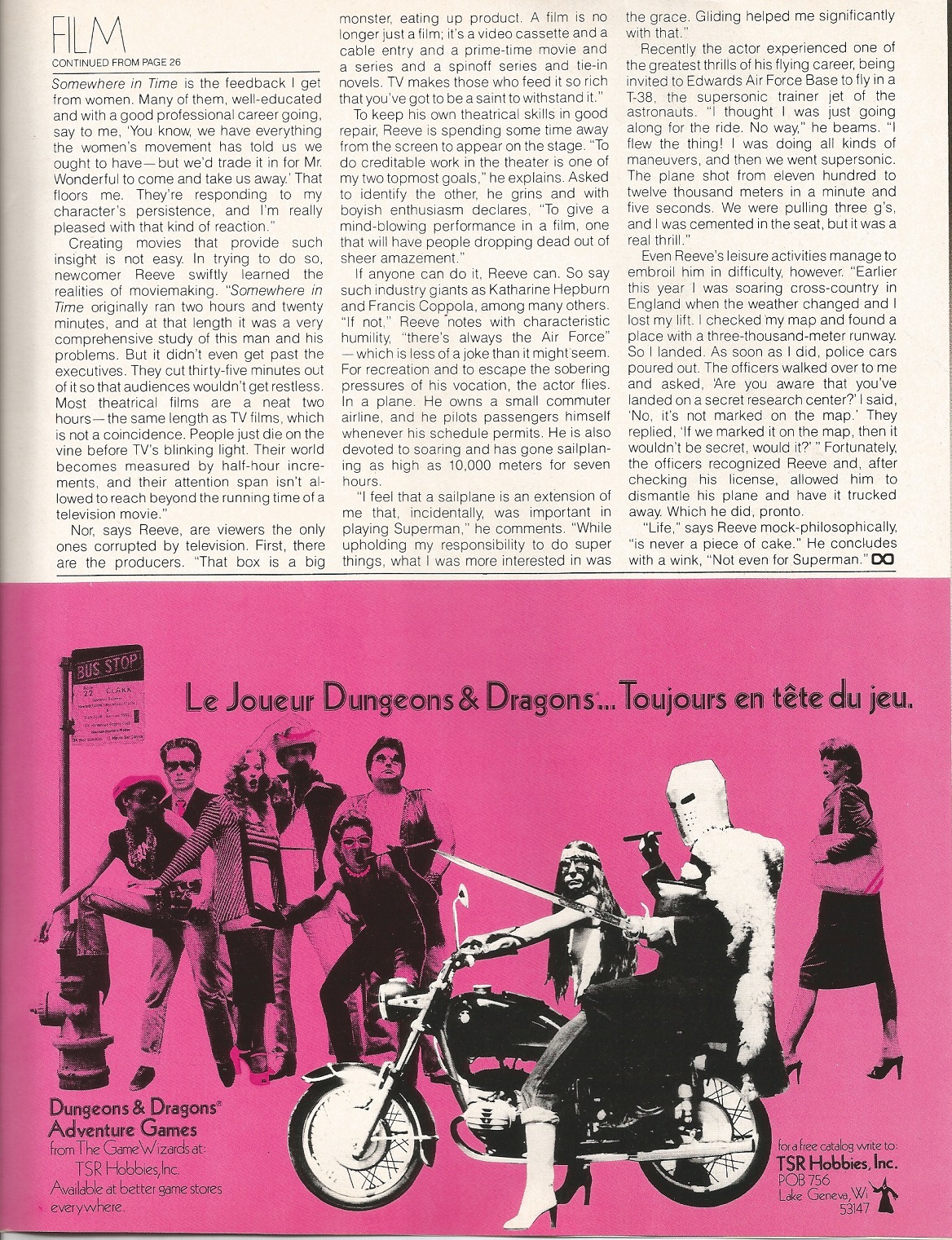
He doesn’t mention D&D, but, to prove the point of his short piece, there’s an ad near the back of the same issue (page 153 of 194).

Omni 10-80 pg. 153 of 194

What’s interesting is that the ad itself wants to be complex and cerebral, and tries to appeal to a more “sophisticated” audience. (The translation is “Play Dungeons & Dragons… Always ahead of the game.”) I’ve been going through a long run of Omni and will post all the D&D ads (and other interesting material). Archive.org has a large catalog of Omni for viewing, but the ads have been left out. That’s to be expected, considering the length of the magazine.

Advanced Dungeons & Dragons Pinball Game (Larami, 1983): ‘Dragon Duel’

DD 1983

DD 1983-2

DD 1983-3

I realize that the D&D name is not on the product, but it’s a TSR license and the art is from Larry Elmore’s cover for Pillars of Pentegarn (1982). A partial license would have cost less than a full, hence Dragon Duel. Made in Hong Kong. A product of your imagination.

UPDATE (5/28/14): I stand corrected. The AD&D name is on the box, per the pictures below:

AD&D Pinball

AD&D Pinball-2

AD&D Pinball-3

(Images via Gene and Troy’s Toys/eBay)

This Book of Homemade D&D Modules Is Better Than Anything Anyone Has Ever Built on Minecraft

Habitation Cover 2013

Last year, when I featured Mikey Walters’ homemade D&D modules from 1981, I wondered how many similar old school epics were out there, buried in family attics and basements, one or two small-scale campaigns away from rediscovery. Was there a responsible way to solicit these now historic documents? More important, was there a responsible way to preserve them? The answer is yes, to both questions. The Play Generated Map & Document Archive (PlaGMaDA for short), founded and managed by Tim Hutchings, “collects, preserves and interprets documents related to game play – especially tabletop role playing games and computer games.” People like you and me donate our “play generated cultural artifacts,” and they’re stored in the archives—PlaGMaDA is partnered with The Strong Museum—for all time.

Gaius Stern’s Habitation of the Stone Giant Lord, written and illustrated by the 14-year-old author in 1982, was one such donation. Hutchings decided to combine “Dungeon Module G2²” with seven other D&D-styled adventures, including two of Walters’ modules, and publish them in a book (funded by a successful Kickstarter campaign): The Habitation of the Stone Giant Lord and Other Adventures from Our Shared Youth (2013).

Hab 1

Detail from Habitation of the Stone Giant Lord, by Gaius Stern

If you’re even a little bit intrigued by the early days of tabletop role-playing and/or the emergent “kid culture” of the time, you will find yourself spellbound by the more than 100 pages inside. (Seriously, someone will need to hit you with a Dispel Magic; otherwise you’ll forget to go to work and feed the kids.) The dedication and detail on display in each of the (playable!) modules is uniquely impressive, and more than that, the authors had no other motive than the challenge, the joy of play, and the promise of sharing their work with fellow adventurers. Some of the writing is damn convincing, too. Here’s a selection from The Lair of Turgon, by Todd Nilson:

The doors, both into and out of this room, are jet black with silver runes upon them. The runes are non-magical: they are an ancient form of cuneiform which relate the eulogy given at Turgon’s burial. A seal of gold had welded the doors shut, but they have evidently been broken by some incredibly powerful force. The hall itself is of granite construction; depicted in bas-relief are scenes from Turgon’s life, from early childhood until his death. This hallway is inhabited by six shadows: more servants of Madros.

The late ’70s and early ’80s saw an explosion of creative energy from young people, who were so deeply inspired by the many novelties and innovations surrounding them that they designed and stitched elaborate costumes from scratch after sketching the real deal inside darkened movie theaters, shot their own Super 8 movies (all of which are better than J.J. Abrams’ Super 8), wrote and drew their own graphic novels, programmed their own (playable!) video games, and, as we see here, wrote, drew, and likely DMed their own fantasy role-playing adventures.

Hab-10

Stone Castle/Castle Stone from Stone Death, by Richard C. Benson

Jon Peterson, the author of what many consider to be the definitive history of wargames and role-playing games, Playing at the World, wrote the excellent introduction to Habitation. Before breaking down each of the featured home-brewed adventures, noting (compellingly) where the creators borrowed from the Monster Manual or the Fiend Folio, what D&D edition was used as a foundation, and so on, Peterson takes us on a comprehensive tour through the early years of TSR, from the company’s beginning promise of making us “authors and architects” of our own fantasies, to the introduction of the adventure module format that Peterson finds somewhat antithetical to that original promise. “When we purchase and rely on a module,” he writes, “are we letting TSR do our imagining for us?”

It’s a fair question, and he says of the works in Habitation that

Each of them, in its own way, illustrates the tension between the commercialization of adventure scenarios and the original invitation of D&D to invent and collaborate and share.

And later:

Players were not content to have TSR do their imagining for them, and when the production of pre-packaged modules began, players responded by positioning themselves as creators of modules and thus as peers of TSR, rather than mere consumers.

Ultimately, I don’t agree with his conclusion. First, I don’t think any of the young authors featured in Habitation were “positioning” themselves to be anything; the modules look to me like a labor of love and, if anything, an homage to and emulation of TSR, as Peterson himself mentions elsewhere. Second, the module format was a signal innovation that expanded the role-playing genre and broadened the player base. Gamers young and old continue to run, tweak, perfect, and be inspired by the likes of The Keep on the Borderlands and Dark Tower. Third, as I’ve argued elsewhere, all D&D products—be it the original set of 1974 or the Dragonlance franchise—are commercial products. TSR certainly did reach a point—in 1982/1983, in my opinion—at which building and inflating the D&D brand took precedence over crafting quality “products of your imagination.” I believe this is Peterson’s larger point, and it’s well taken.
Hab-6

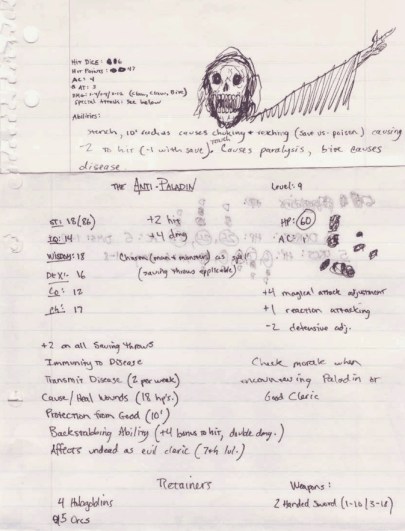
A page from The Tomb of the Areopagus the Cloaked and Japheth of the Mighty Staff, by Michael M. Hughes

What makes the work collected in Habitation so historic, and Peterson talks about this as well, is that it captures how real players approached D&D at a time when “playing mind games with dice,” to use Chris Hart’s phrase, was so profoundly untried. The game gave young people such an unprecedented amount of imaginative freedom, in fact, that it became a malignant bogeyman to those who rejected the idea that young people deserved any freedom, and who were terrified of dreamers and freethinkers of all ages.

In short, please consider getting yourself a copy of Habitation right here, and have a look through PlaGMaDA’s incredible archive right over here. And after that, maybe you’ll delve into those musty trunks and dot matrix computer paper boxes and dig out your old character sheets, your #2 pencil-drawn grid paper dungeons that not even a Conan-Gandalf multiclass could survive, your lengthy and grammatically suspect descriptions of demilich lairs and warring sky-castle kingdoms. Hell, PlaGMaDA will take a scrap of paper with nothing but your scribbled (and probably padded, let’s be honest) ability score rolls. Donate it all right here. You don’t even have to use your real name, although you really should, because what you made with your own mind and hands from scratch and for the love of the game when you were 12 years old is better than whatever Wizards of the Coast is putting out next, and more awesome than anything anyone has ever built on Second Life or Minecraft.

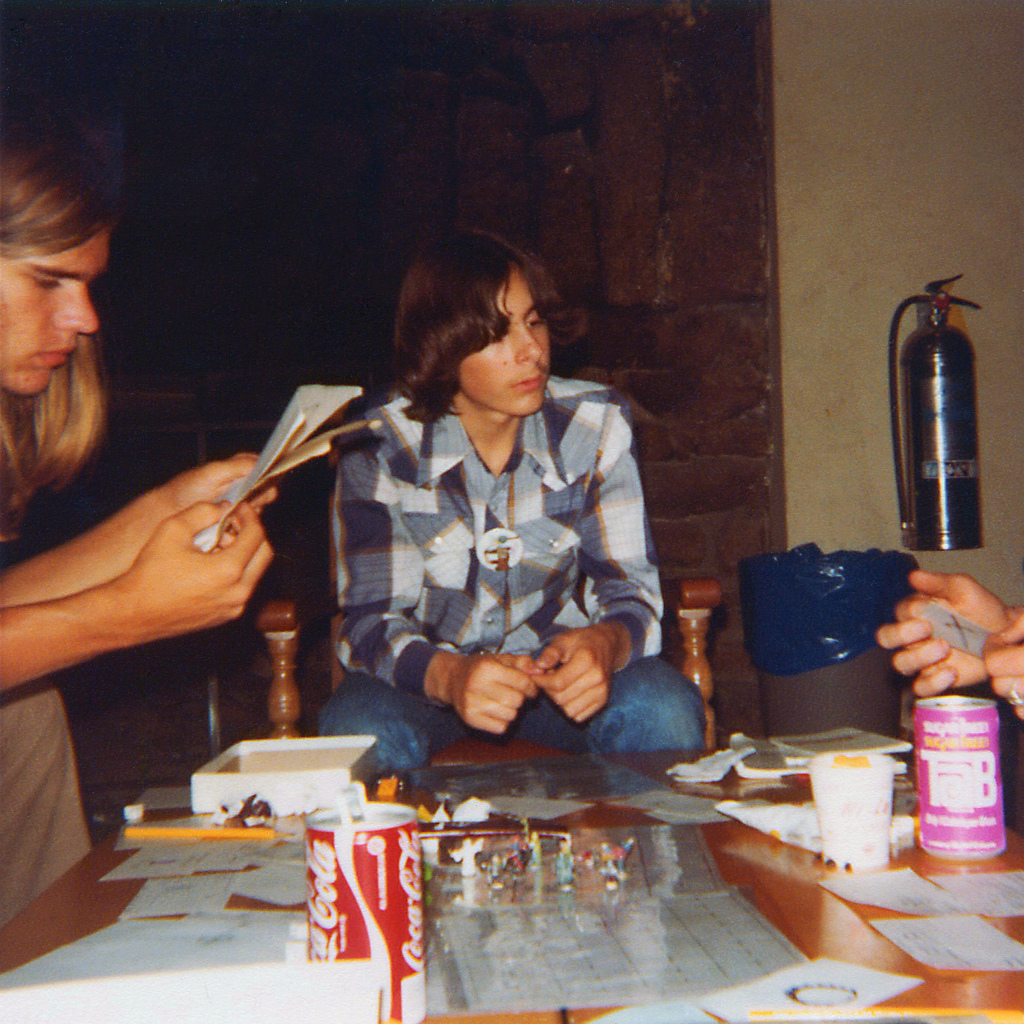
A Portrait of Young Geeks Playing D&D (1978)

D&D 1978-2

D&D 1978

The earliest portraits I’ve found so far, taken at a camp in Asilomar Beach, California, are courtesy of Pip R. Lagenta. I believe the guys are using the 1975 printing of the original D&D set. You can see the bottom of the white box on the left of the first photo, and I think two of the three booklets on the right. The book on the bottom looks too big to be part of the set. The white box is in the second shot as well.

Oh, and the Tab can.

Pip names the players in the group here and here. UPDATE: Pip says in the comments section below:

I took those Asilomar photos of the D&D games in 1978 with my cheap Kodak Instamatic X-15 camera. Donald Chapel, the guy with the bright colored camera strap, had a much more expensive camera, but I don’t know that he ever took photos of the D&D games. David Woolsey, the DM, put a lot of work into creating artwork for his adventures, drawing his own versions of treasure, tools, maps and monsters on cards, in addition to painting figurines. As a side note, Paul Marsters, the guy with his back to the camera in one photo, is the younger brother of James Marsters, the actor who played the character `Spike’ on the TV show Buffy the Vampire Slayer

* * *

Tomorrow I’ll be reviewing an incredible book full of homemade D&D modules from the early ’80s. The project behind the book is as incredible as the book. Please tell your friends about both!

New posts will resume on Monday.

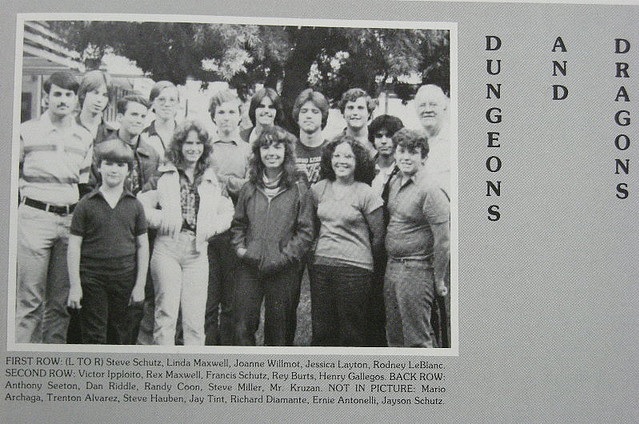
Dungeons & Dragons Club, Circa 1982/1983

D&D Club 82-83

D&D Club 82-83-2

Two successive years of the D&D Club at Downey High School in California. A Mr. Kruzan was the faculty rep for both years.

One of the kids in the first photo is wearing a Van Halen shirt. Not much else I can make out, except that the turnaround between years one and two is extensive.

More D&D Clubs (and more Van Halen t-shirts) here. There was also a D&D summer camp, if you haven’t seen it yet.

(Photos via Michael Poulin/Flickr)

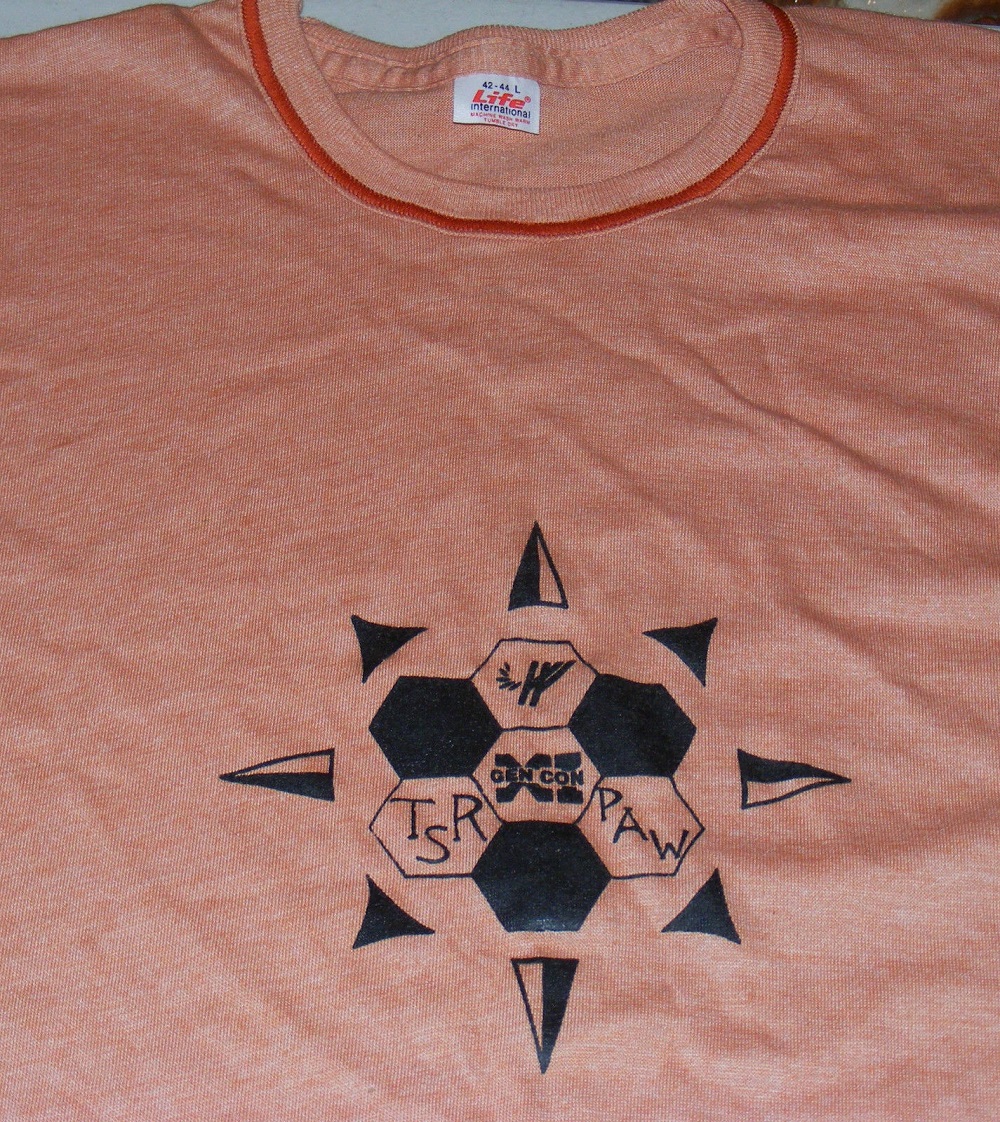
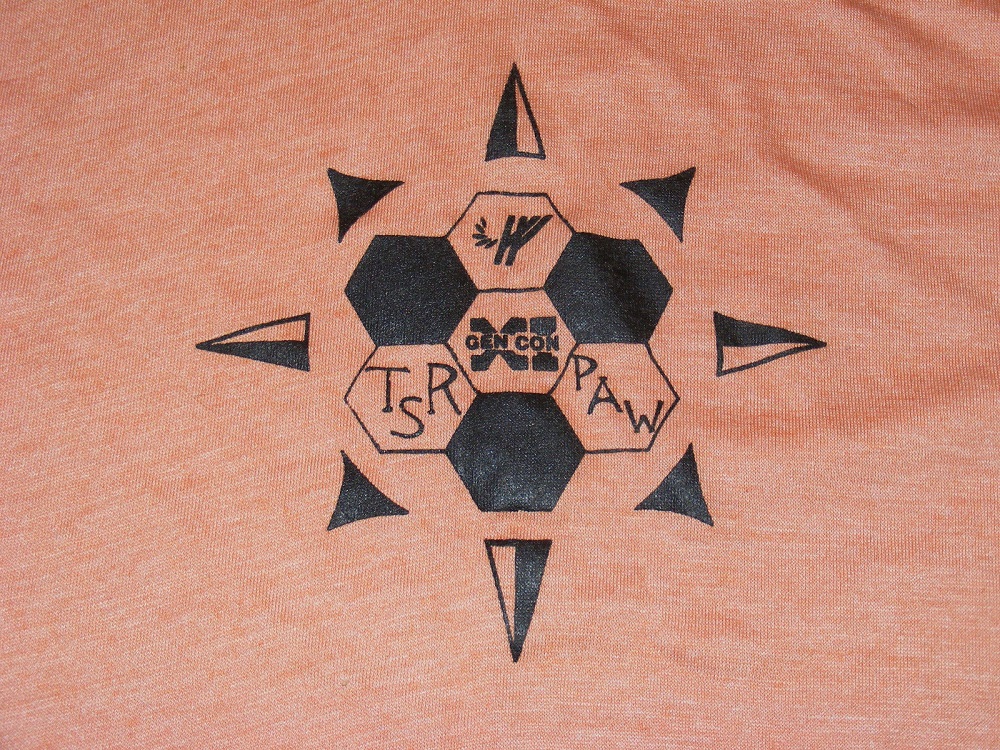
Gen Con XI Ringer T-Shirt (1978)

Gen Con T-1

Gen Con T-2

TSR and the Parkside Association of Wargamers (PAW) co-hosted Gen Con XI at the University of Wisconsin-Parkside. See an ad for the convention at Zenopus Archives. Can someone tell me what the symbol in the top grid stands for?

The shirt sold for $41 on eBay.


Pages

Archives

Categories

Donate Button

Join 1,118 other subscribers