Archive for the 'D&D' Category


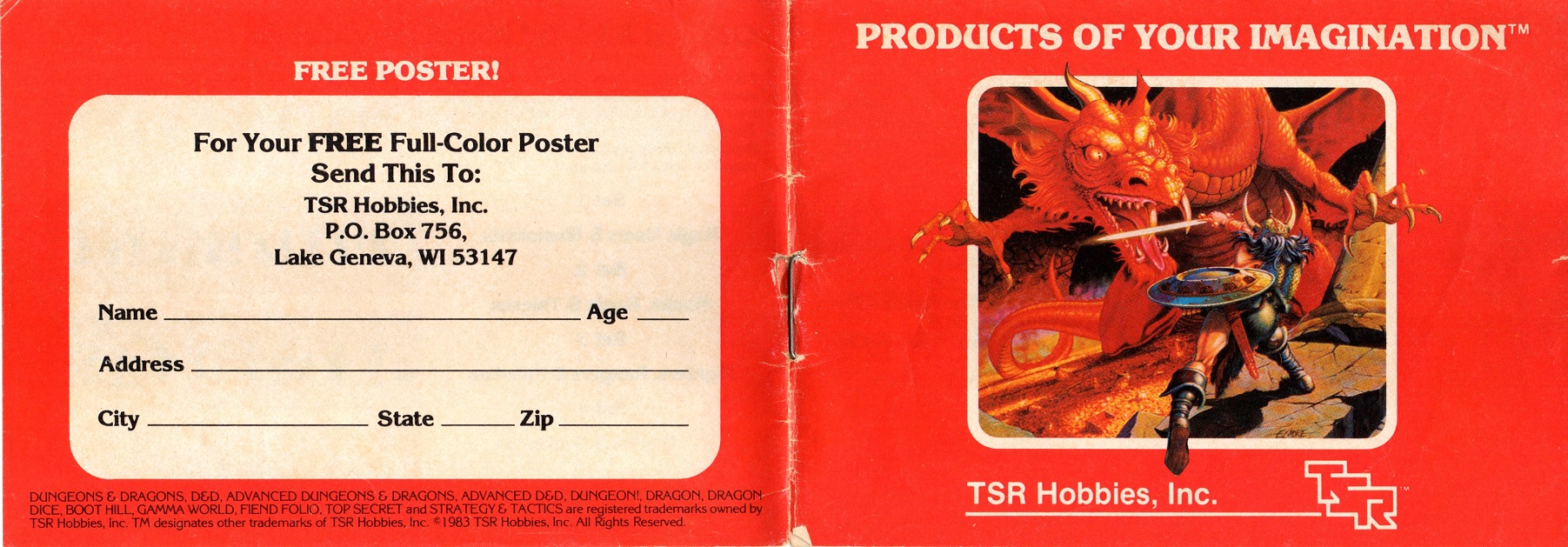
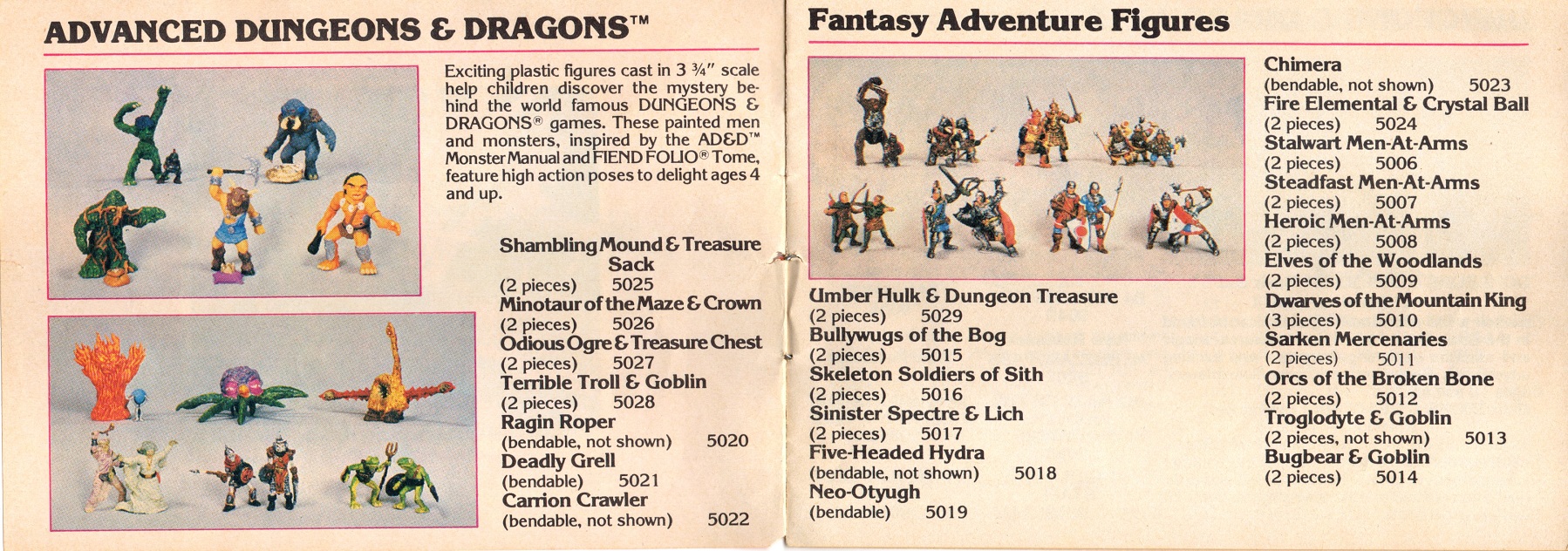
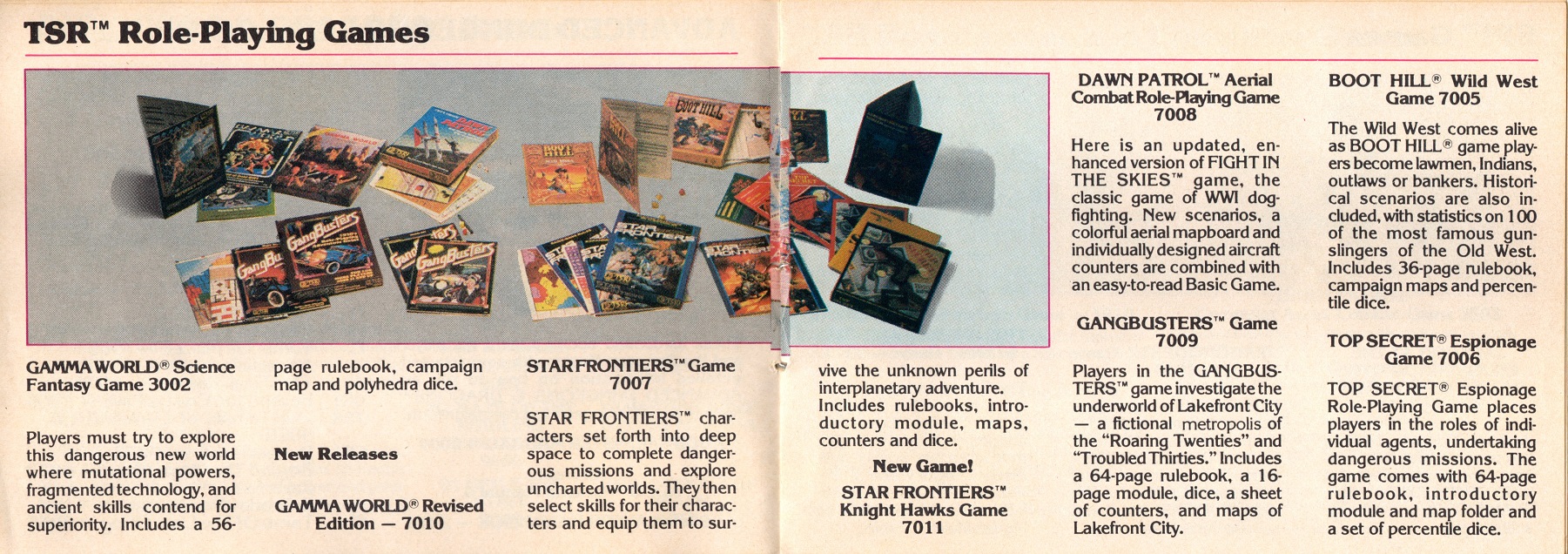
1983 TSR ‘Products of Your Imagination’ Catalog

TSR Cat-1

TSR Cat-2

TSR Cat-3

TSR Cat-4

TSR Cat-5

TSR Cat-6

TSR Cat-7

TSR Cat-8

On the first page of the 1981 TSR catalog, you’ll find the D&D Basic and Expert Sets, core role-playing products you’d expect to be front and center. In 1983, the toys come first. It looks like the action figure line wasn’t ready when the catalog went to press, because only the bendable monster and “adventure figures” (PVC) are seen here.

SPI games make an appearance on page seven because TSR acquired SPI’s trademarks in 1982/1983, as I mentioned here. Three of the computer games listed on the facing page are available at the Internet Archive: Dungeon!, Dawn Patrol, and Theseus and the Minotaur—(thanks for the heads up, Dungeons & Dragons: A Documentary). I’ve never seen or heard of Ordeal of Magic and Alien Conquest. Does anyone know if they were ever released?

Happy New Year, by the way.

Christmas Morning, Circa 1981: Dungeons & Dragons Basic Set

Christmas D&D Basic 1981

Dr. Glaze wins Christmas!

Christmas Morning, 1983: Dark Tower and Advanced Dungeons & Dragons Toys

Christmas 1983 Dark Tower

Ho ho ho. The first shot of the Christmas season comes from Brett Hudoba via Board Game Geek. The big, beautiful Dark Tower box is unforgettable, thanks to artist Bob Pepper. The game—I probably got it in 1983 as well—anchored a corner of my closet for many years.

The AD&D Sword & Dagger Set! In the wild! There were a few other sets, and you can see them all in the 1984 Placo Toys Catalog.

There are two AD&D LJN action figures in the shot: Northlord is guarding the plant, and Strongheart (above the Garfield plush) awaits release from his packaging.

The shirt appears to be homemade, the illustration taken from the Blue Dragon card in TSR’s Dungeon! board game. Ladies and gentlemen, you have entered the presence of the nerd elite.

Oh, and I had a version of that scratchy old chair.

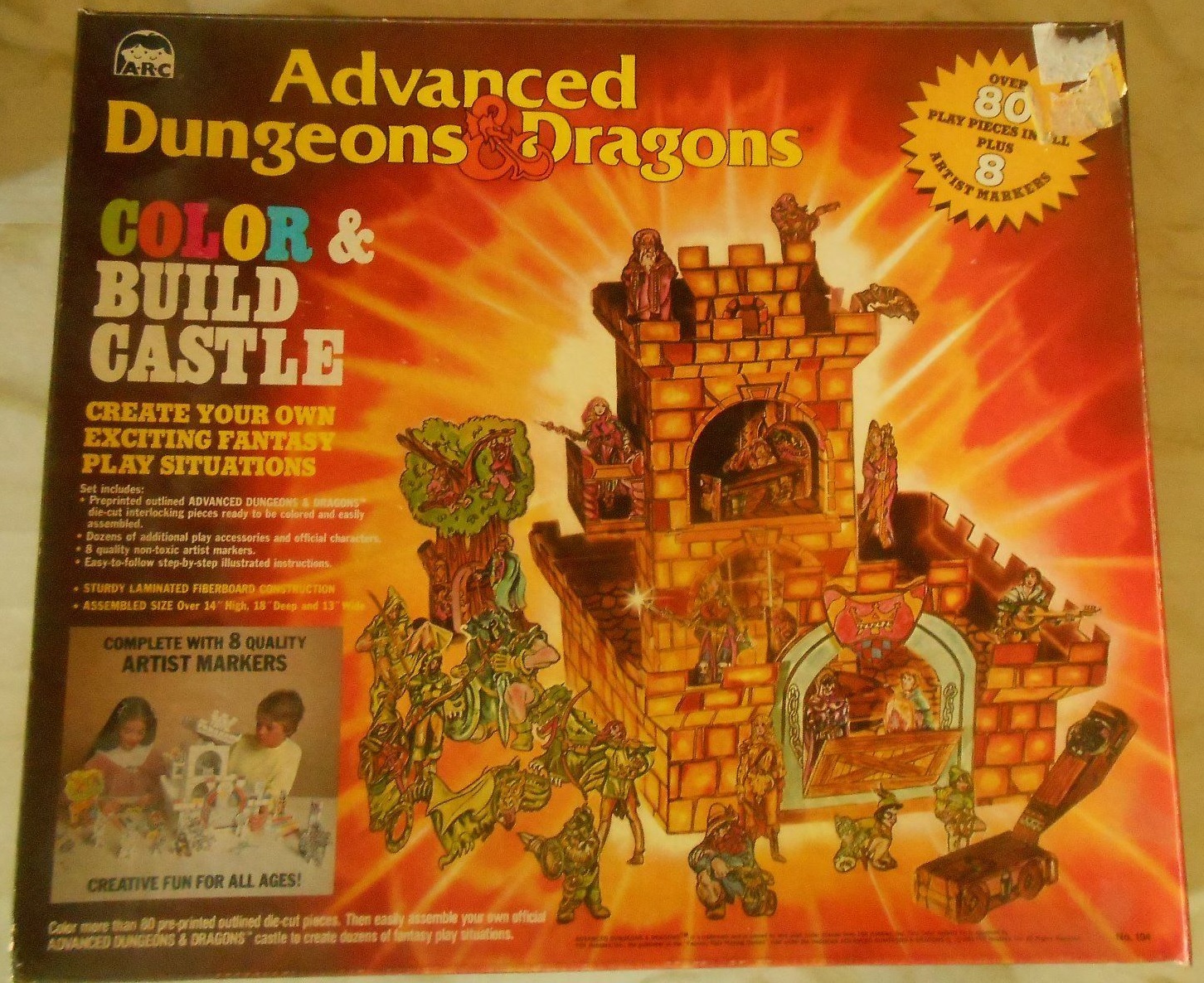
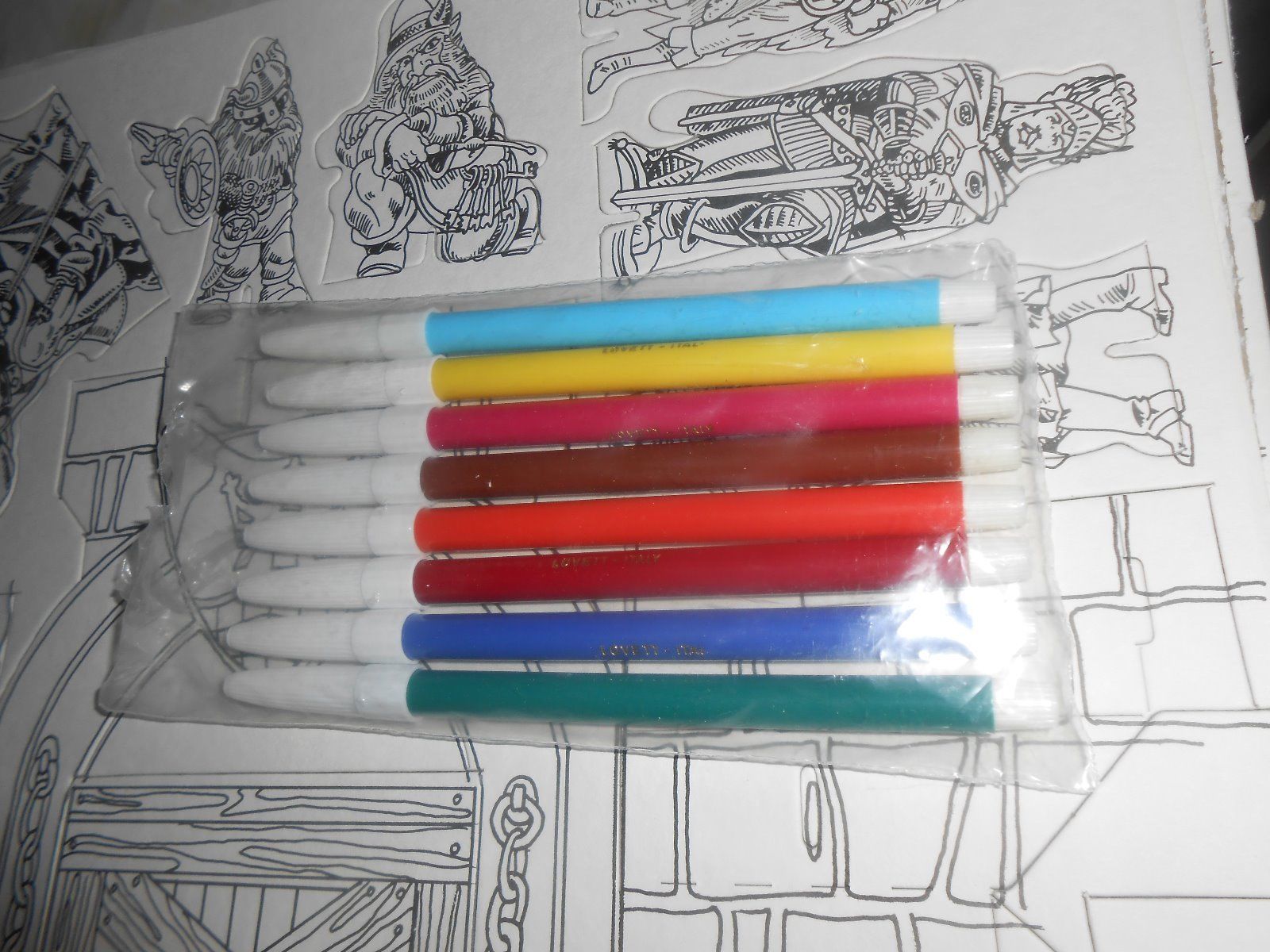
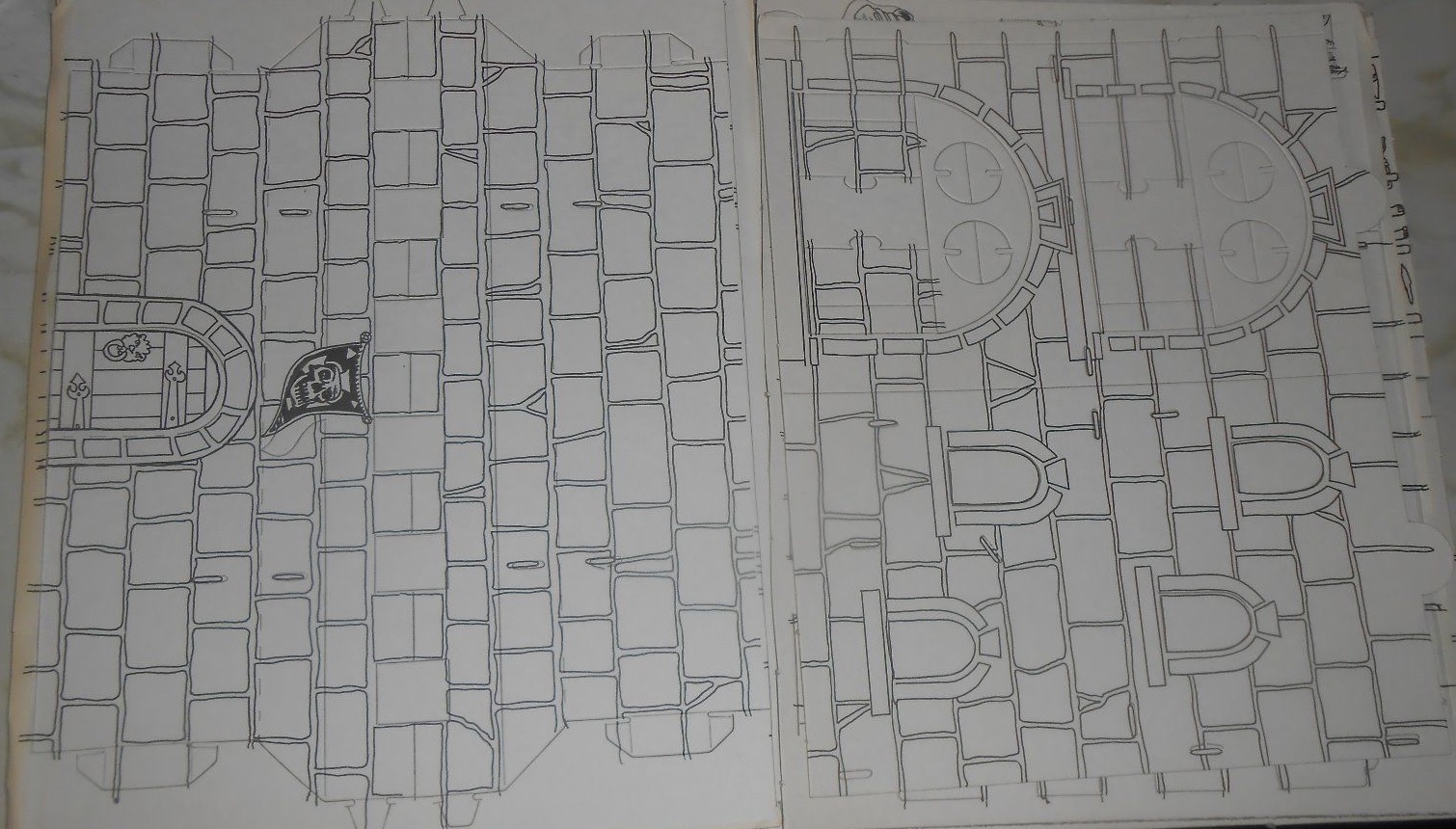
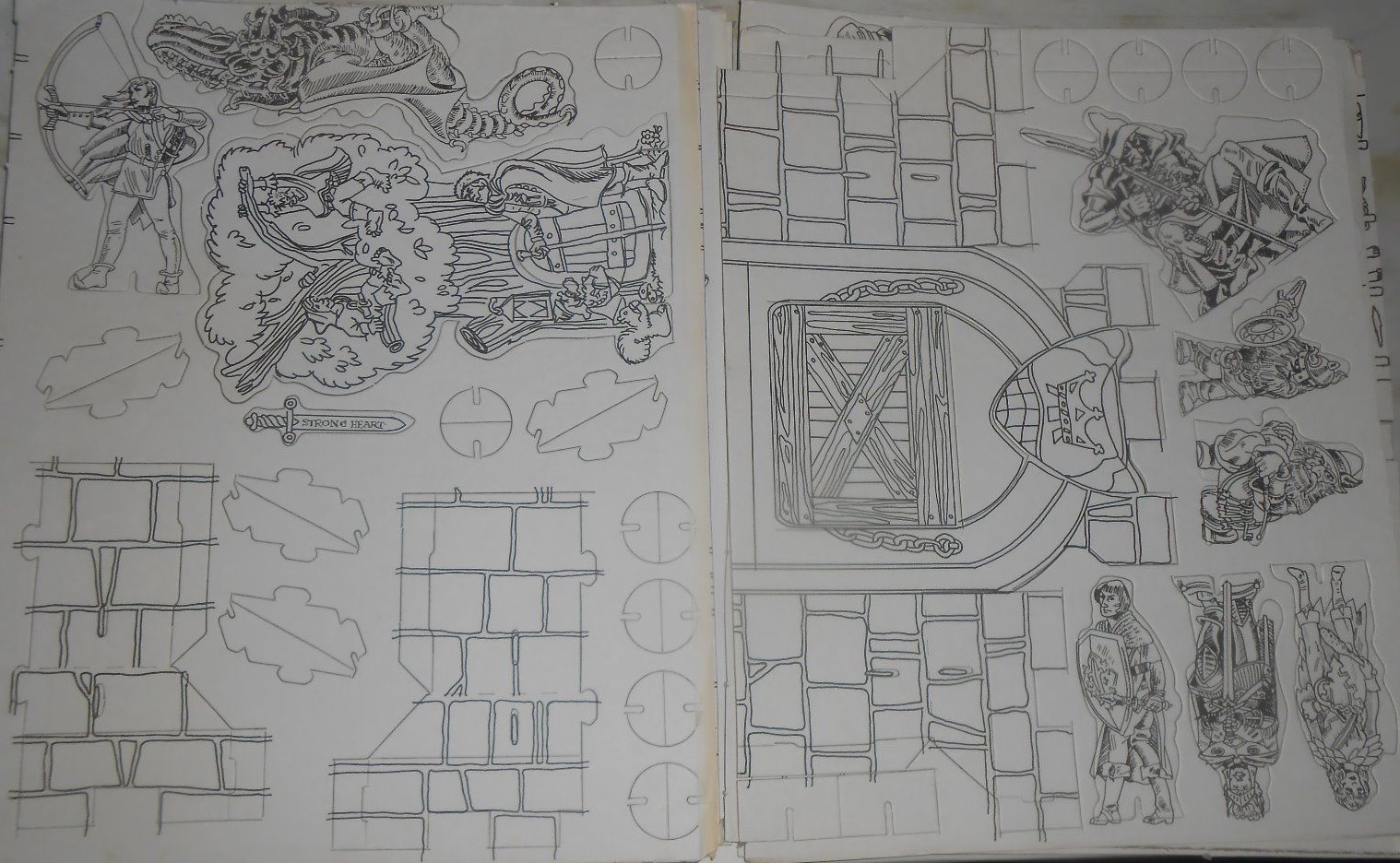
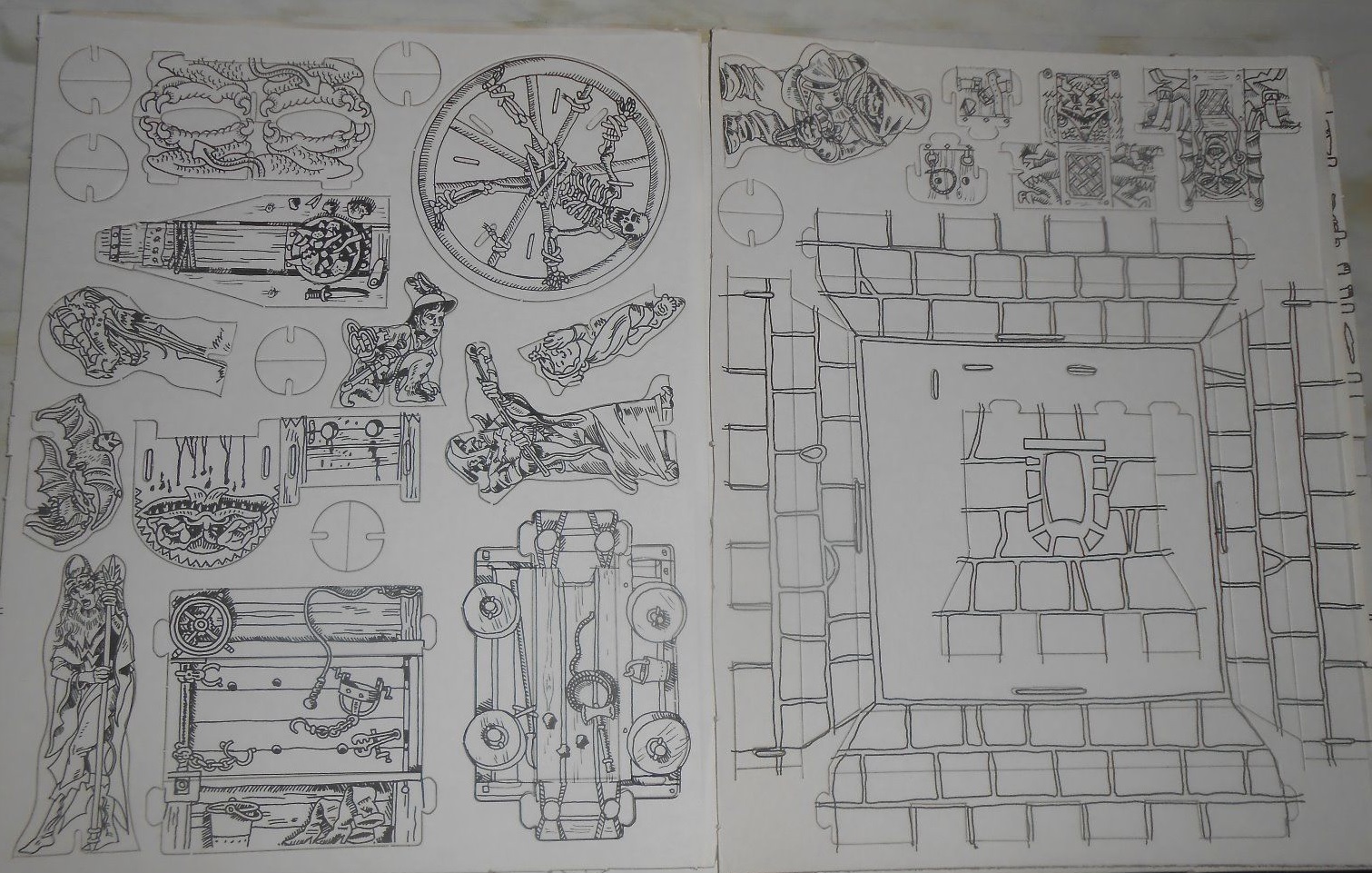
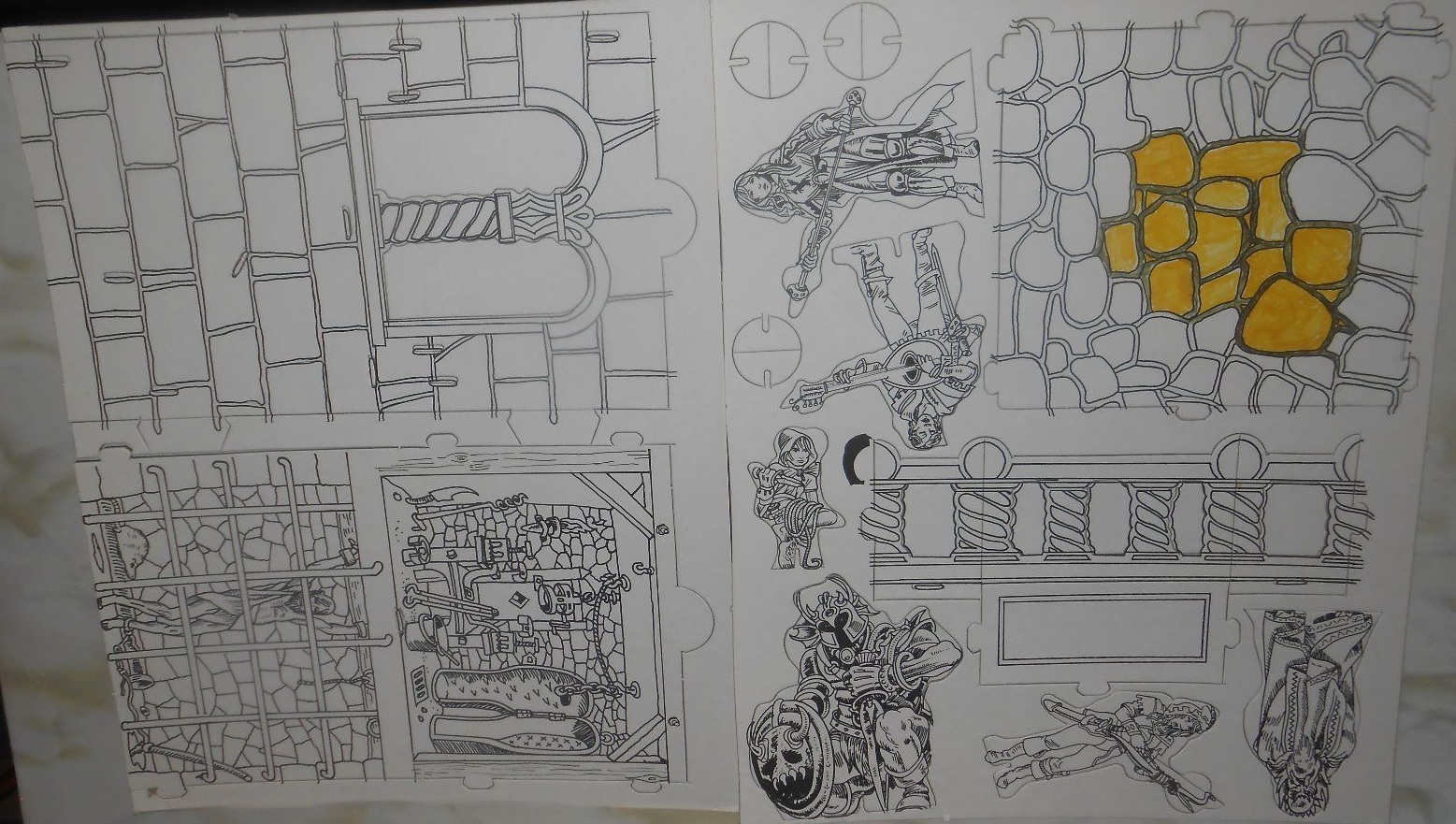
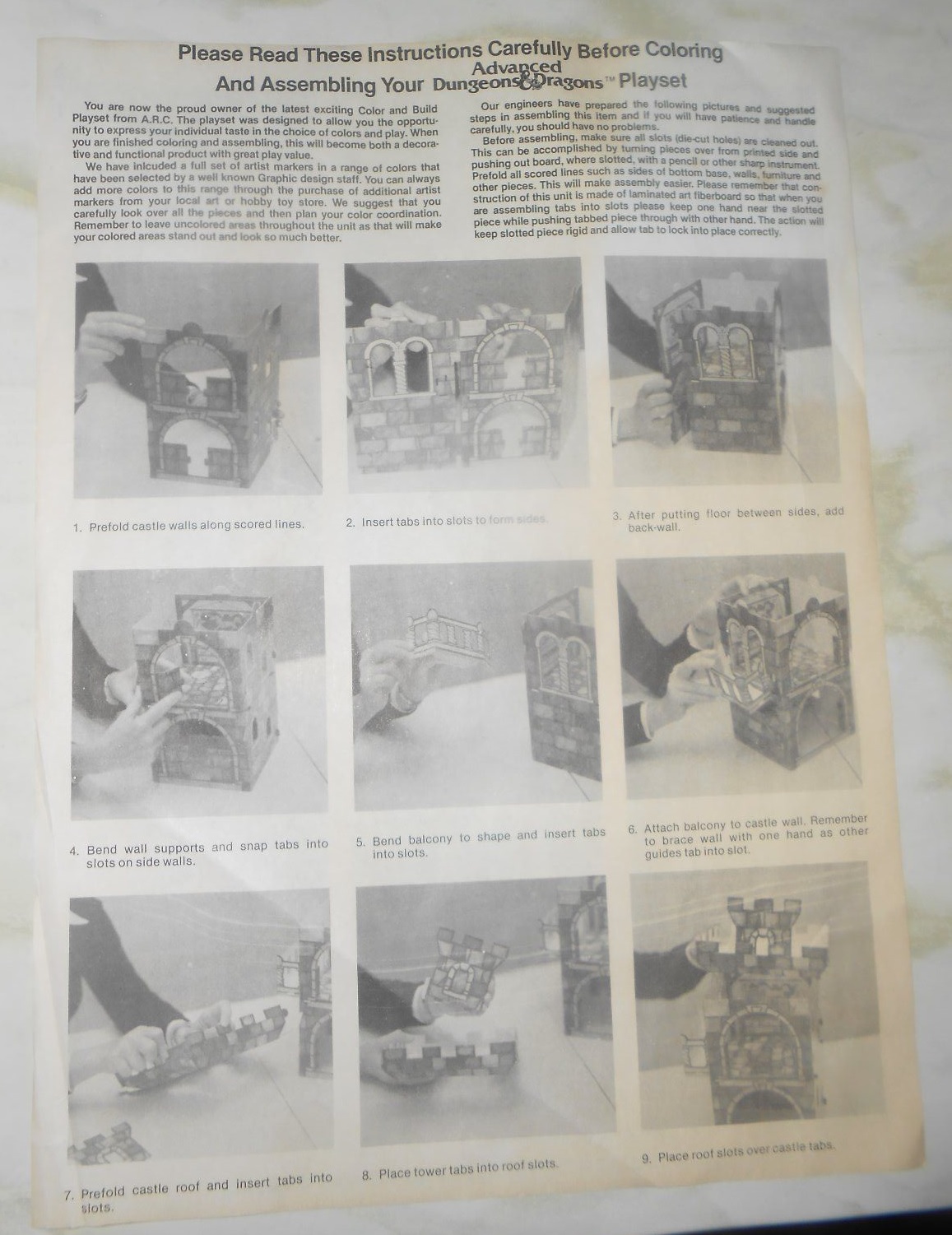
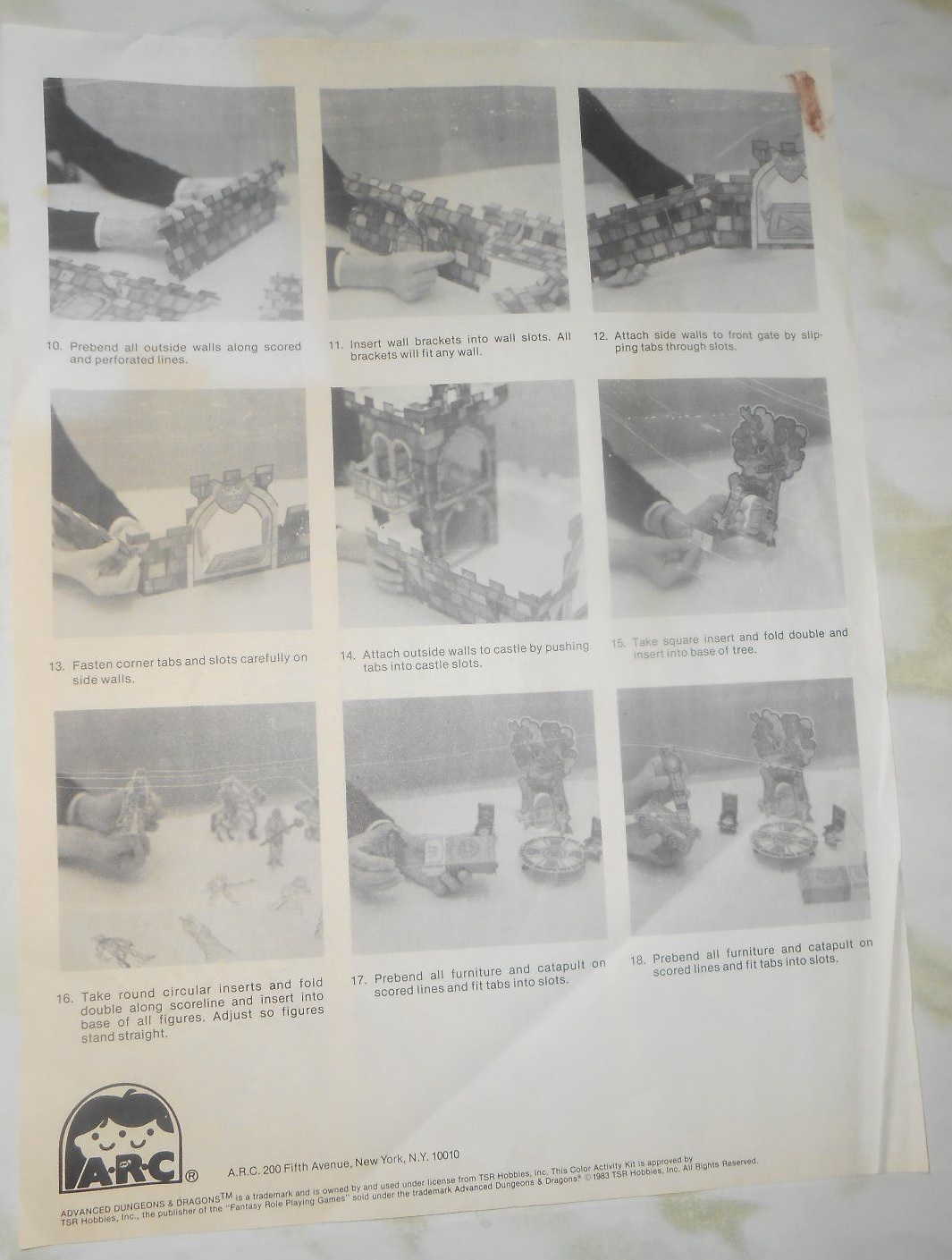
Advanced Dungeons & Dragons Color & Build Castle (A.R.C., 1983)

AD&D Castle 1983-1

AD&D Castle 1983-2

AD&D Castle 1983-3

AD&D Castle 1983-6

AD&D Castle 1983-7

AD&D Castle 1983-8

AD&D Castle 1983-9

AD&D Castle 1983-4

AD&D Castle 1983-5

It’s not this incredibly amazing paper model of Prague Castle from the 1970s, but what is? At least it took some imagination to devise (paper craft combined with poster art), and a lot of effort to complete (you’ll see that our first owner did not get very far). And it’s versatile enough to be gaming-relevant, especially for younger players.

Warduke and friends are here, of course, prime for catapulting. There’s even a page of torture devices!

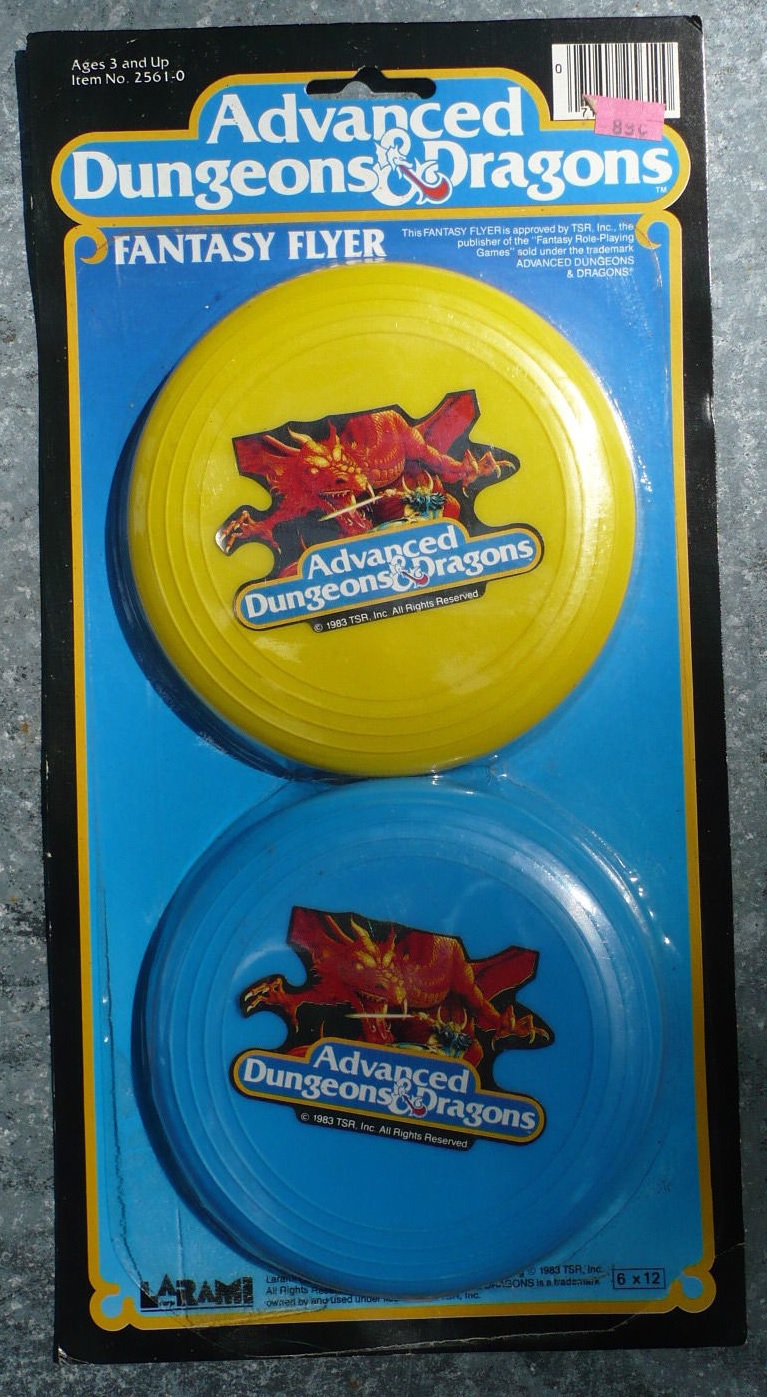
Advanced Dungeons & Dragons Fantasy Flyer (Larami, 1983)

AD&D Flyers 1983

Early in 1984 a group of Wisconsin nerds dressed up in homemade ring mail took several fantasy flyers to the steam tunnels and played “Dungeon Frolf” for two consecutive days and nights. One of the nerds never came back, and it’s Larry Elmore’s fault!

Dungeons & Dragons in Games Workshop’s Owl and Weasel (1975)

Owl & Weasel #5 June 1975-1

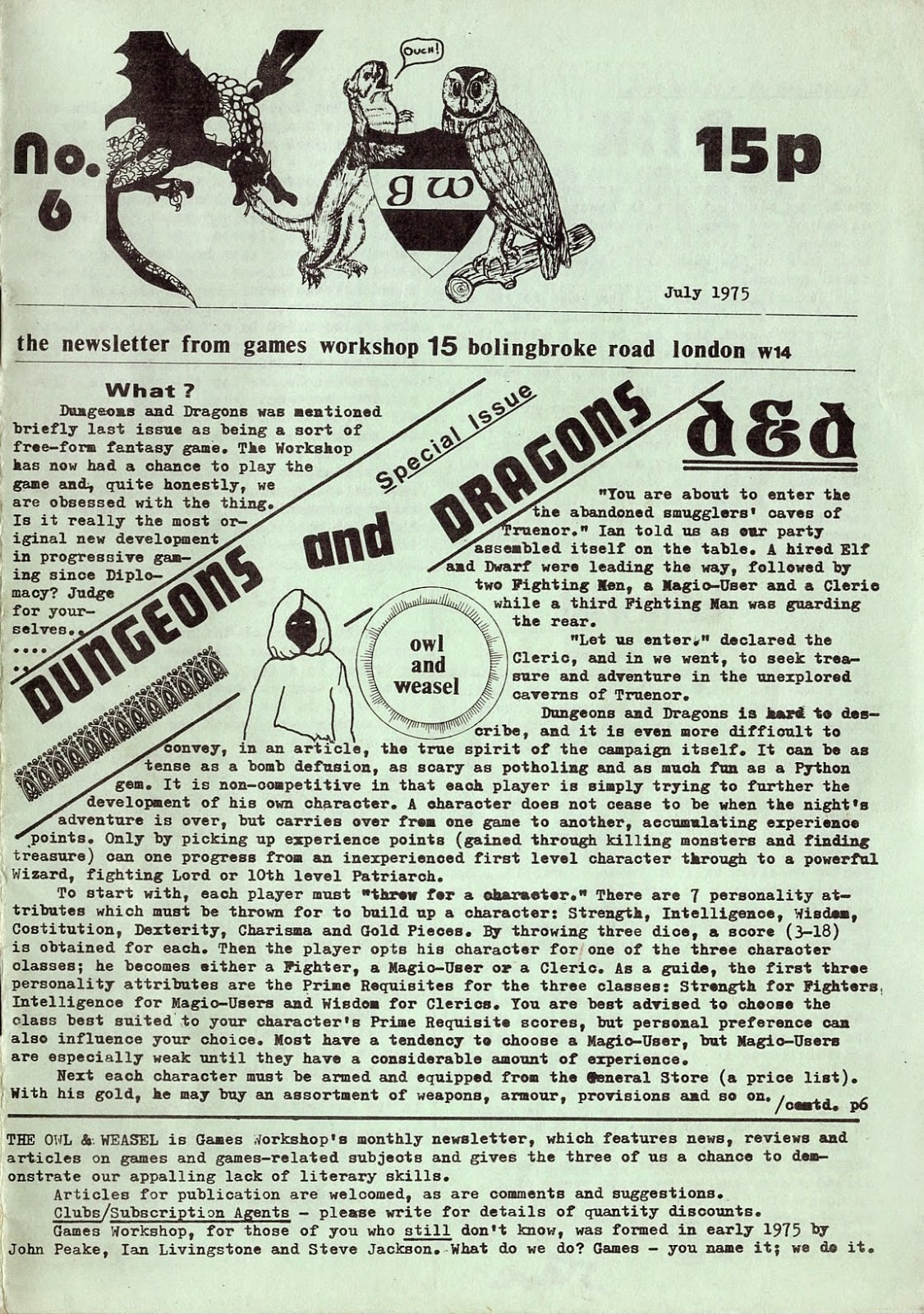
Owl and Weasel (February 1975 to April 1977) was the first Games Workshop newsletter, eventually becoming White Dwarf in 1977. The snippet above, from Owl and Weasel #5 (June, 1975), is probably the first time GW co-founder Steve Jackson mentions D&D in print. He hasn’t even played the game yet, but “watched one in progress the other week at the City University Games Club…”

The very next issue, Owl and Weasel #6 (July, 1975), is a “Special Issue” dedicated to Dungeons & Dragons, described as “a sort of free-form fantasy game.” Jackson delves into the game mechanics as he outlines his party’s adventure, and touches on the novelties of the game: “It is non-competitive in that each player is simply trying to further the development of his own character…”; “The beauty of the game is that any decisions made by any of the players can be incorporated…”

Owl & Weasel #6 July 1975-1

Owl & Weasel #6 July 1975-2

Owl & Weasel #6 July 1975-3

The last page advertises TSR products that GW hasn’t even received yet. The board game Dungeon! hasn’t been released, and it costs more than the D&D set. $10.00 in 1974/1975 is the equivalent of $50.00 today—a lot of money, as Jackson notes in the article. And that’s not including shipping and handling. After meeting Jackson and Ian Livingstone at Gen Con IX (1976), Gary Gygax granted Games Workshop exclusive rights to distribute D&D products in the UK. (Jackson talks about the early days of GW at a 2013 interview at The Register.)

We have Timothy Brannan at The Other Side to thank for the scans, and he has lots more selections from Owl and Weasel to peruse. Brannan is a RPG writer who specializes in the horror genre. Check out his books here.

A Portrait of Young Geeks Playing D&D (1985/1986)

D&D 1986-2

Via MainlyCats, we behold the tail end of a late-night session (the red splotch on the table was a candle) at the University of East Anglia in Norwich, UK. Specifically, the lads are in the kitchen of the Waveney Terrace building, a section of the university known for its Spartan accommodations. Or, as the UEA Alumni Association put it in 2005, when Waveney was demolished:

Much loved, Waveney Terrace opened in 1972; what it lacked in aesthetic charm was compensated for by a sense of community and character.

Read an account of Waveney in the ’80s here. There’s also a Flickr pool dedicated to the place.

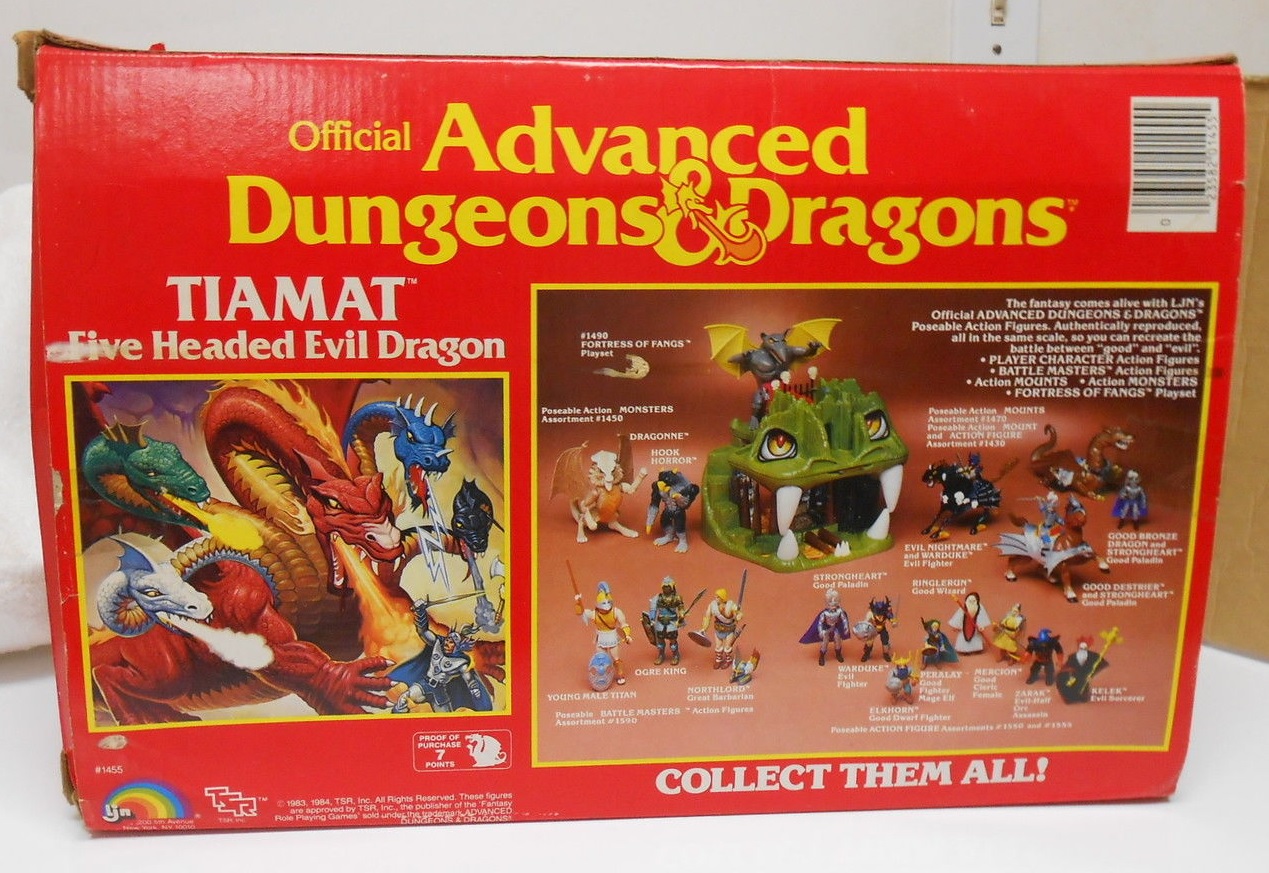
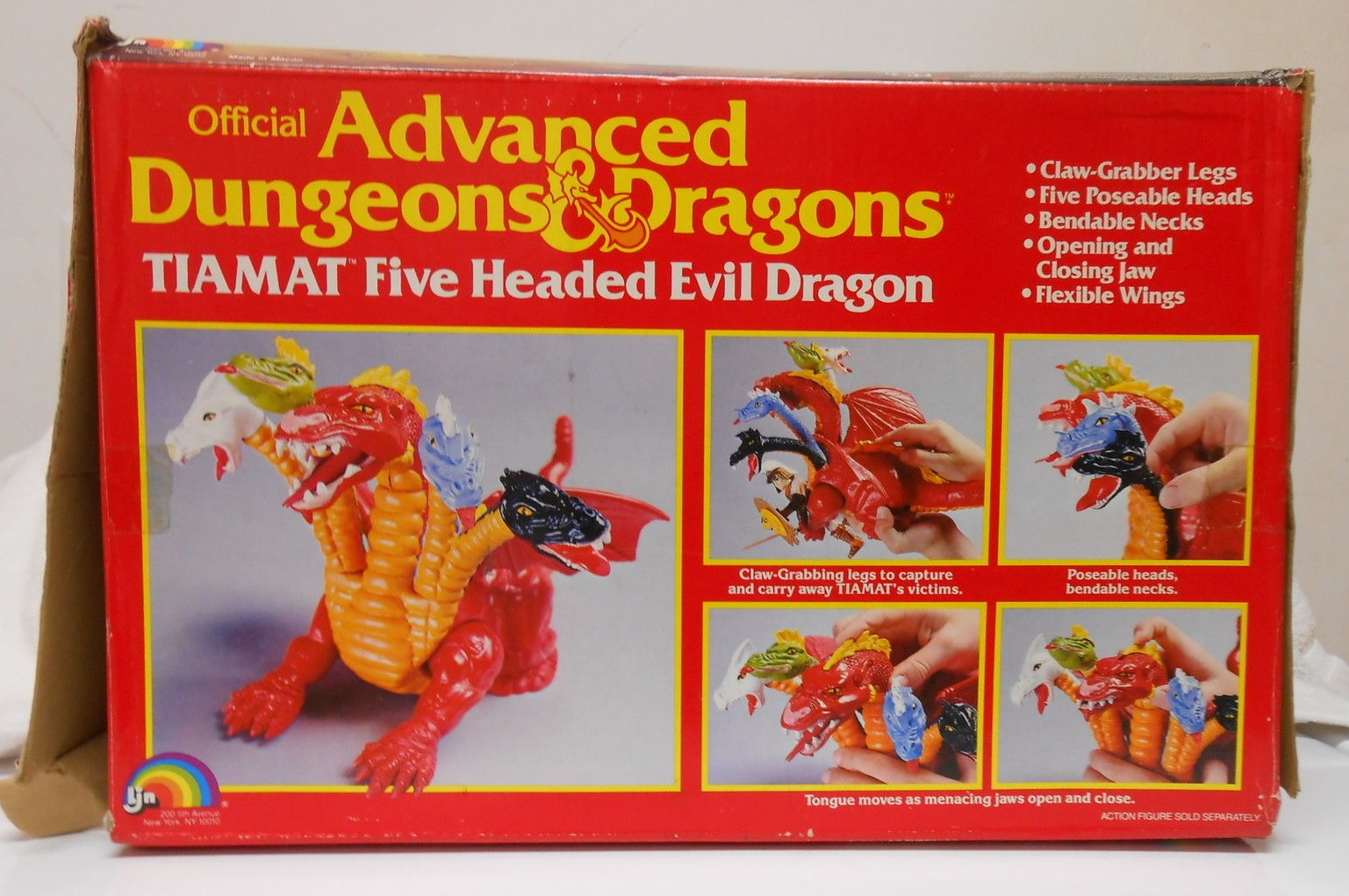
LJN’s Advanced Dungeons & Dragons Toys: Tiamat – Five Headed Evil Dragon (1984)

Tiamat LJN 1983-1

Tiamat LJN 1983-2

Tiamat LJN 1983-3

Tiamat LJN 1983-4

Tiamat LJN 1983-5

Saying the toy didn’t live up to the spectacular Ken Kelly box art is a bit of an understatement.

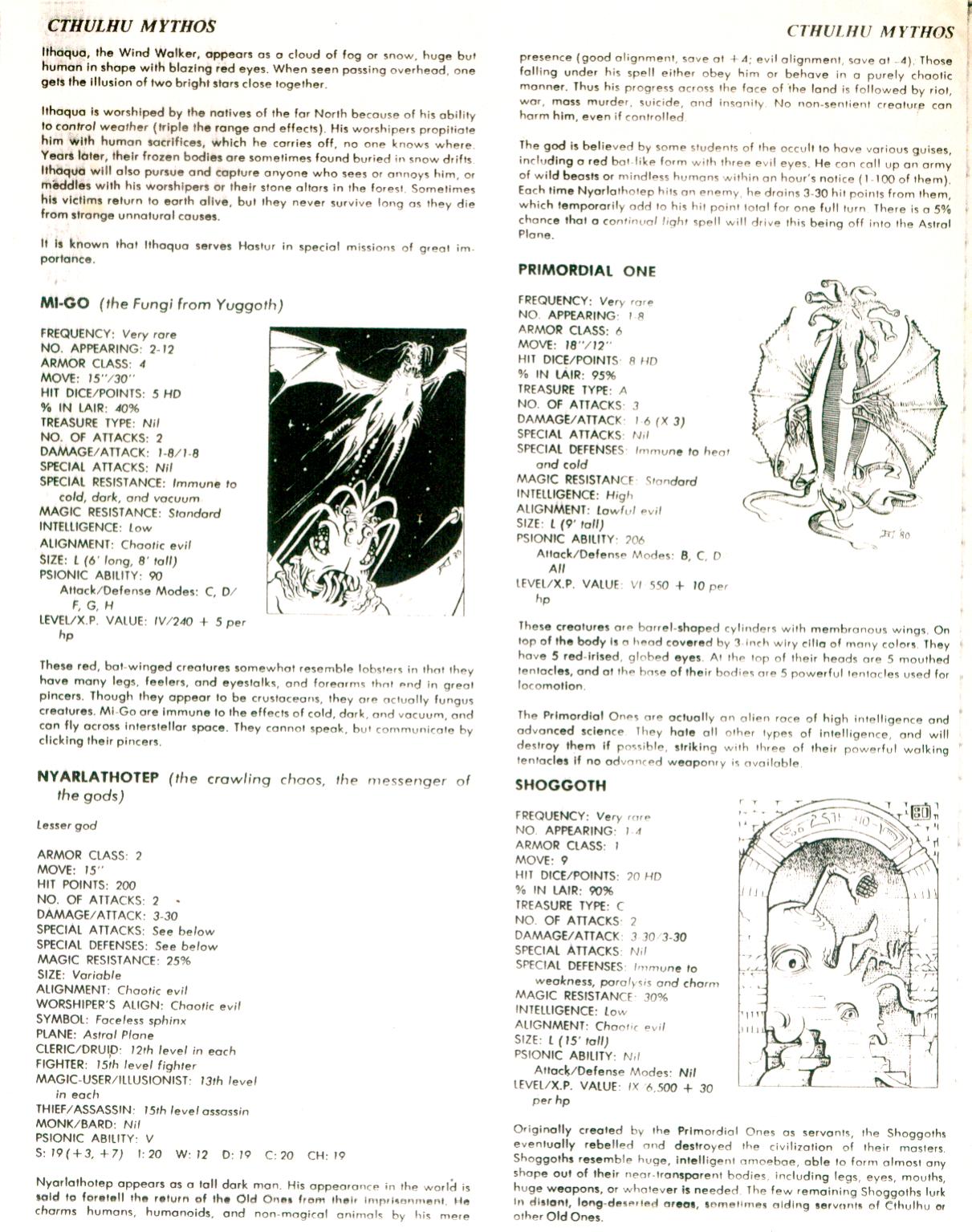
The Cthulhu Mythos in TSR’s Deities & Demigods (1980)

Cthulhu-1

Cthulhu-2

Cthulhu-3

Cthulhu-4

Cthulhu-5

Cthulhu-6

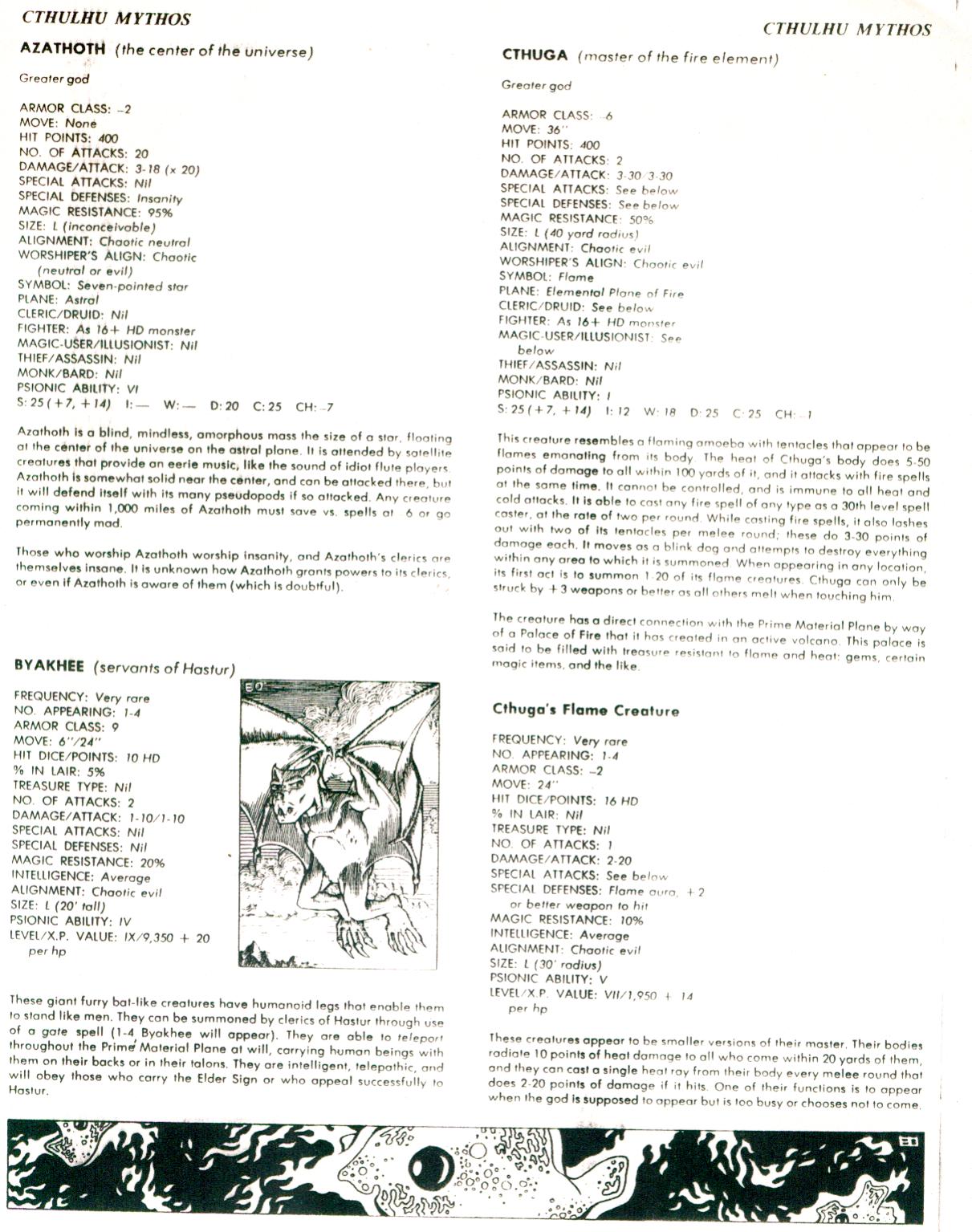
Compare the entries and stats here to the “Lovecraftian Mythos” article in The Dragon. Despite J. Eric Holmes blowing off a reader’s suggestion to raise the hit points of the Great Old Ones, that’s exactly what’s happened—and a number of other criticisms have been addressed as well. My favorite part of the Azathoth entry—about the universe collapsing and all life being destroyed in the event of the creator’s death—has been removed, and instead of being “the creator of the universe,” Azathoth is now “the center of the universe.” The idea is to make the gods appropriately awesome and intimidating while also making them approachable from a role-playing perspective.

The illustrations are by Erol Otus, who, in my opinion, is the definitive early D&D artist and one of the greatest fantasy artists of all time. Lovecraft’s vibe suited him perfectly, and I wish he’d done—or would do—a portfolio or an illustrated edition. His smug Cthulhu is what I see when the name is invoked, and all the arcane denizens and their haunts shimmer with high strangeness and psychedelic mania.

To admire more Otus art from Deities & Demigods, visit The Erol Otus Shrine.

(Images via Dr. Theda’s Crypt)

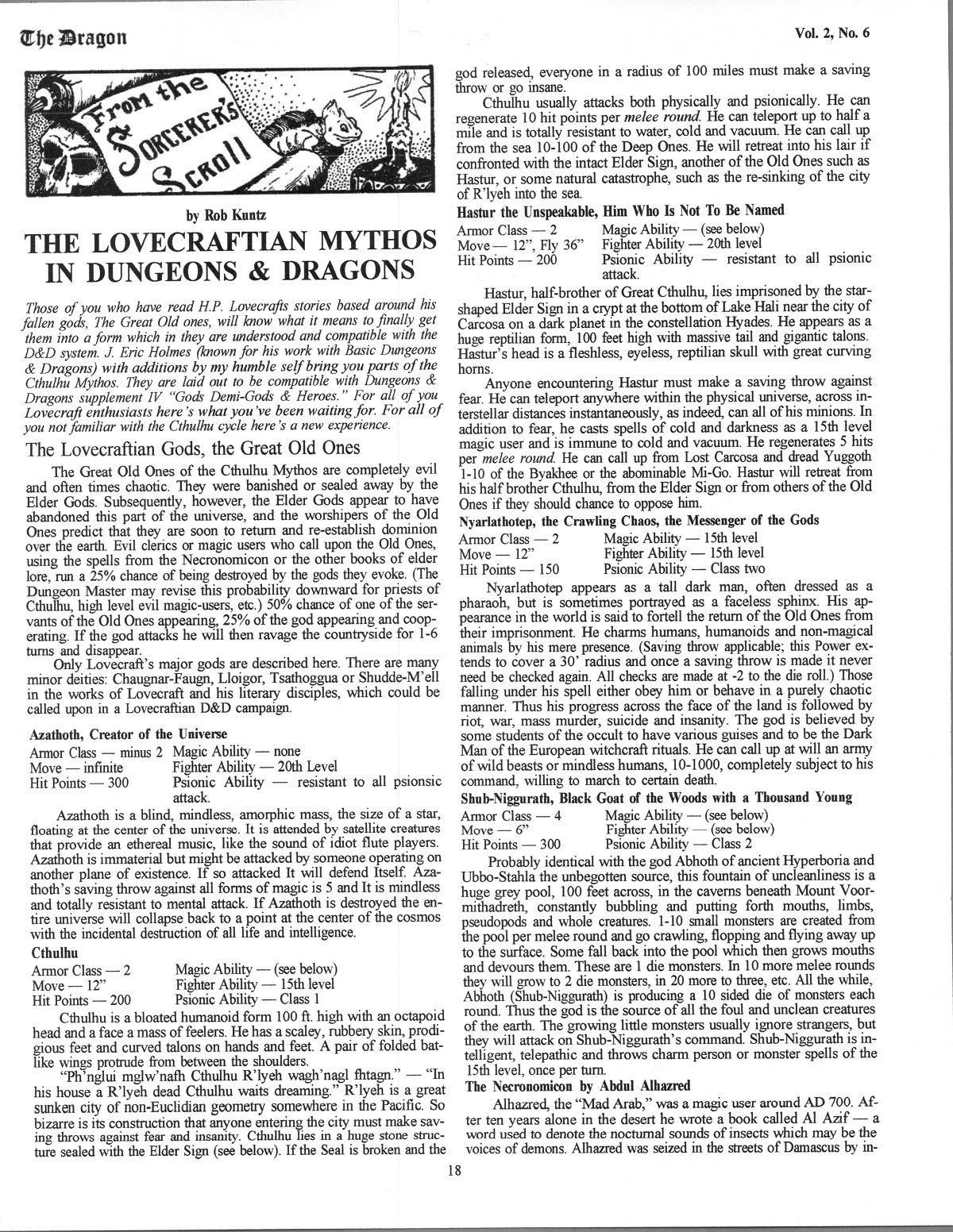
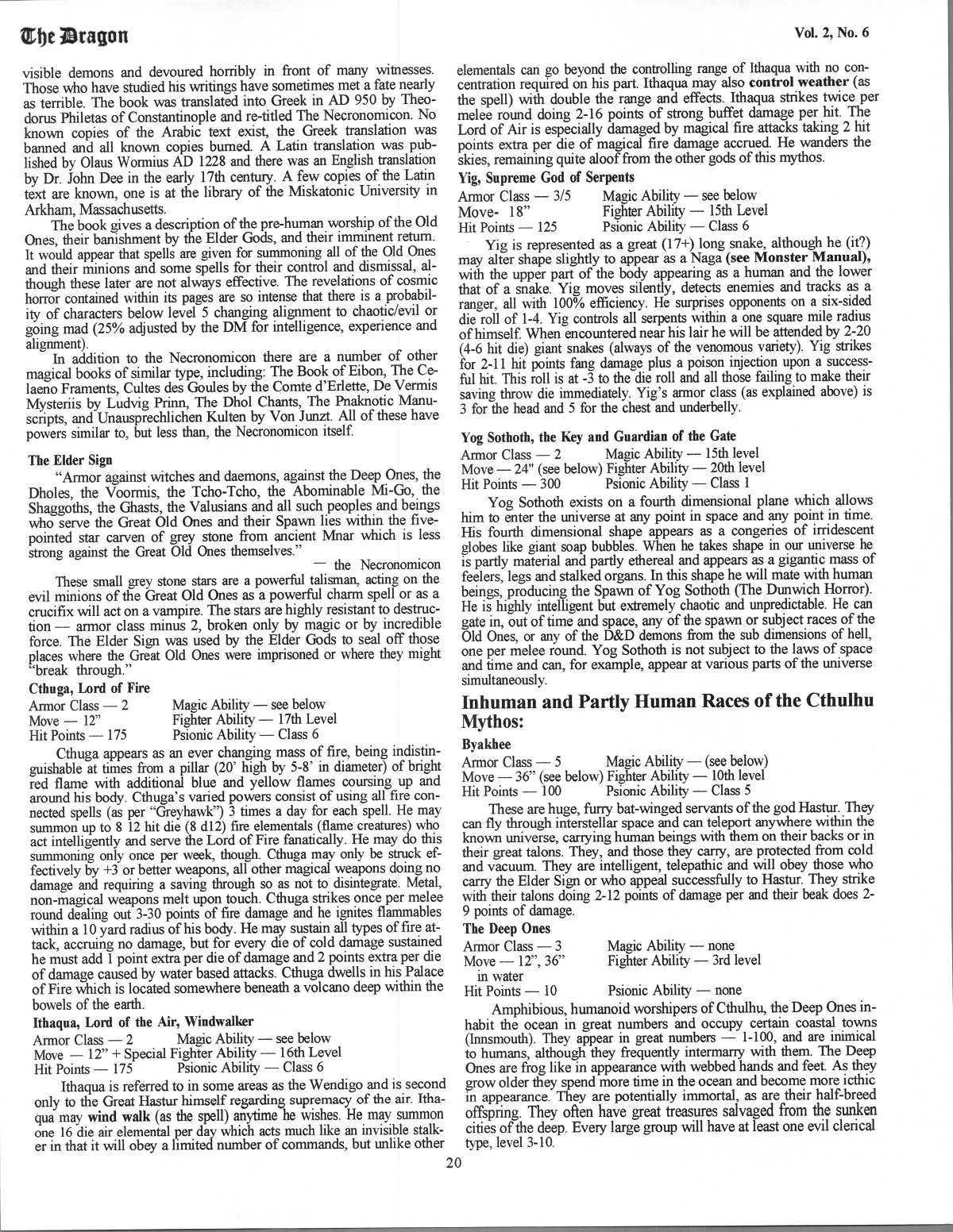
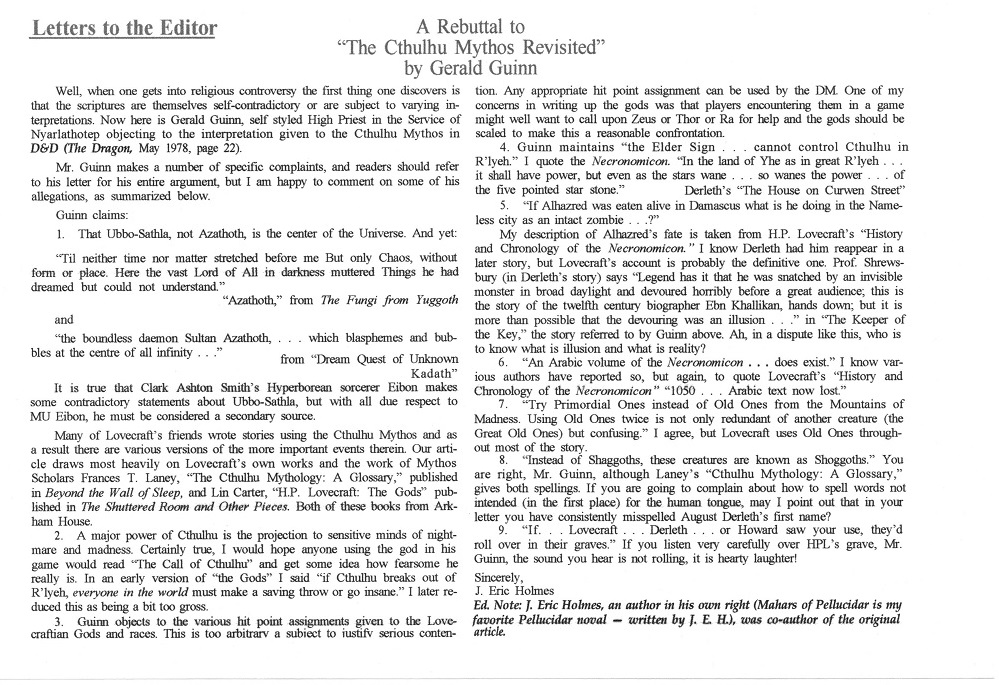
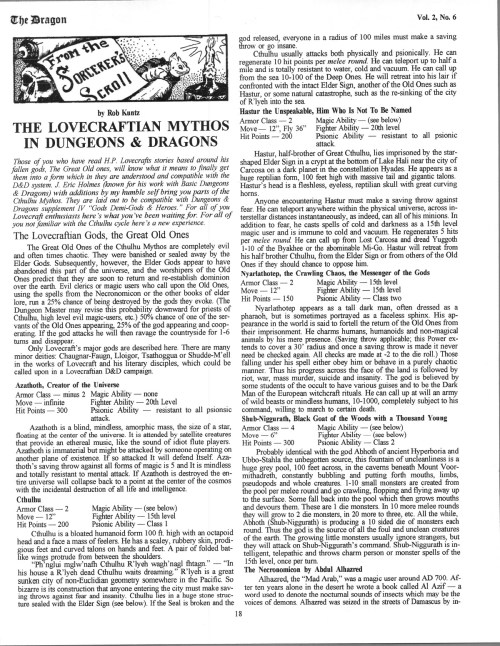
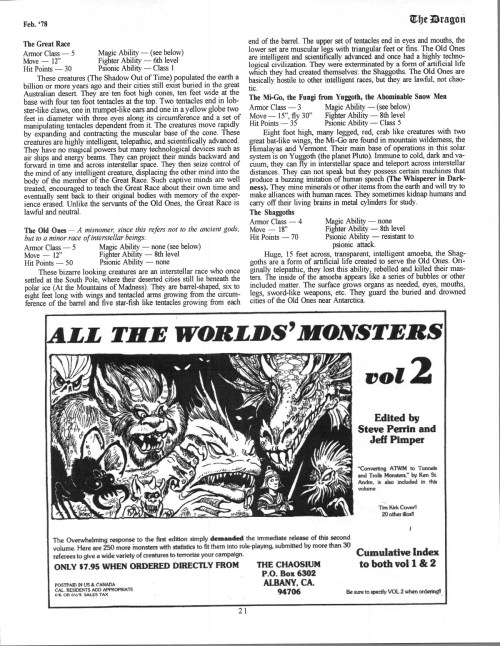
‘The Lovecraftian Mythos in Dungeons & Dragons’ from The Dragon #12 (February, 1978)

D&D Characters014

D&D Characters015

D&D Characters016

“The Lovecraftian Mythos in Dungeons & Dragons” is a fascinating and important supplement to Gods, Demi-Gods & Heroes (1976), which was itself a supplement to the original D&D set of 1974. The column was penned by two genre legends: Rob Kuntz, co-author of Gods, Demi-Gods & Heroes and the first edition Deities & Demigods (1980), and J. Eric Holmes, author of the first D&D Basic Set (1977). H.P. Lovecraft was, of course, listed as an “immediate influence” upon AD&D in Gygax’s famous Appendix N of the AD&D Dungeon Masters Guide (1979). Despite having little to do with the heroic fantasy genre as we know it, Lovecraft’s oeuvre is consistently identified with it, and has been just as influential on the development of fantasy role-playing as Tolkien and Robert E. Howard, Lovecraft’s long-distance friend.

There are a couple of reasons for this. First, the Cthulhu Mythos is fueled by occult lore and traditions: ancient magic, arcane knowledge and sacred mysteries, astral planes, psychic gateways, monsters of the deep, etc. As silly as the ’80s “satanic panic” was, the D&D universe (or multiverse) is alive with the same occult elements—employed as fictions, obviously, not facts. Second, Lovecraft, following Poe, used a journalistic approach when writing his weird fiction, sort of like a police procedural applied to supernatural phenomena. His world and its denizens are so convincing and internally consistent, in fact—so real—that actual cults have grown up around his writings and the anti-humanist, anti-rationalist philosophy they encompass. (See, for example, K.R. Bolton’s “The Influence of H.P. Lovecraft on Occultism.”)

Like Tolkien, Lovecraft experienced a dramatic resurgence in the 1960s, when alternative spirituality and the quest for altered consciousness reached a new high (so to speak). The Moral Majority resented, among other things, the spiritual independence won by young people by the end of the Summer of Love decade, and they feared that D&D and other products of the imagination would corrupt—i.e. render freethinking—a new generation of youngsters. The difference between literate hippies and early geeks is that the former wanted to replace the “technocratic” real world with a new one based on love, freedom (in politics and consciousness), and a return to nature, whereas the latter simply wanted to create and play in a sandbox of alternative realities.

The idea of inserting Lovecraft into D&D sums up the glorious absurdity at the heart of fantasy role-playing: on the one hand, we want to escape to a fictional time and place that is less complicated than the real one, a world in which magic exists; on the other hand, we want our fantasy worlds to be systematically playable, and for that to happen, statistics must be applied to said worlds and the beings inhabiting them. It’s equal parts Romanticism and Enlightenment, art and science. Hence the brilliant entry for `Azathoth, Creator of the Universe’:

If Azathoth is destroyed the entire universe will collapse back to a point at the center of the cosmos with the incidental destruction of all life and intelligence.

Talk about game over. And the creator of the universe only has 300 hit points!

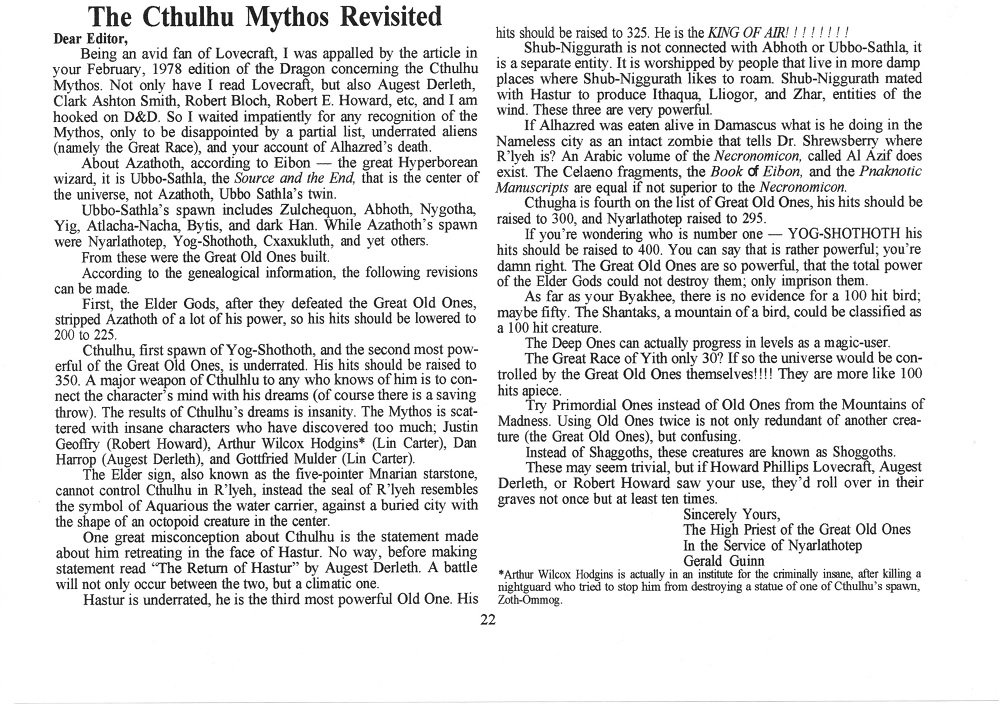
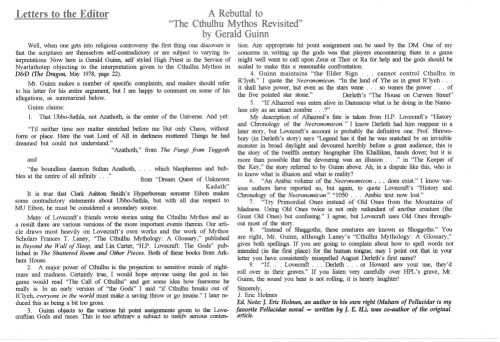
In The Dragon #14 (May, 1978), a letter from reader Gerald Guinn cheekily objected to a number of points made in the “Lovecraftian Mythos” article. J. Eric Holmes cheekily responded in The Dragon #16 (July, 1978). Both letters are below. Holmes’ response, along with the original article, are listed in Lovecraft scholar/biographer S.T. Joshi’s H.P. Lovecraft and Lovecraft Criticism: An Annotated Bibliography (1981).

A “Cthulhu Mythos” section (see tommorow’s post) expanded from the Dragon article appeared in the first edition of Deities & Demigods, but was famously removed from subsequent editions because TSR didn’t want to acknowledge its debt to Chaosium, which had acquired the rights—or the blessings of Arkham House, anyway, since Lovecraft’s works were and are in the public domain—for the Call of Cthulhu role-playing game.

For a comprehensive list of Cthulhu Mythos references in early D&D, see this post at Zenopus Archives.

Dragon #14 May 1978 Guinn

Dragon #16 July 1978 Holmes Lovecraft


Pages

Archives

Categories

Donate Button

Join 1,118 other subscribers