Archive for the 'Magazines/Zines' Category


Comic Book Stand, 1975

Comic Book Rack, 1975

Photo via Detective21

Oh, how they gleam with fresh-off-the-press-ness. I can smell them from here.

Horror titles (comics and magazines) were immensely popular at the time, and comic back issues will cost you a grip today, even in poor condition. The genre saw a huge resurgence in the ’70s for a number of reasons, all of them mutually reinforcing: the commercial success of 1968’s Night of the Living Dead and especially Rosemary’s Baby; changes in the Comics Code (1971) that permitted the depiction of “vampires, ghouls and werewolves”; the proliferation of syndicated horror showcases across the nation: Fright Night (1970), Creature Double Feature (circa 1972), Chiller Thriller (circa 1974), etc. (I’ll post some of the intros later on Facebook.)

As much as I love The Tomb of Dracula and all of Marvel’s monster titles, DC really set the comics standard with The Unexpected, House of Mystery, House of Secrets, The Witching Hour, and Ghosts. Weird War (not pictured here) was a brilliant combination of the horror and war genres. If I had a choice of a full run, that’s the one I’d want.

Above the comics you’ll see some magazines, including Monsters Unleashed, Vampirella, and Famous Monsters of Filmland. The pile of Mad magazines on the bottom right is #174. Cheap!

Mad #174

Odyssey #8 (August, 1981)

Odyssey #8 FC

Odyssey #8 IFC

Odyssey #8 pg. 3

Odyssey #8 pg. 12

Odyssey #8 pg. 13

Odyssey #8 pg. 14

Odyssey #8 pg. 15

Odyssey #8 pg. 16

Odyssey #8 pg. 17

Odyssey #8 pg. 18

Odyssey #8 pg. 19

Odyssey #8 pg. 30

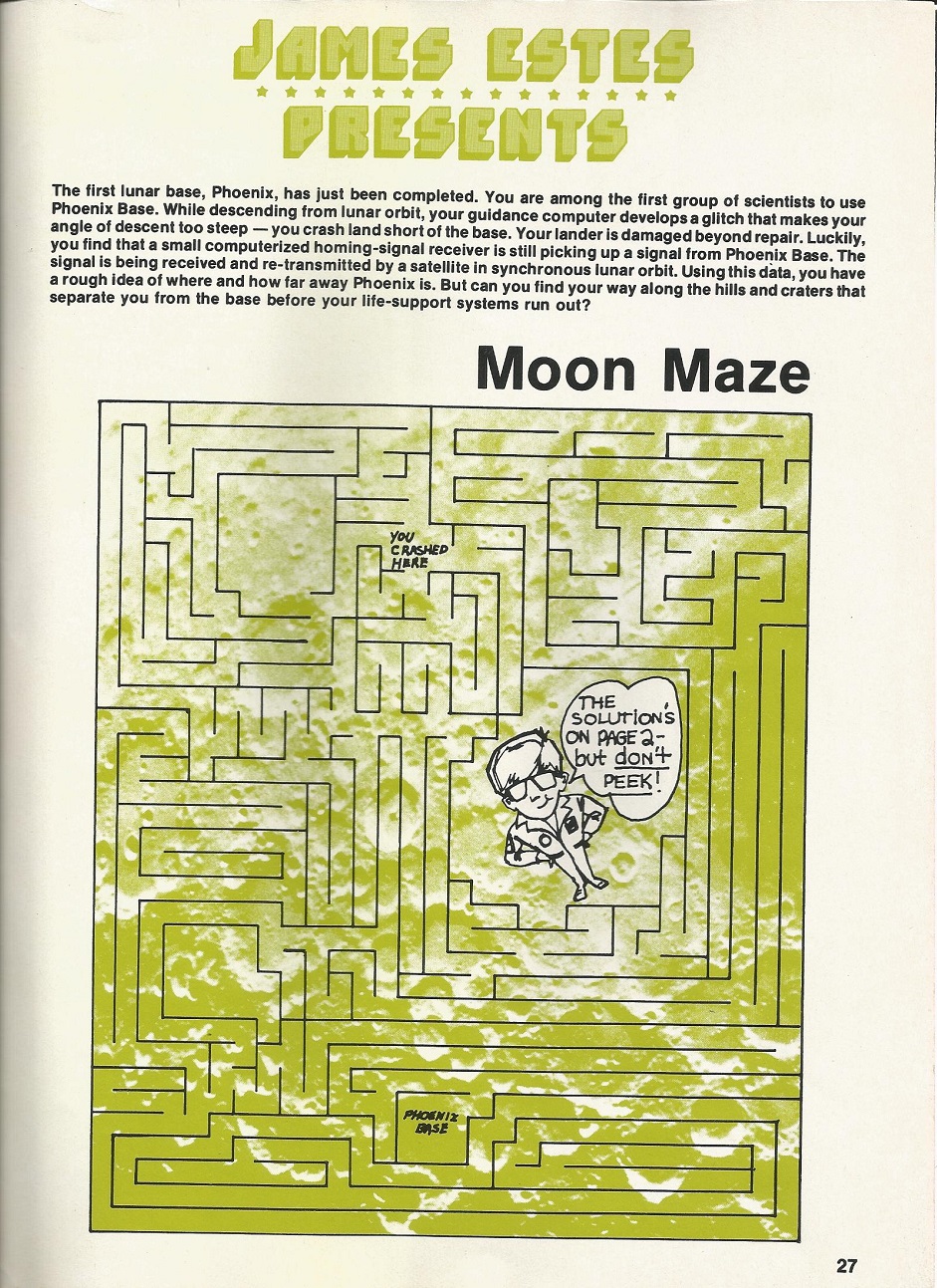
Odyssey, “The Young People’s Magazine of Astronomy and Outer Space,” ran from 1975 through 1991. Originally published by AstroMedia Corp., the magazine was sold to Kalmback publishing in 1985. I don’t have any issues from the later period, but I’ve seen some for sale, and it looks like the format changed slightly. I bought a good run from ’81 and ’82 and plan to post selections from each issue.

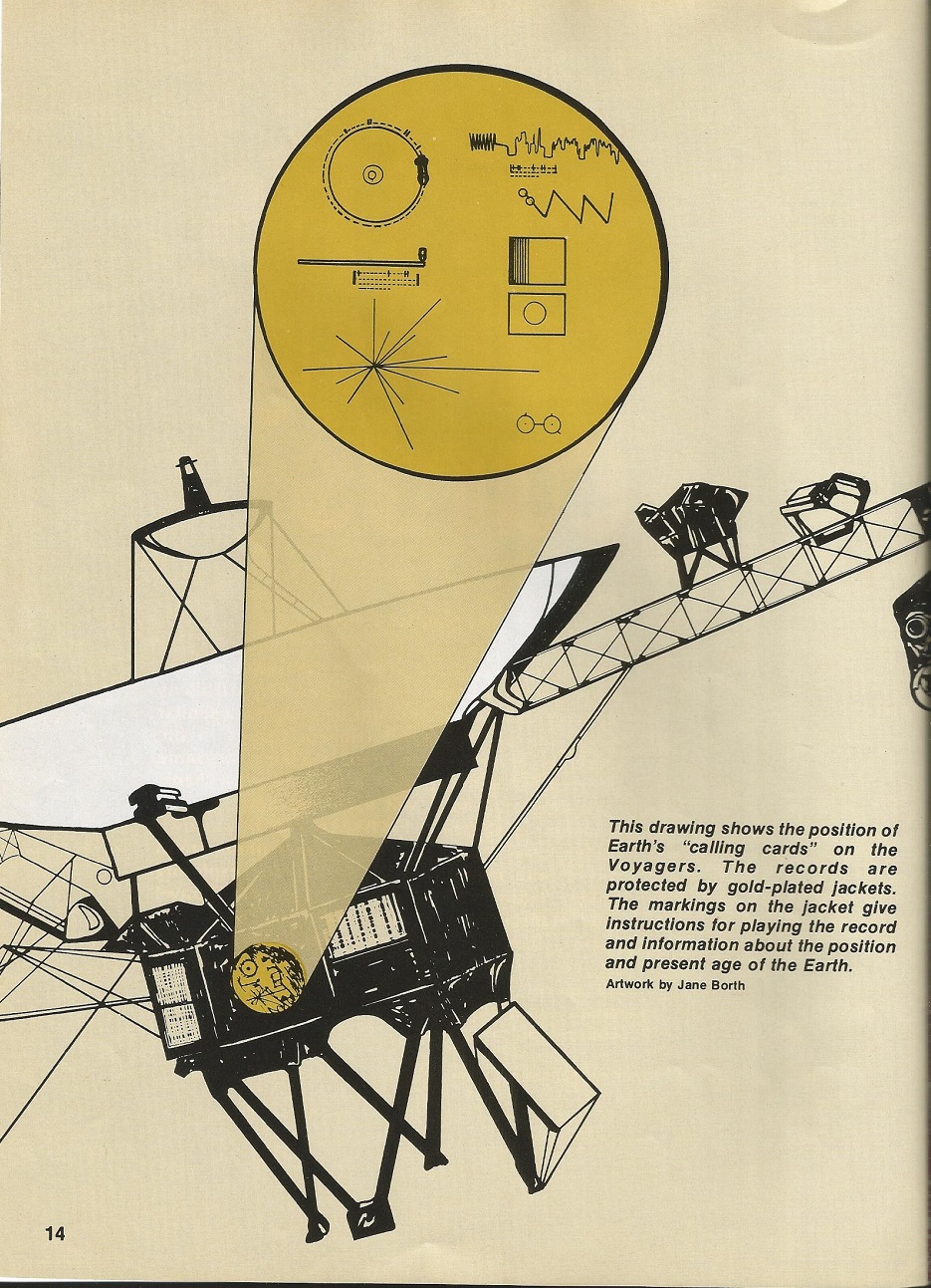
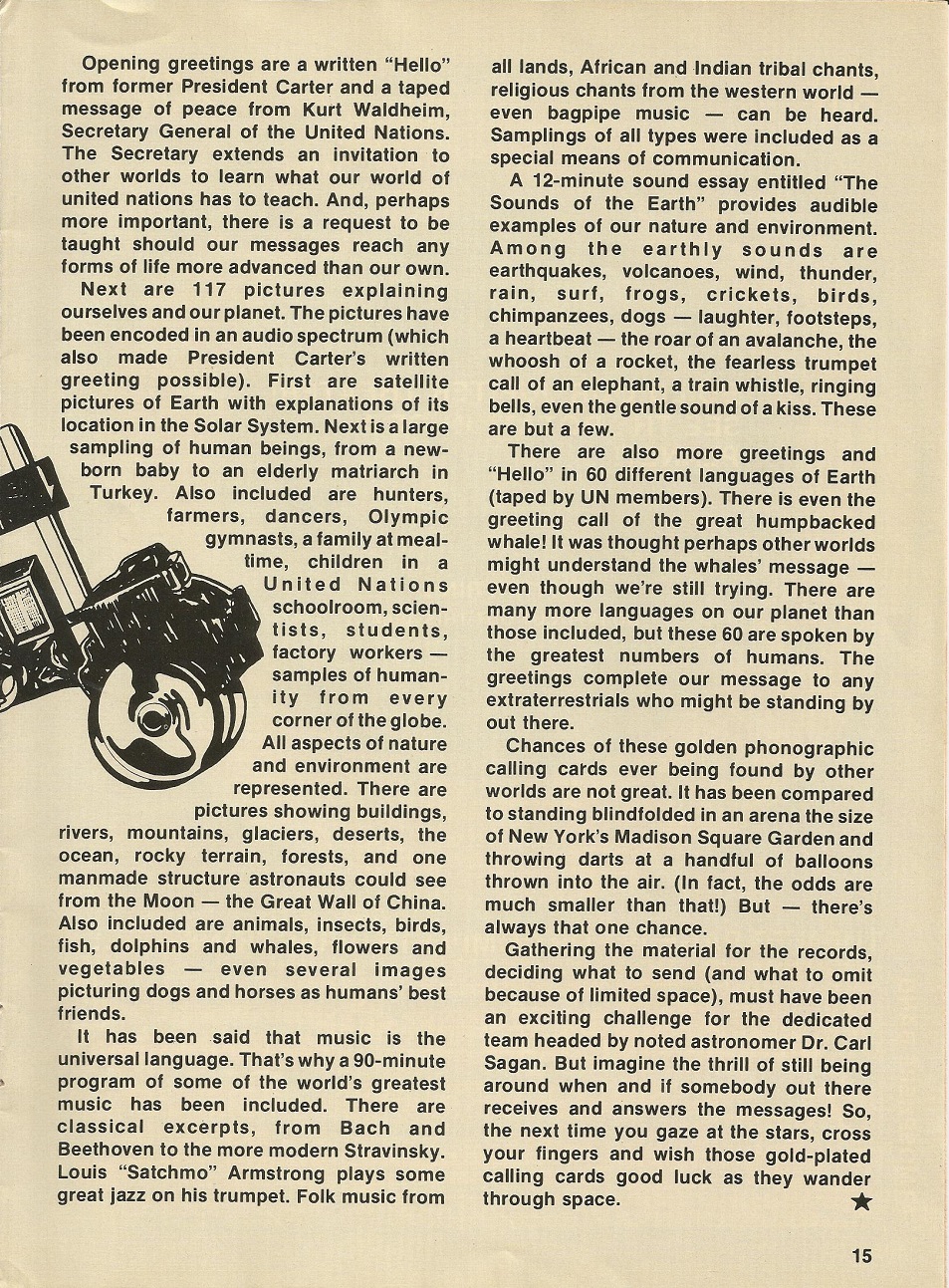
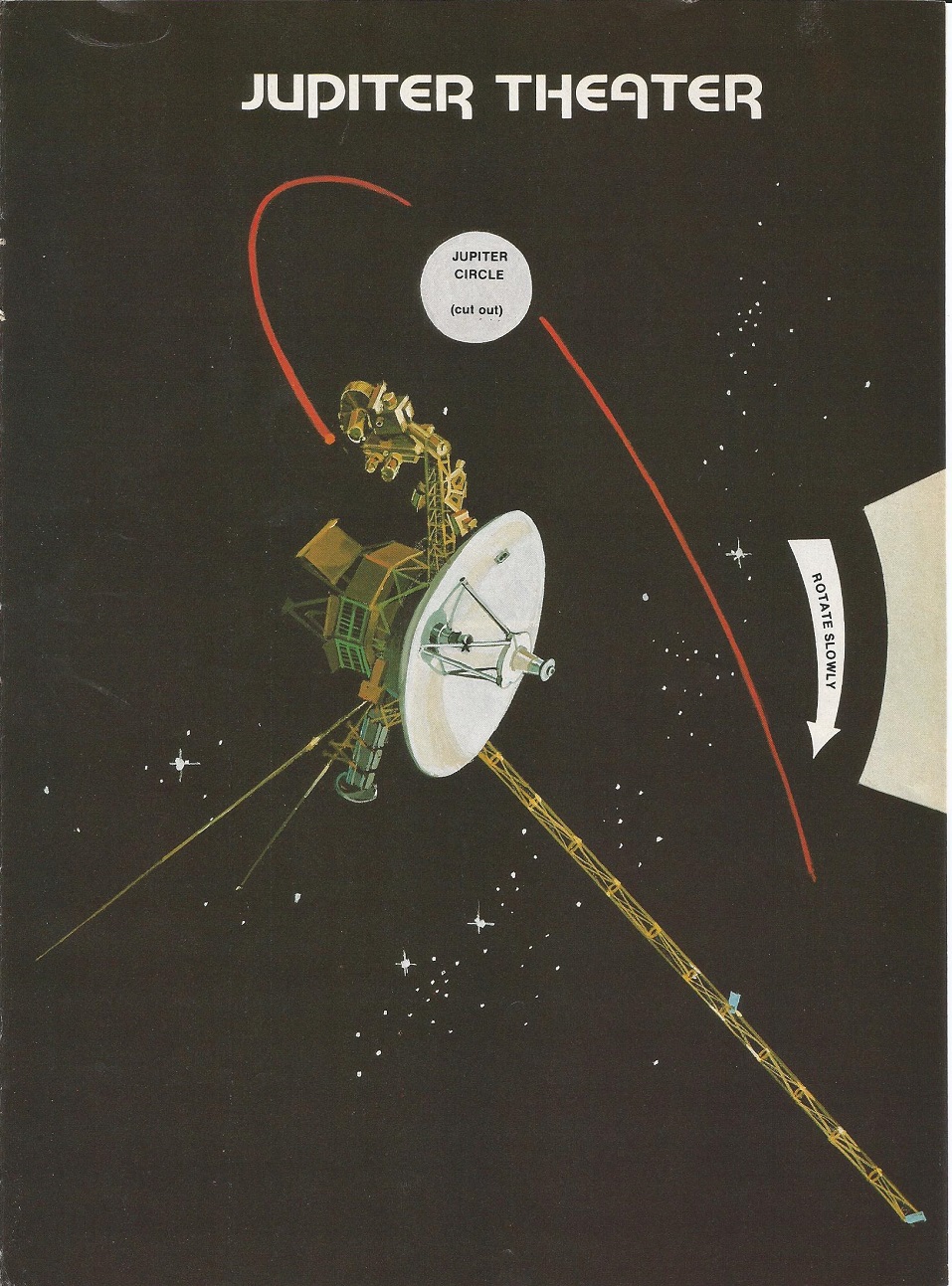
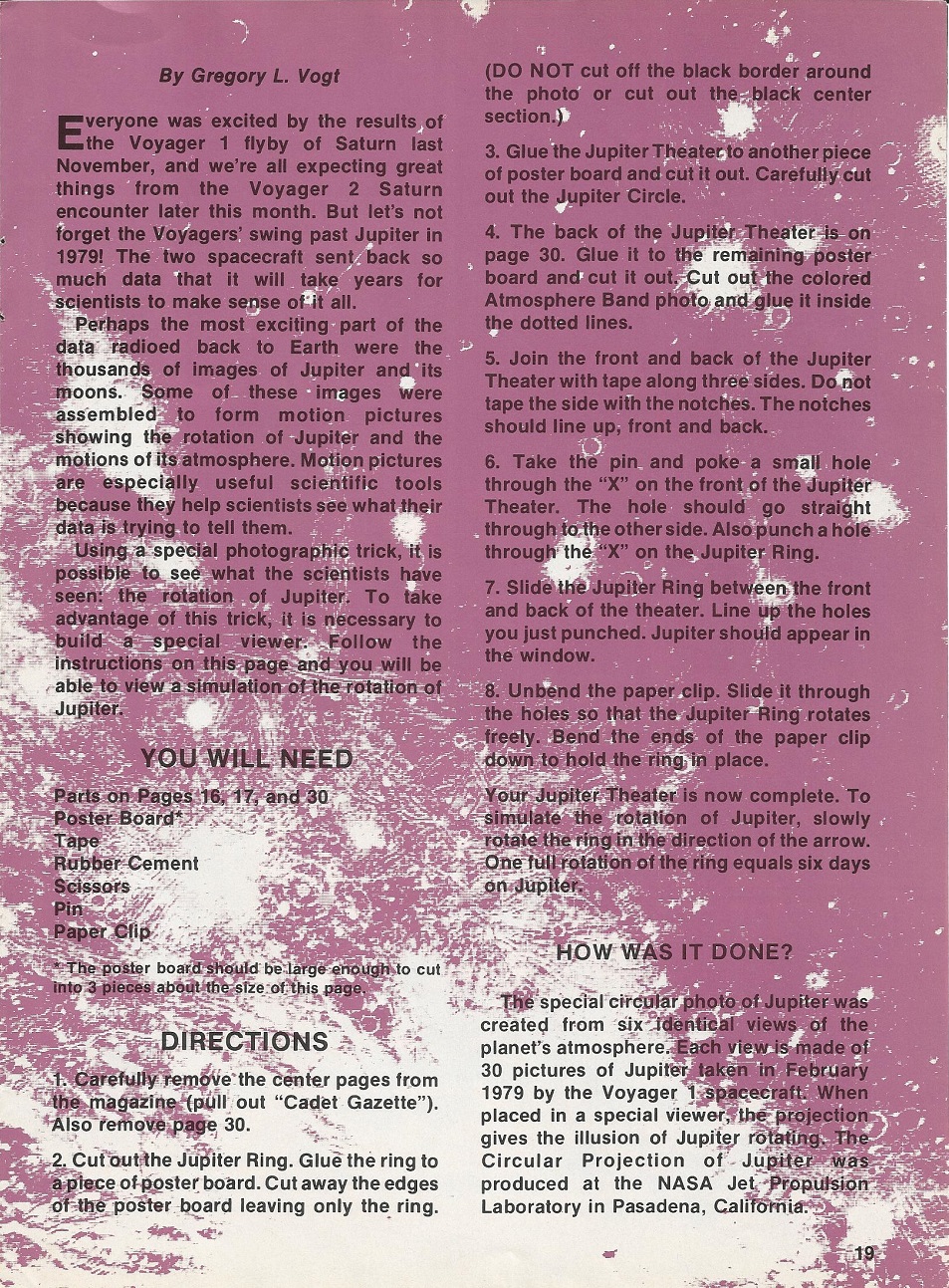
Kids used to be excited about space travel and the stars. Consequently, they were excited about science. Funny how that works. The magazine is excellent quality, even if some of the science is outdated. Above you’ll find an article on Voyager’s Golden Records, and instructions on how to build a Jupiter Theater (if anyone gets it done, send me some pics and I’ll show them off.)

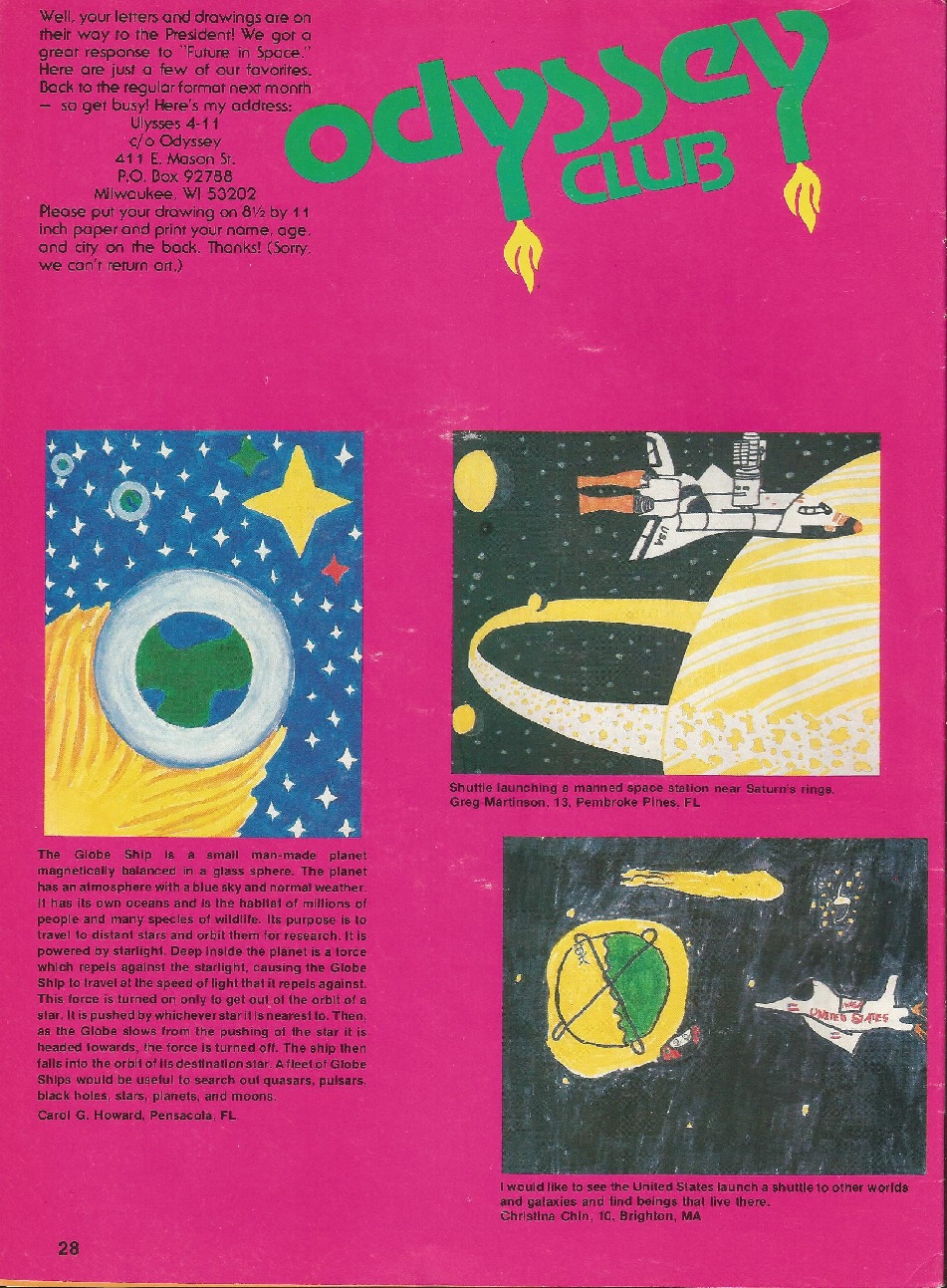
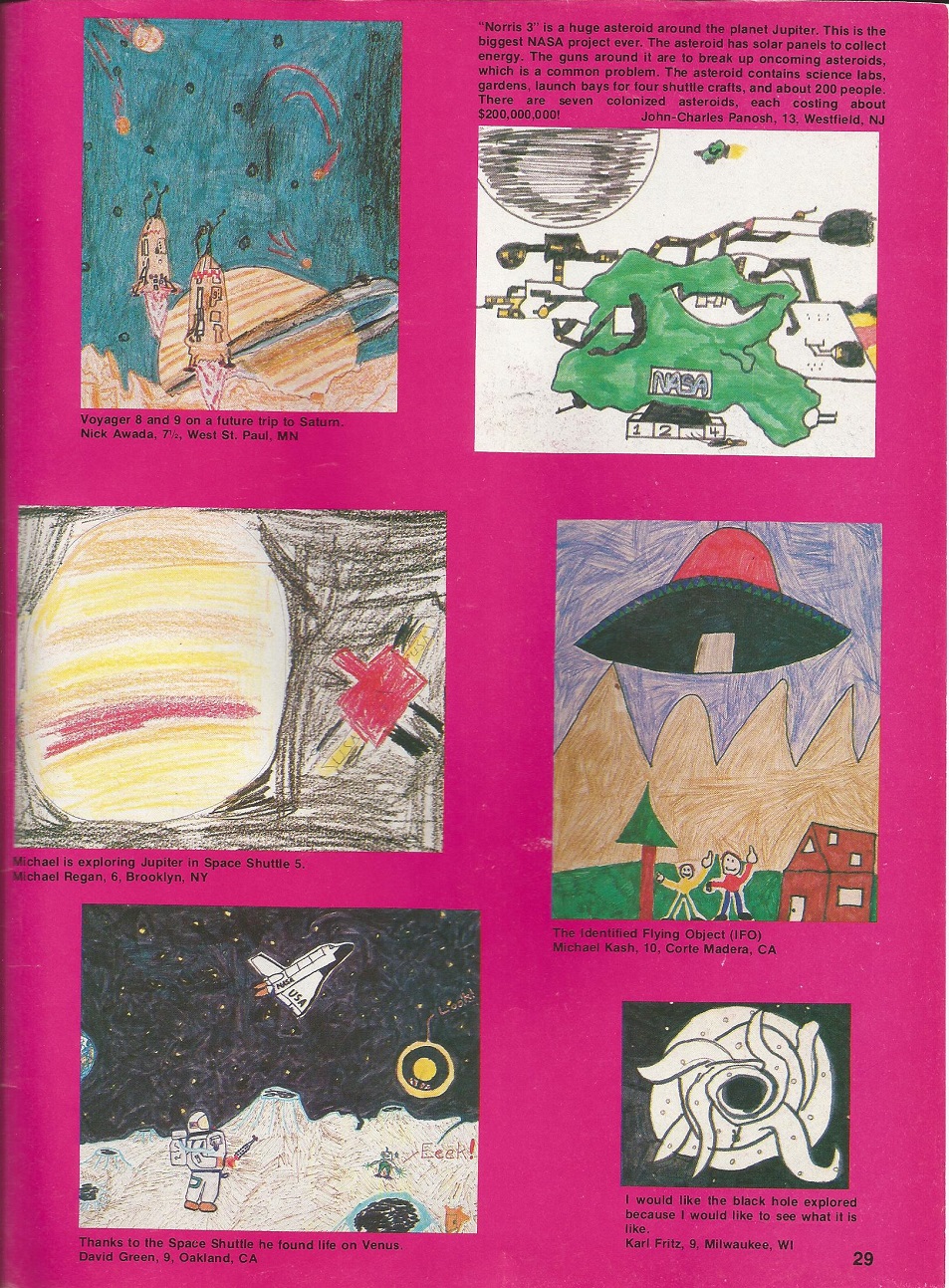
A number of regular features are below. The first two feature Odyssey‘s robot mascot, Ulysses. The third is even better: kid art depicting space themes. The theme for this issue is “Future in Space.” Along with the letters printed at the beginning of the issue, the drawings were sent to President Reagan, who was threatening to cut NASA’s budget at the time.

The blurbs accompanying the art are brilliant. Talk to me, Christina Chin: “I would like to see the United States launch a shuttle to other worlds and galaxies and find beings that live there.”

Amen.

Or how about John-Charles Panosh’s “Norris 3,” an asteroid colony orbiting Jupiter? Pretty cool. Do you think it’s named after Chuck Norris?

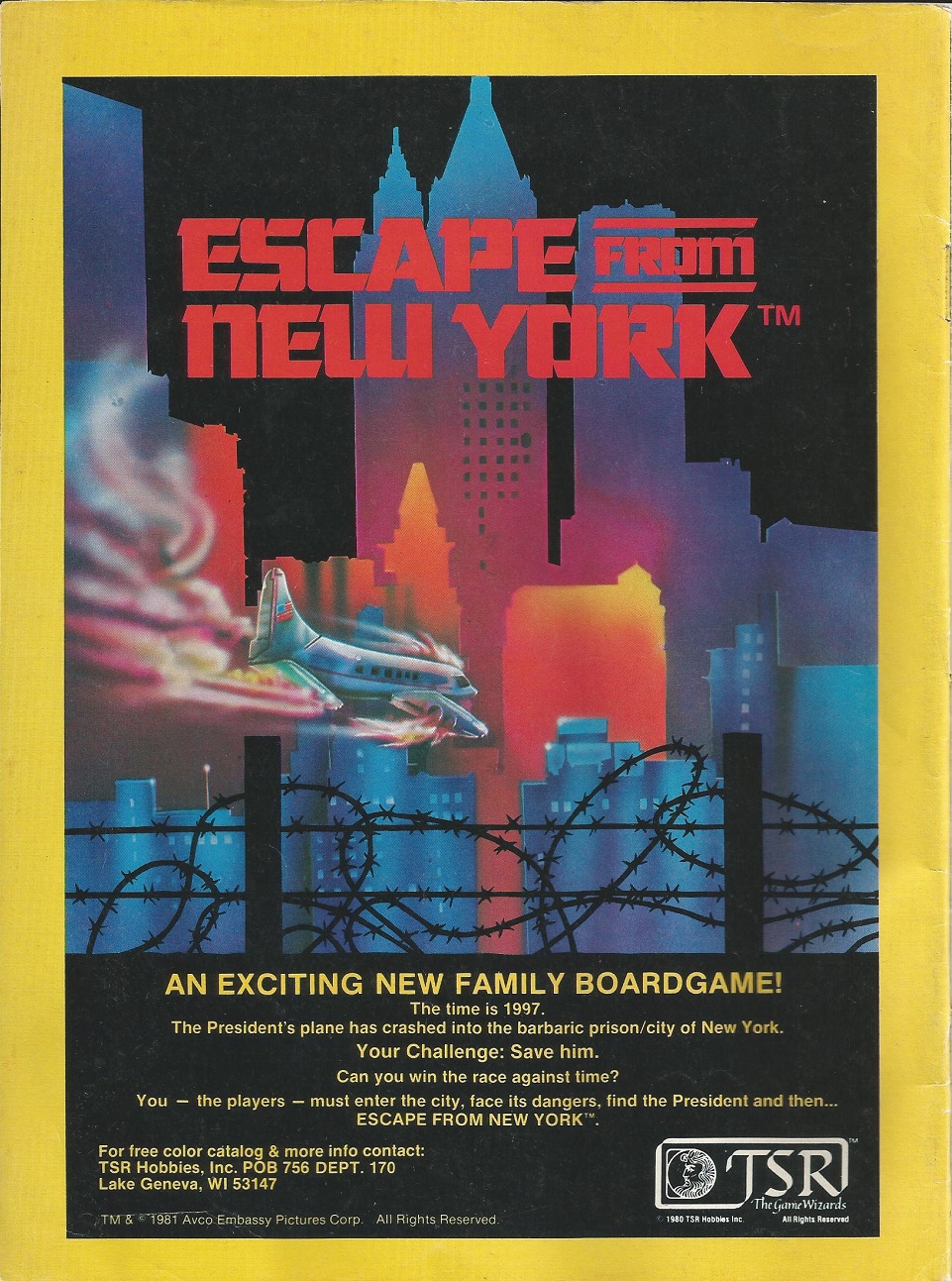
The back cover is a surreal ad for TSR’s Escape from New York board game. In fact, every issue of my run has a TSR ad on the back cover.

Odyssey #8 pg. a

Odyssey #8 pg. 26

Odyssey #8 pg. 27

Odyssey #8 pg. 28

Odyssey #8 pg. 29

Odyssey #8 BC

Comic Book Store, 1978

Comic Shop 1978

The ad, showing Vancouver’s The Comic Shop, is from The First Vancouver Catalogue. The pic on top shows rows and rows of fantasy paperbacks in the glorious heyday of fantasy paperbacks. Several editions of Conan appeared between 1966 (Lancer Books) and the early ’80s. They included Howard’s original stories and new works by contemporary authors, notably L. Sprague de Camp and Lin Carter.

The Marvel titles in the bigger photo are mostly obscured, but what a great look at all the magazines. Will Eisner’s Spirit, 1984, The Hulk! (formerly The Rampaging Hulk) #10 (Val Mayerik cover art), and The Savage Sword of Conan #33 (killer Earl Norem cover). On the second row, you’ll see a `Jaws vs Ape’ headline. That’s Famous Monsters of Filmland #146.

FM #146 1978

Not cover specialist Bob Larkin’s best work, and why the hell is the ape beating on Jaws, anyway? Here’s my best guess.

1976’s A*P*E (no shit, it stands for Attacking Primate MonstEr) is compellingly awful, and introduces a young Joanna Kerns (the mom in Growing Pains). RKO sued the production company for its blatant attempt to rip off Dino De Laurentiis’s 1976 King Kong remake, hence the hilarious disclaimer at the end of the trailer.

Also, listen for the very poorly edited “See giant ape defy jaw-shark!” I’m sure the narrator originally used ‘jaws’, but was forced to change it due to legal pressure from Universal Pictures. So, in true exploitation fashion, they replaced the ‘s’ by dubbing ‘shark’ over it.

***

I’m happy to report that The Comic Shop is still there. On the website’s history page, I found a bonus photo of co-founder and owner Ron Norton in 1975. You can spot several more comic magazines behind him, including Unknown Worlds of Science Fiction #1, and more fantasy and sci-fi paperbacks (Zelazny, Silverberg) in the foreground.

Comic Shop 1975

(First image via Sequential: Canadian Comics News and Culture)

(Video via TrashTrailers/YouTube)

Fantastic Films #27 (January, 1982): Interview with Jim Steranko

FF #27 FC

FF #27 TOC

FF #27 pg. 50

FF #27 pg. 51

FF #27 pg. 52

FF #27 pg. 53

FF #27 pg. 62

Comics and illustration genius Jim Steranko on his Raiders of the Lost Ark pre-production art:

The first Raiders painting I did established the character of Indiana Jones. There was really no actor discussed at this point, at least not with me […]

I got a note from George’s [Lucas] secretary describing Indiana Jones, which said that Indy should have a jacket like George wears. That was the only instruction. Fortunately, I knew what kind of jacket George wears. It all worked out very well. I perceived Indiana Jones as a cross between Doc Savage and Humphrey Bogart […]

The definitive image appears on Kenner’s 1981 Raiders of the Lost Ark Game.

Raiders Board Game

Steranko’s Outland adaptation was serialized in Heavy Metal from June, 1981 through January, 1982. You can read the first few pages here.

The movie it’s based on, written and directed by Peter Hyams (Capricorn One, 2010), is generally dismissed as a heavy-handed retelling of High Noon (1952). That’s a mistake. As Steranko says, “[Outland] struck me as being the first noir science fiction film, somewhat in the ‘Chandleresque’ vein.” The film also verges on cyberpunk, and it came out a year before Blade Runner.

It’s fitting that Steranko, deeply influenced by the pulps, also did the cover for the Marvel Super Special Blade Runner cover.

Marvel Blade Runner

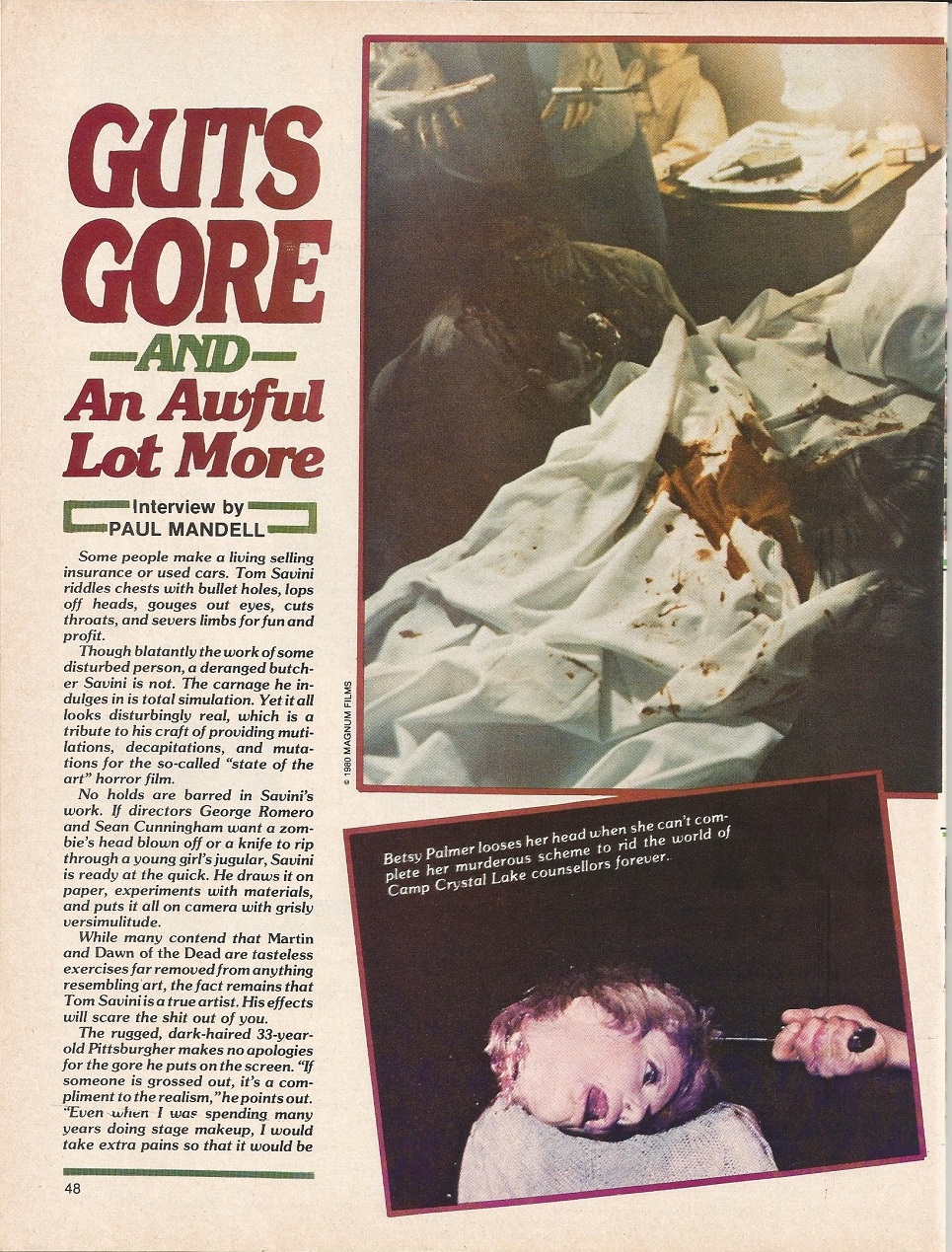
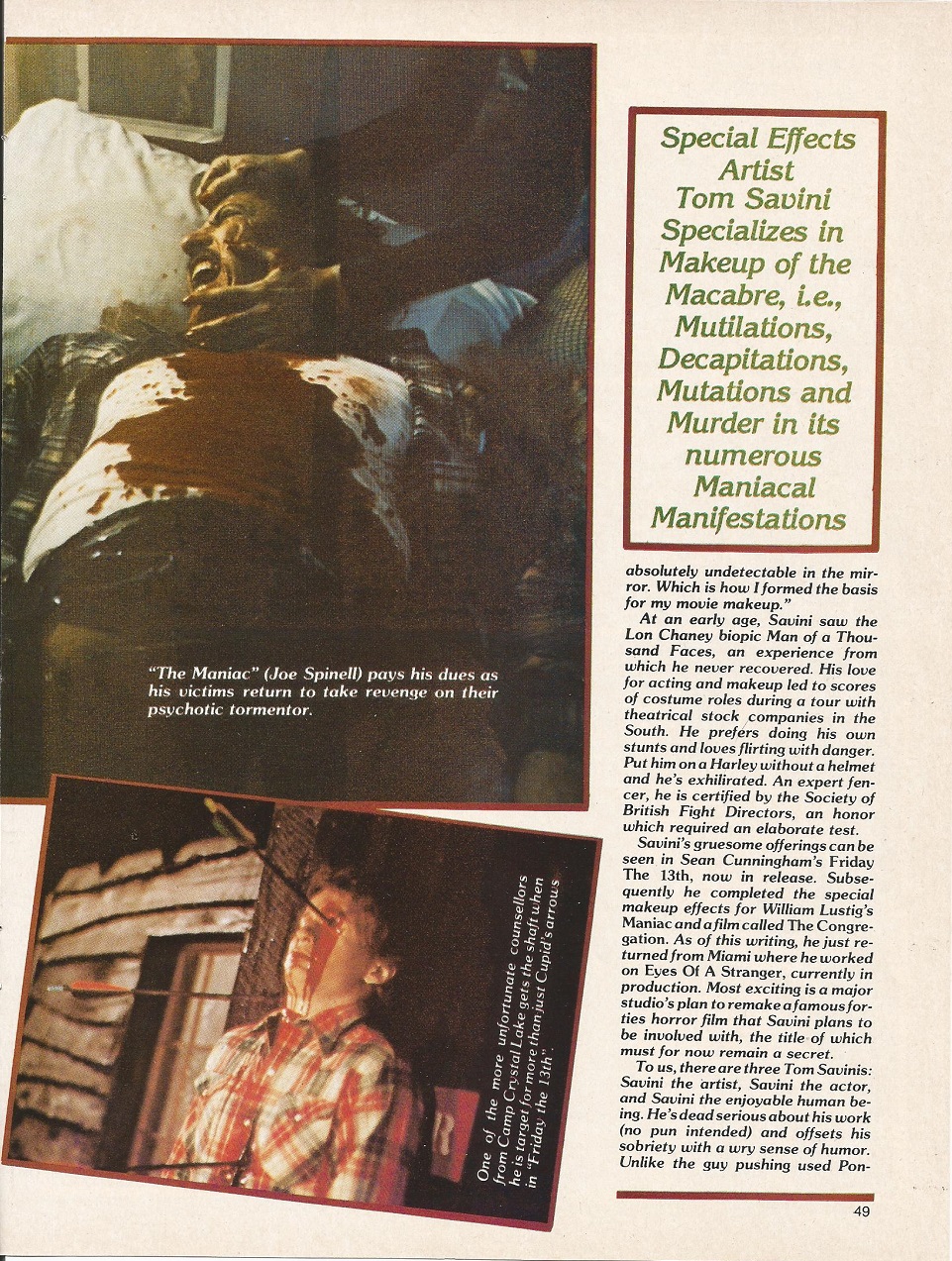
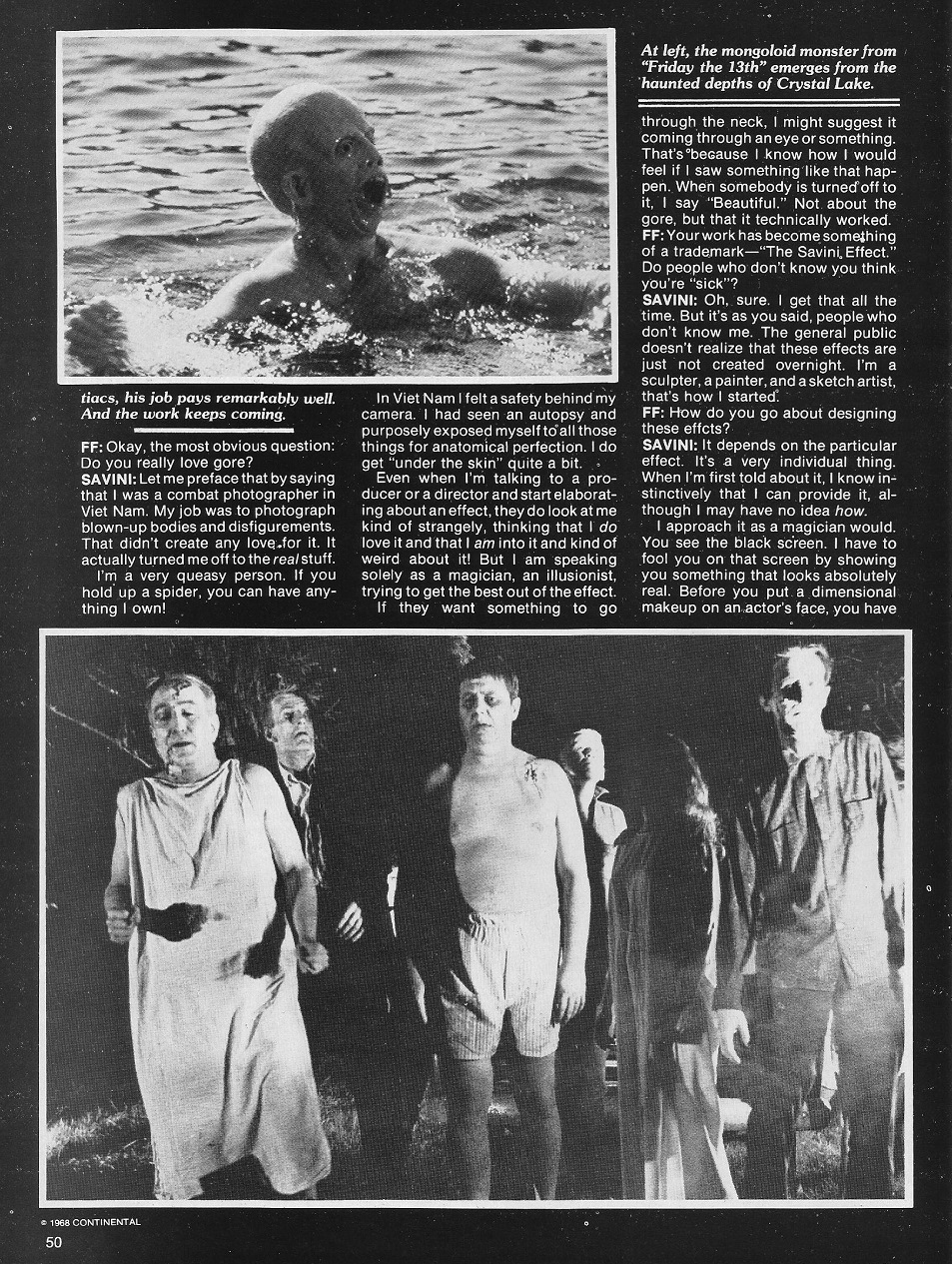
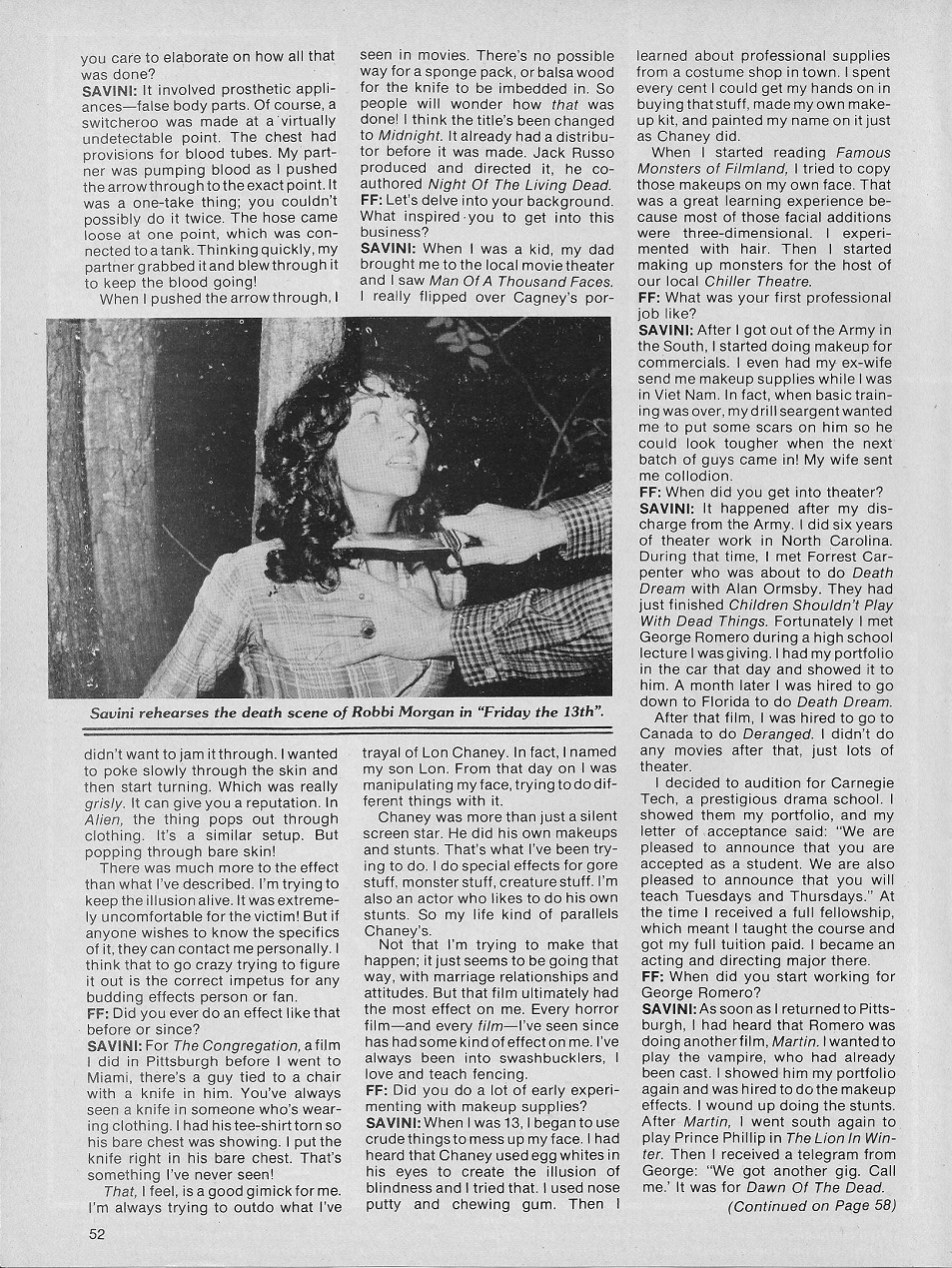
Fantastic Films Collectors Edition #20 (December, 1980): Interview with Tom Savini

FF CE #20 pg. 48

FF CE #20 pg. 49

FF CE #20 pg. 50

FF CE #20 pg. 51

FF CE #20 pg. 52

FF CE #20 pg. 58

FF CE #20 pg. 59

Tom Savini’s first makeup effects job, at the recommendation of George Romero, was Deathdream (a.k.a. Dead of Night), a brilliant 1972 film about a G.I. in Vietnam who dies in the war but returns to life—and comes home—as a vampire. After that, Savini did makeup for 1974’s Deranged (written by Alan Ormsby, who also wrote Deathdream), loosely based on the grisly career of Ed Gein. Martin (1976), another outstanding vampire film (kind of) written and directed by Romero, was next. Savini, already a theater veteran, wanted to play the lead. He did makeup and stunts instead.

After Martin, Savini returned to the theater, taking the part of King Philip in a production of The Lion in Winter. When that wrapped, Romero called him in to do effects for Dawn of the Dead (1978), the greatest zombie movie ever made, and easily in the all-time horror top 10. On to Friday the 13th (1980), whose realistic effects sent the American slasher film into the mainstream. (Bob Clark, who directed Deathdream, also directed the first true American slasher: 1974’s underrated Black Christmas. Clark is best know today as the director of A Christmas Story.)

No one in the makeup effects business did more to define the modern horror genre than Savini, not even Rick Baker or Stan Winston. His experience as a combat photographer in Vietnam gave him a unique (and terrible, I would think) insight into death.

Not at all the grisly brooder or the “deranged butcher” people expect, Savini emanates an easygoing affability in interviews. It’s clear that he loves life, and he’s giddily dedicated to his craft. All of that comes through when FF asks him if he had fun on Friday the 13th:

Oh, it was one of the greatest times I’ve ever had. The weeks in the Poconos, riding around without a helmet, taking my time and doing really elaborate things, and having a fortune to spend. Toward the end, I received a Dear John phone call from my girlfriend, which at the time seemed to destroy the whole experience. But as I look back on it, it didn’t at all. I just had a terrific time.

Despite his genius for illusion, Savini saw himself as an actor first. Romero finally gave him his chance in Knightriders (1981), a misunderstood movie about a jousting motorcycle troupe that’s also an elegy on the decline of the ’60s counterculture. Savini plays one of the leads, opposite a 30-year-old Ed Harris, and more than holds his own.

(The first and second installments of Fantastic Films #20 are here and here, respectively.)

Geekery in the UK: Games Workshop and the Early Selling of ‘Mind-Games with Dice’

Games Workshop Ad 1981

I’ve talked a little bit about TSR’s early marketing campaign in the U.S., and now, thanks to Dirk Malcolm of The Dirk Malcolm Alternative, we see how game makers won over the kids in Britain.

The ad above is from the December 1981 issue of Starburst, “the world’s longest-running magazine of sci-fi horror and fantasy.” I don’t remember seeing anything like it in the U.S. It’s very effective, the staid schoolboy quietly conjuring his inner barbarian. The message is a moral: reality comes with escape hatches, and it’s okay to use them. (For the low, low price of £7.95!)

Games Workshop was (and is, they’re still very successful) a British company that started to import D&D and other U.S.-produced RPGs in 1978. In a 2008 interview, Gary Gygax talks about granting GM, founded by Steve Jackson and Ian Livingstone, “a license to produce TSR products in the UK, even print their own material unique to the UK.” The cost of importing was high, so the deal effectively unleashed the swelling nerd-thusiasm of the new market. (There was even talk of a TSR-Games Workshop merger at one point, but the parties couldn’t come to terms.)

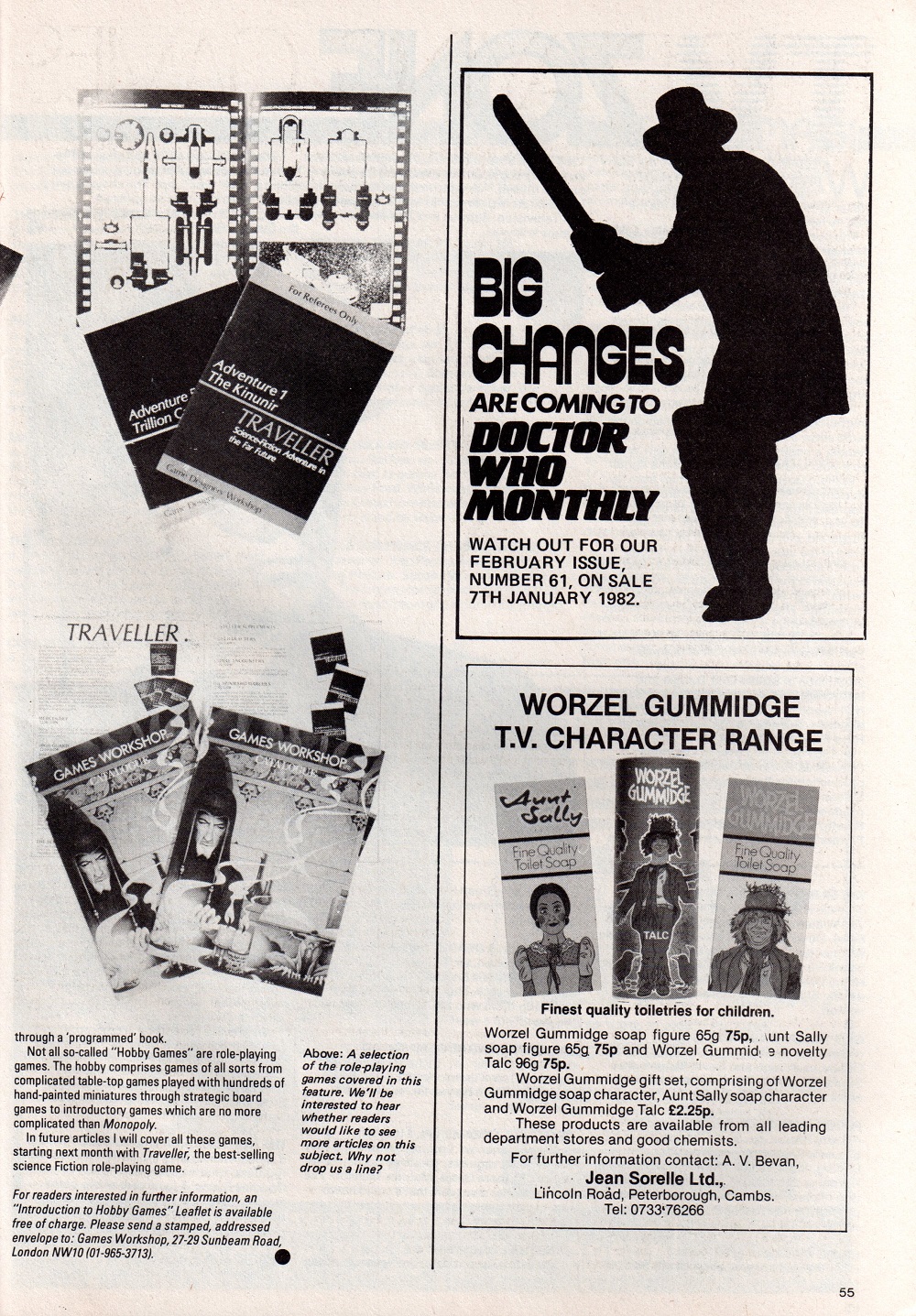
RPG Article 1981

RPG Article 1981-2

In the same Starburst, there’s an article (above) written by Steve Jackson introducing the concept of role-playing games. In his post, Starburst Memories: Tired of Reality?, Dirk talks about the impact it had on him at the time.

When I read this article back in 1982, everything seemed to click into place, and those mysterious games that sat in the corner of Boydell’s Toy Shop in Bolton, became a tantalizing gateway into a new world.

He also nicely describes the stark novelty of the hobby when it first appeared:

It is difficult to appreciate now how much of a conceptual leap it was to play a game that didn’t have a board. This was before Fighting Fantasy (choose your own adventure books), before Zelda, before Warhammer, before Total Warcraft and before Second Life. Most people are used to hypertextual narrative games, they are part of everyday life, but back in the early 1980s it took a leap of faith to move from Monopoly to playing mind-games with dice.

STAY TUNED: Dirk (a.k.a. Chris) has kindly agreed to participate in my Interview with a Geek series. I’m super excited about getting a non-American perspective on living life “with funny-shaped dice,” among other things.

(All images are courtesy Dirk Malcolm/Chris Hart)

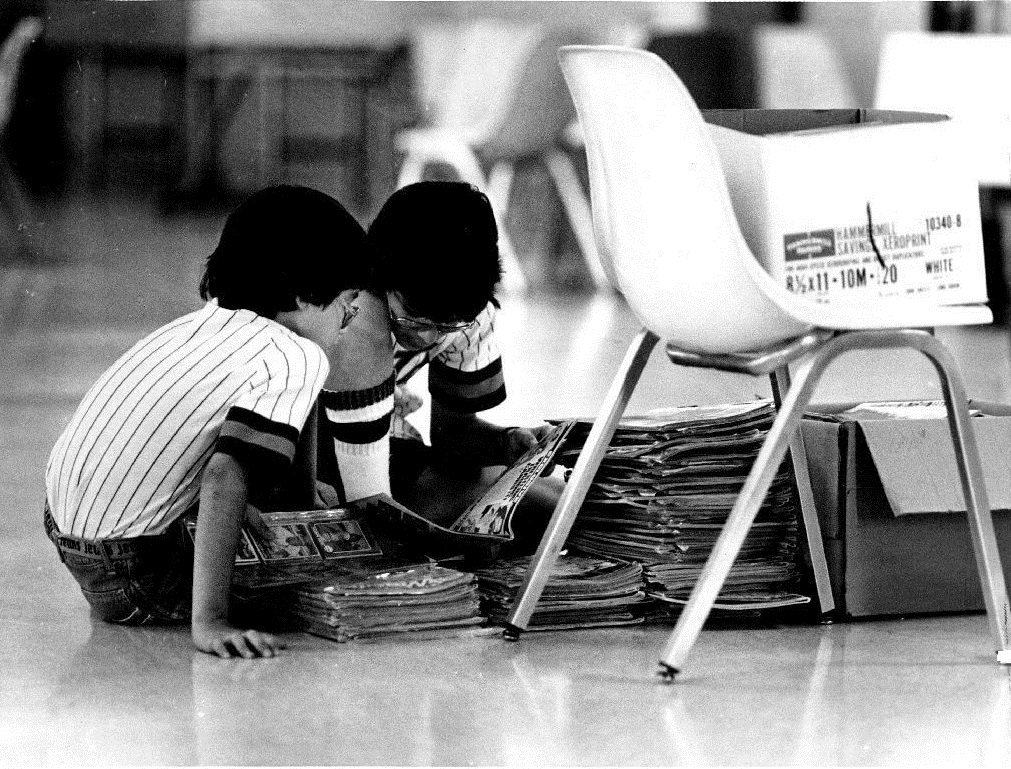
Boys Reading Comic Books, 1981

Boys Reading Comics 1981

Press photo: September 26, 1981

Looks like the kids are going to or coming from baseball practice. The collection they’re pulling out of the boxes is a mix of comics and magazines. The boy on the left is holding a sheet of baseball cards. I think the kid on the right might be reading Starlog.

(Photo via Big Ole Photos/eBay)

Fantastic Films Collectors Edition #20 (December, 1980): Interview with Chuck Comisky

FF CE #20 pg. 8

FF CE #20 pg. 9

FF CE #20 pg. 10

FF CE #20 pg. 11

FF CE #20 pg. 12

Chuck Comisky was the special effects supervisor on Roger Corman’s Battle Beyond the Stars (1980), a fun, clever sci-fi adaptation of The Magnificent Seven. His interview defines what was great about B movies when the people who made them had the integrity and talent to turn serious time and money constraints into lasting artistic triumphs, many of the productions outdoing their big budget counterparts. Here’s Comiski summing it up:

And what we’re doing is we’re substituting ingenuity, hard work, and a little bit of common sense for a big budget. When you don’t have money and you don’t have a big budget, it forces you to think creatively. You have to say, “How the hell are we gonna’ get the shot and make it look good: We don’t have any money to do it with.” So then you find yourself manufacturing some of your models out of greeting card racks and terrariums and developing systems… to avoid matte problems.

Comiski has some curt words for the first art director on the film, who “never took the trouble to look at the [spaceship] models and try to match up the interiors to the ships.” Comiski and his crew had to sort all of that out in addition to doing all the effects. The first art director was fired before shooting started and Comiski hired a replacement: James Cameron*. It was Cameron’s big break, and he went on to do some really brilliant work for other notable B features, including Escape from New York and Galaxy of Terror (both from 1981).

Comiski has great things to say about the visual effects in Star Wars, but he pans The Black Hole and Star Trek: The Motion Picture for being bloated and unimaginative—for substituting money for “creative imagination.”  Fantastic Films asks him if he would have done more elaborate effects if the budget had been bigger. “No,” he says. “If I had more money, the one thing I would do is pay my people more money.”

Cameron, after Titanic made all that money and won all those Oscars, would return the favor and hire Comiski as visual effects supervisor for Ghosts of the Abyss (2003) and, later, as 3D specialist on Avatar (2009). The irony is almost painful: Avatar is the most bloated sci-fi production in history, a textbook case of throwing money at effects to gloss over a hackneyed script. I won’t say it doesn’t look like shiny candy, or that it didn’t make a gazillion dollars, but I’d much rather rewatch Battle Beyond the Stars. It’s a superior film with, yes, better special effects.

_________________________________________

*In The Directors: Take One, Volume One (Ed. Robert J. Emery), Cameron says: “I was actually hired by the head of visual effects on a movie called Battle Beyond the Stars… Then they fired the art director because he wasn’t prepared… So I said, `Oh, I’ll do that.’ So I became the art director on the film.”

The Wikipedia entry on Battle Beyond the Stars reads, in part: “after the original art director for the film had been fired, Cameron became responsible for the special effects in Battle Beyond the Stars, or, as Cameron later put it, `production design and art direction.'” This is incorrect. Comiski was in fact responsible for special effects, which are not the same thing as production design or art direction.

Charles Breen appears to be the art director who was fired. Breen was assistant art director on, go figure, Terminator 2: Judgement Day.

(The first installment of Fantastic Films #20 is here.)

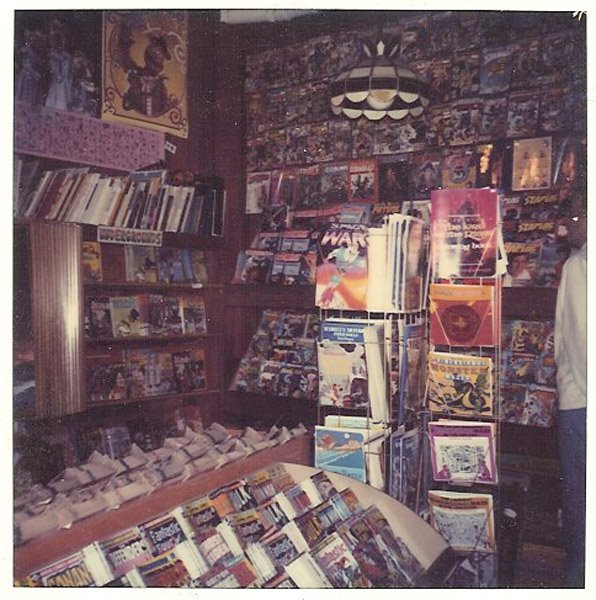
Comic Book Store, 1980

Comic Book Store 1980

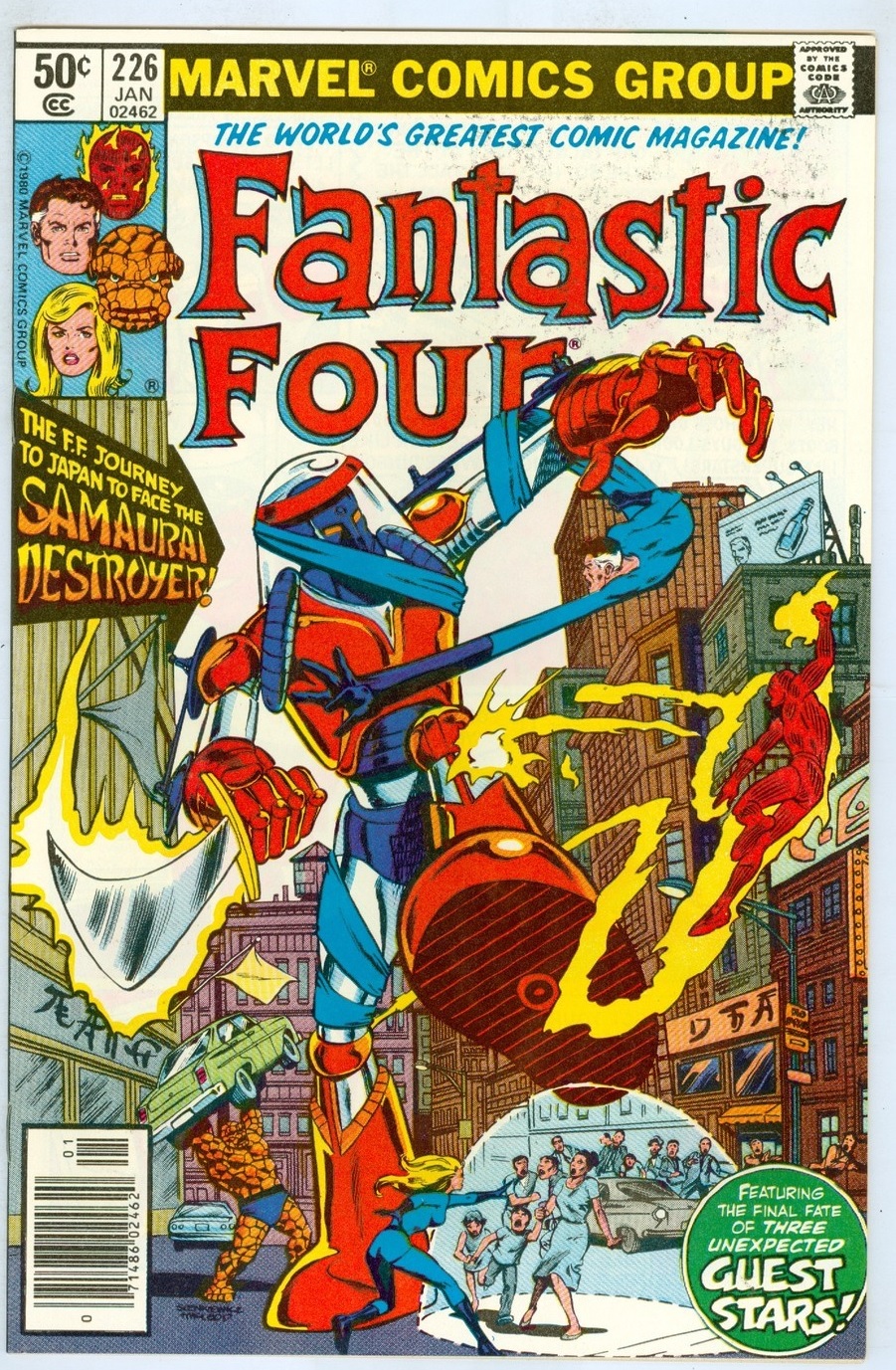
Another beautiful interior shot of a Bronze Age comic shop, this one from Flying Colors Comics. Let’s nail down the date. The best look I can get of the nearest comics is the Fantastic Four on the bottom shelf, three in from the far right. It’s FF #226, with a publication date of January, 1981. (Look for the hand of the Samurai Destroyer under the ‘sti’ of ‘Fantastic’.)

FF #226 Jan 1981

The newest book would be in full view, with back issues tucked behind it. Publication dates ran two to three months in advance, so we’re in October or November of 1980. Other than the FF, I spot Defenders #89 (pink cover) and, below it, #91 (yellow cover, same publication date as FF #226). Man, 1980. What a beautiful time to be a kid.

I’m not into DC, so I can’t identify any of the comics on the bottom rack in back of the store, but I do see, just to the right of J.R.R. Tolkien’s The Lord of the Rings Coloring Book (more on that in a sec) at the top of the spinner rack, Starlog #39 (October, 1980), with Gil Gerrard on the cover.

Starlog #39 Oct 1980

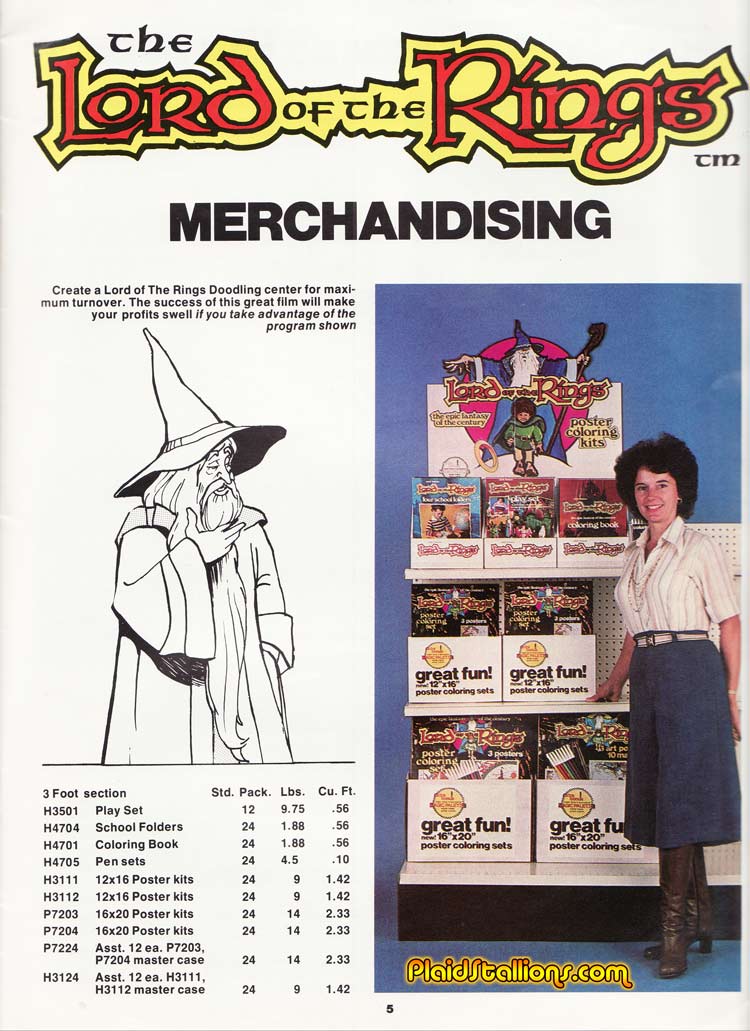
Now, the spinner rack. The LoTR coloring book was part of the promotional campaign for Ralph Bakshi’s 1978 LoTR adaptation, as you can see in this sweet catalog at Plaid Stallions.

LOTR Catalog 1979

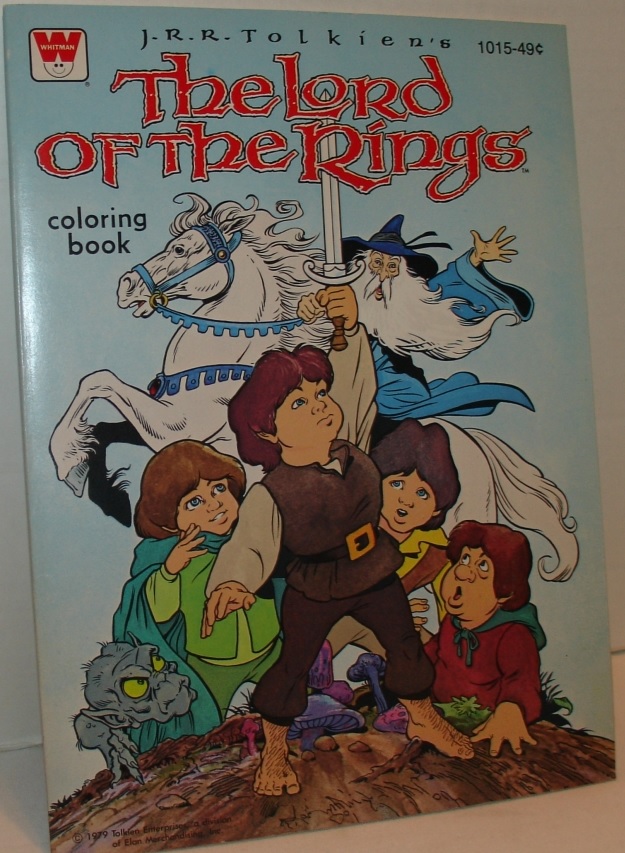
The version seen here (top right, by the weird lady’s head) and in the comic shop was originally published in 1978. An alternate cover version, seen below via eBay, came out in 1979.

LOTR Coloring Book 1979

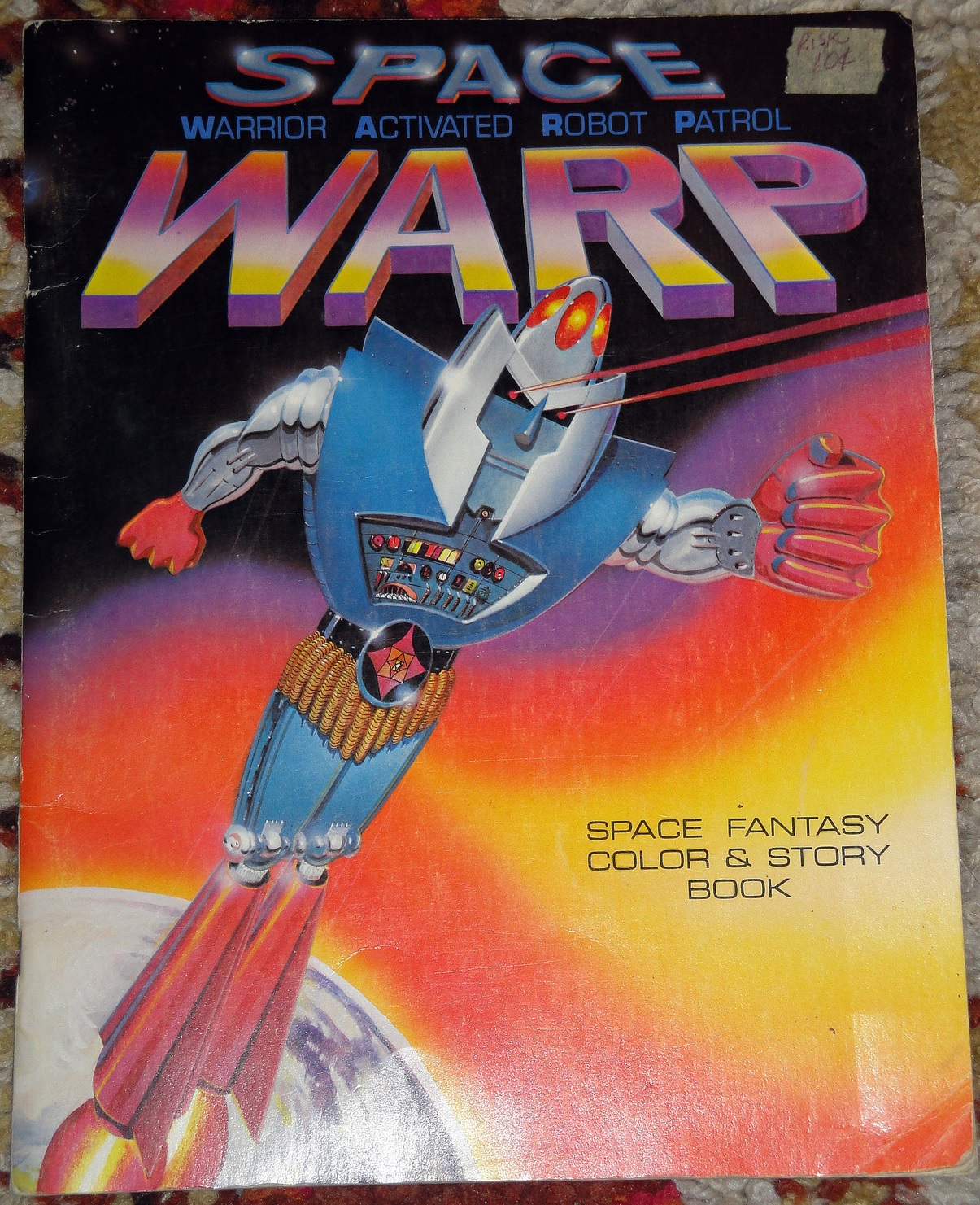
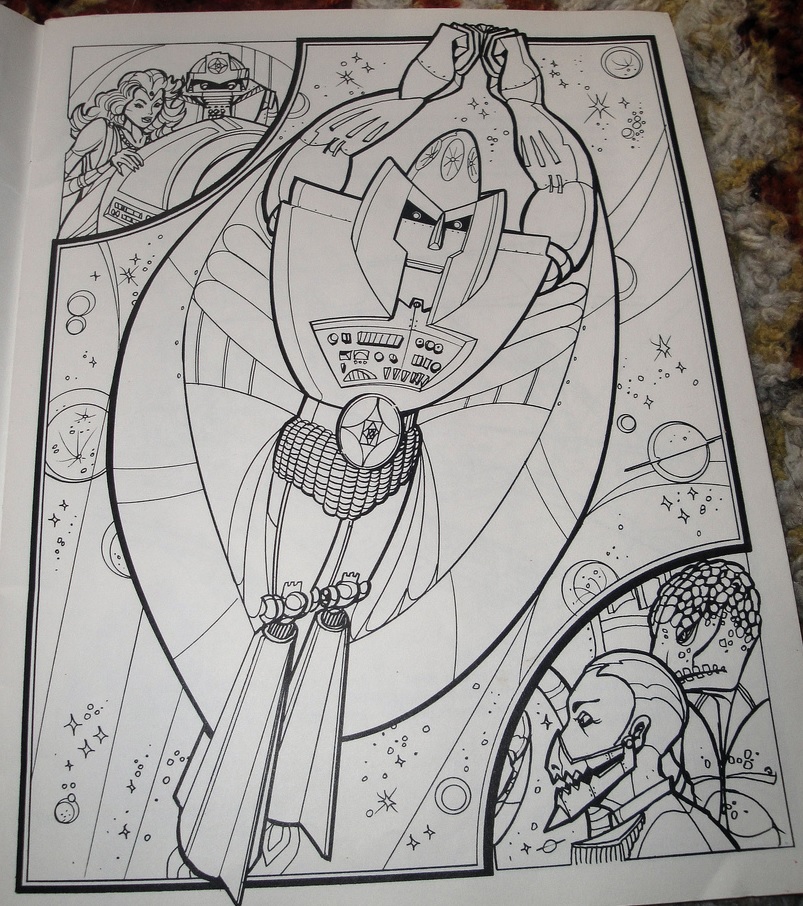
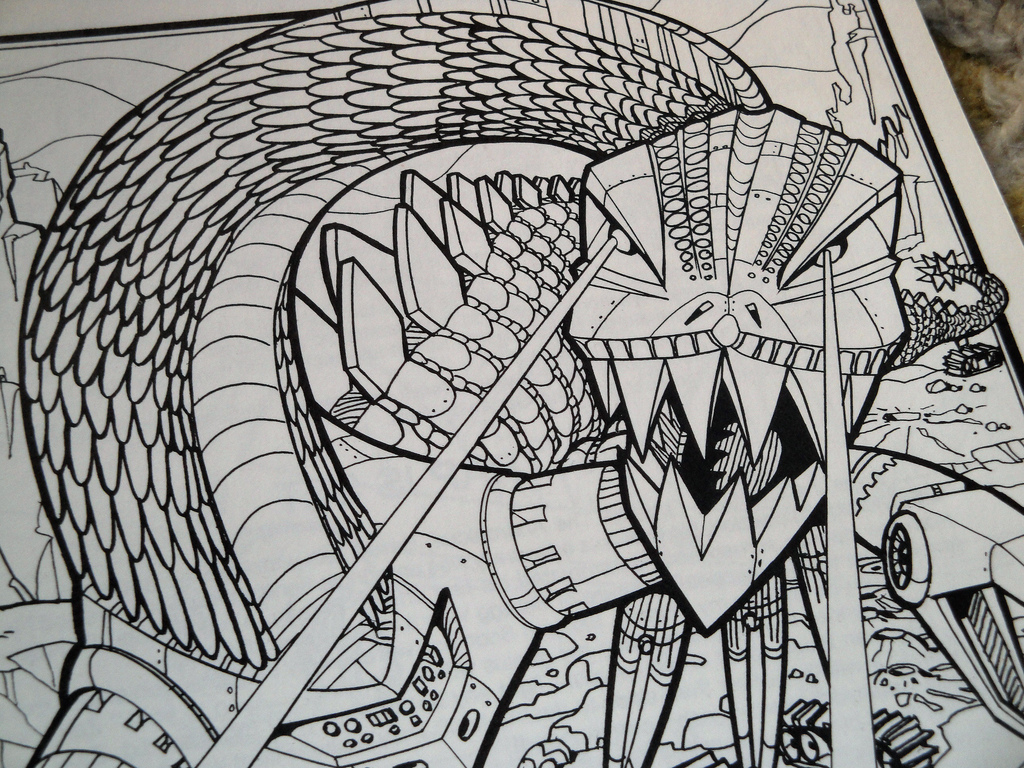
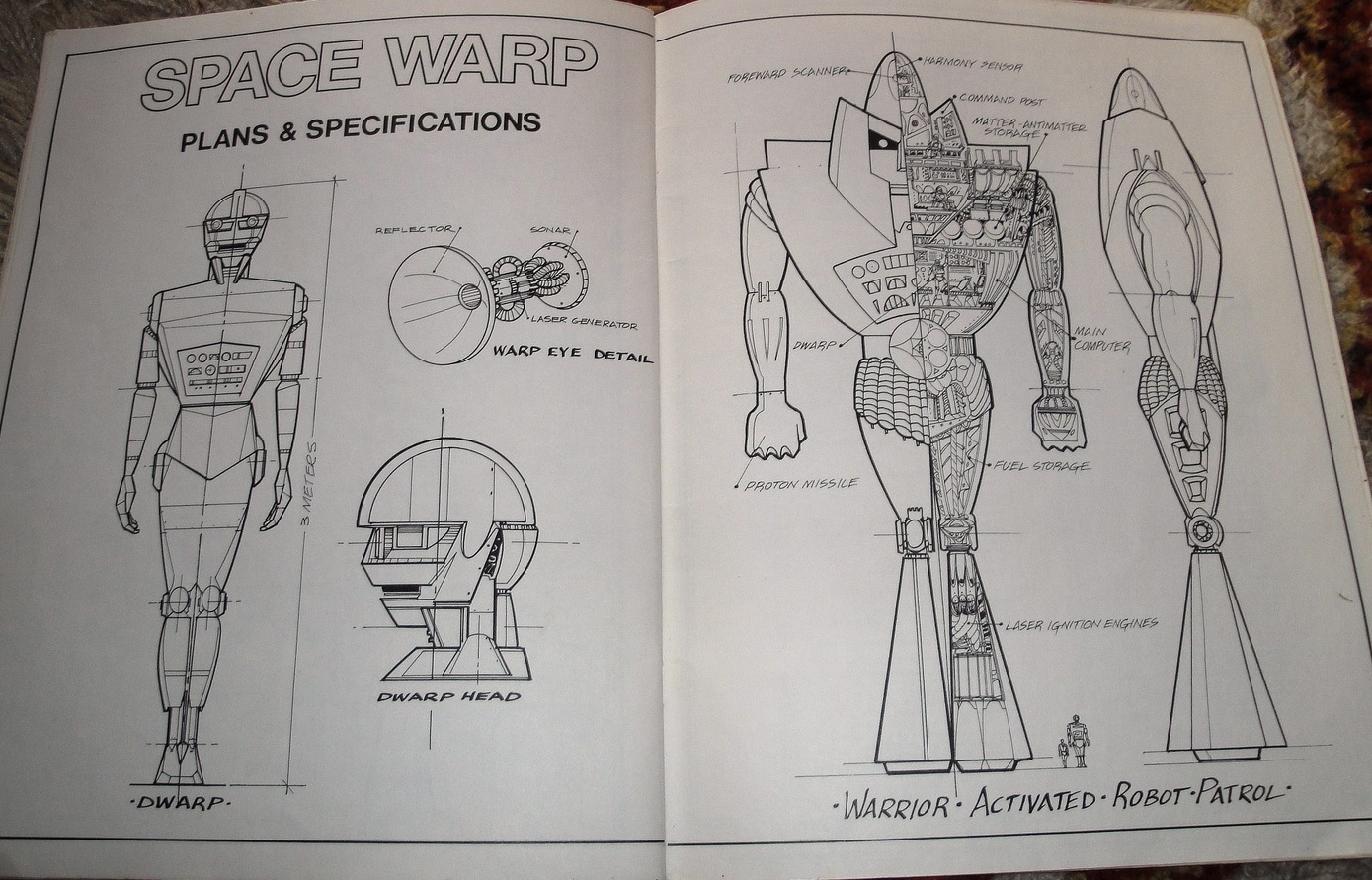
To the left of the LoTR book you’ll see what’s become a cult item in the pop art world: the Space WARP Space Fantasy Color & Story Book (1978), published by Troubador Press. I want it badly.

We have Philip Reed and Matt Doughty to thank for the pics. See more at Reed’s Flickr.

UPDATE (11/22/13): Malcolm Whyte, who ran Troubador Press for 30 years, spotted more Troubador titles on the rack: Maze Craze 4 is just beneath the LoTR book; Larry Evans’ 3-D Monster Mazes is just beneath that; and two different Evans 3-D Maze Posters volumes (“huge fold-out jobs and complex!” Malcolm notes) are beneath that.

Space Warp 1978

Space Warp 1978-2

Space Warp 1978-3

Space Warp 1978-4

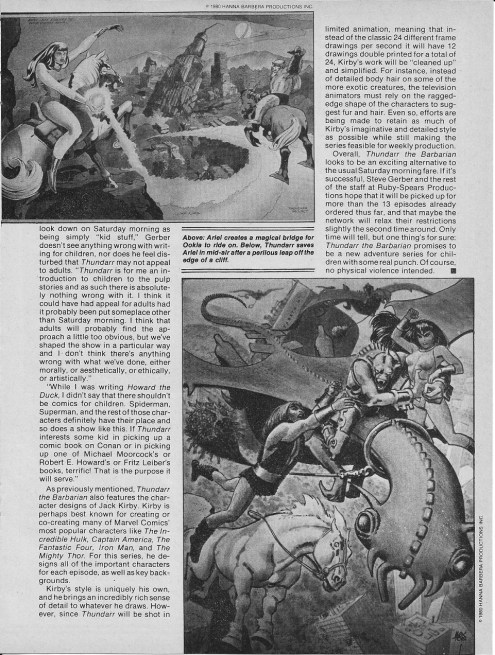
Fantastic Films #20 (December, 1980): Thundarr the Barbarian Article

FF CE #20 pg. 40

FF CE #20 pg. 41

FF CE #20 pg. 42

FF CE #20 pg. 43

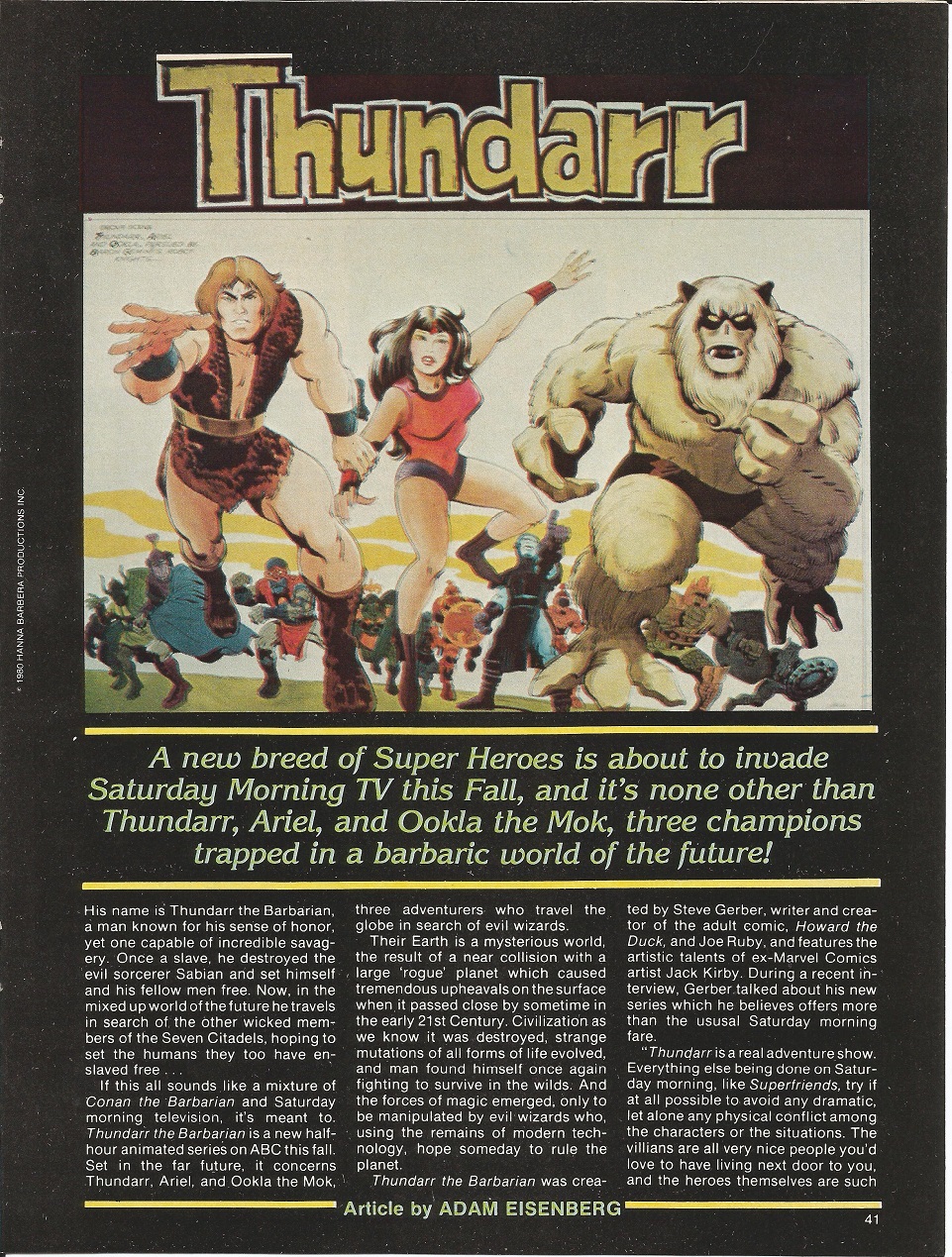
Thundarr the Barbarian is, hands down, the greatest American cartoon of the 1980s. Here’s why.

(1) In the opening sequence alone, set to the darkest, most epic cartoon theme song of all time, the Moon blows up, the Earth is ravaged by tidal wave, volcanic eruption, and earthquake—“man’s civilization is cast in ruin.” Then, 2000 years later, we see the “reborn” planet, now ruled by “savagery, super science, and sorcery.” (Yeah, super science.) A massive ocean liner, illuminated by the riven moon, sticks lengthwise out of the jungle muck into the fuming, noxious atmosphere. A masked wizard conjures up a slimy, Lovecraftian demon. Thundarr, a barbarian slave, “bursts his bonds” and vows to fight for justice, waving around his “fabulous Sunsword” from the back of a white steed. Ookla the Mok is a giant, foul-tempered raccoon with fangs and a mane. Princess Ariel is a bad-ass, raven-haired sorceress.

This ain’t Super Friends, kids.

(2) The show was and is a pretty sophisticated combination of literary (When Worlds Collide, Robert E. Howard’s Conan and Solomon Kane stories, Jack Kirby’s Kamandi) and cinematic/television (Star Wars, Planet of the Apes, Seven Samurai, Kung Fu, The Lone Ranger) sources. It also predates Escape from New York and The Road Warrior, two brilliantly realized post-apocalyptic visions that have been imitated (but never bested) ever since.

(3) Alex Toth (Space Ghost, The Herculoids) designed the three main characters, while Jack Kirby (‘Nuff said) designed the secondary characters, many of the sets and backgrounds, and the Sunsword.

(4) Like the early marvel creations of Stan Lee, Jack Kirby, and Steve Ditko, Thundarr is grounded in the Western mythic tradition. The idea of the wandering hero goes back to Odysseus and especially the knight-errant (errant, from the Latin itinerant, means “traveling”) of the Medieval romance. I don’t want to overstate the importance of a cartoon about a barbarian wearing a fur monokini, but there is something of the heroic in the series, as Thundarr and his friends somberly wander the festering ruins of America seeking out the dispossessed and persecuted. Nothing lasts forever, they know, and danger is everywhere, but they choose to do what good they can with the time they’ve got.

The article above features some dazzling pre-production art from Kirby and Toth, and Thundarr co-creator (with Joe Ruby) Steve Gerber comes off as a really intelligent, quick-witted guy who is struggling to overcome serious creative restrictions. I didn’t know just how strict the censors were at the time, so I’ll quote him on it:

The Program Practices will still not allow our main character to throw a punch or to hit anybody… The criteria seems to be what children can emulate. If Thundarr sticks out his foot and trips a couple of werewolves, that’s emulable… If, on the other hand, Thundarr picks up a boulder and throws it in the path of the werewolves, thereby tripping them up, that’s not emulable, and we’re allowed to do that…

The big thing that we’ve had to overcome is that the censors tend to treat children as if they’re not just morons, but lunatics, potentially dangerous creatures.

And Thundarr’s sword posed a problem, since “knives and other sharp objects are outlawed on Saturday morning.” (The last drawing on the first page shows our hero holding a metal sword.) They couldn’t do a laser sword because of Star Wars, so they went with a “lightning sword.” I had just assumed all these years that they were trying to emulate the lightsaber.


Pages

Archives

Categories

Donate Button

Join 1,117 other subscribers