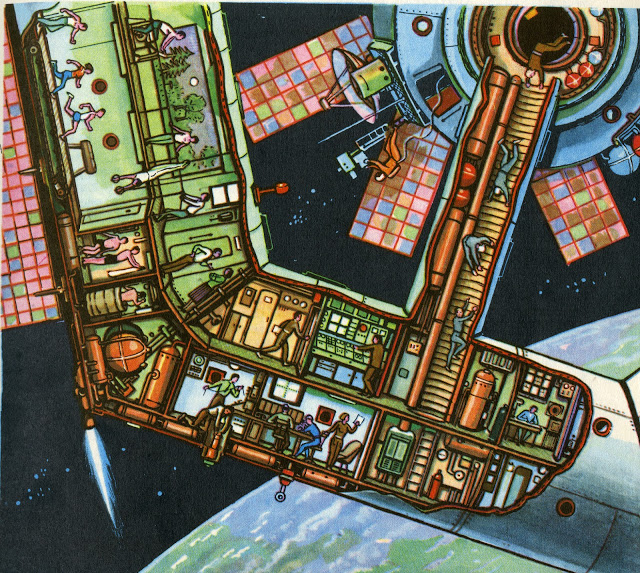
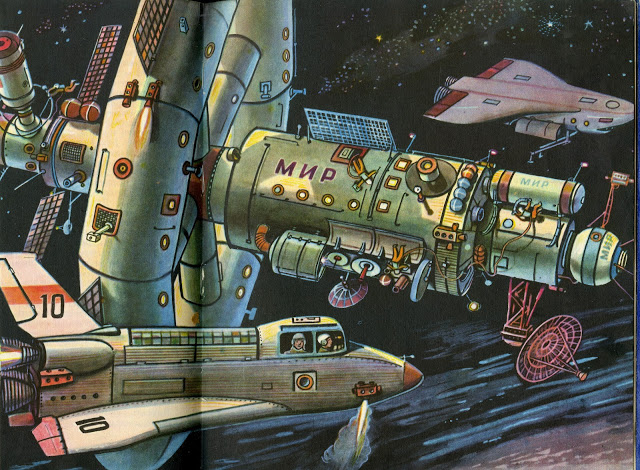
Just a few unmissable selections from various Russian children’s books from one of my favorite websites, Dreams of Space.
Archive for the 'Sci-Fi/Space Art' Category
Cold War Russian Space Art
Published January 23, 2013 Sci-Fi/Space Art , Space Race , Space Travel/Exploration Leave a CommentTop Trumps Spacecraft Cards
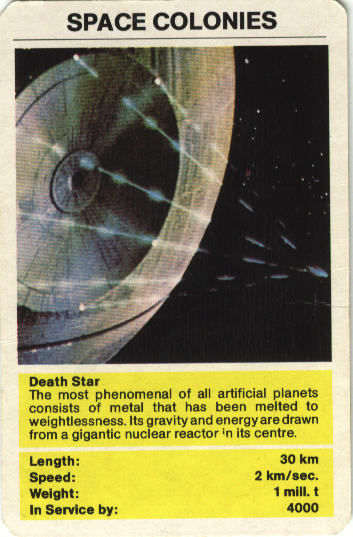
Published January 21, 2013 Battlestar Galactica , Sci-Fi/Space Art , Star Wars (Original Trilogy) , Trading Cards Leave a CommentFascinating West German cards from about 1980. I’ve seen them on eBay/UK before, and I’m assuming they were big with the Star Wars kids across the pond. The spacecraft represented are an odd mix of sci-fi and sci-almost-fact, and the descriptions are priceless.
The speed of the Yavin Interceptor, to be in service by the year 4000, is 25 km/sec, but the speed of the Apollo Lunar Module Eagle, in service as of 1972 (how about 1969, when it actually landed on the moon), is “unknown.”
The Cyclon [sic] Raider is “super-fast,” the Colonial Viper can “change direction without turning around,” the Death Star “consists of metal that has been melted to weightlessness,” etc.
See the entire 32-card set at The Pointless Museum, where I grabbed the images above.
The Space Art of Robert McCall
Published November 6, 2012 Robert McCall , Sci-Fi/Space Art , Space Race , Space Travel/Exploration Leave a CommentRobert McCall, who passed away at age 90 in 2010, was NASA’s “visual historian” for almost 40 years. He was also a prolific painter of exquisite, utopian visions like those seen above.
McCall did the artwork featured on the unforgettable theatrical poster for 2001: A Space Odyssey. He also did production and conceptual art for Star Trek: The Motion Picture and The Black Hole. Below (via subnutty/Flickr) is a rendition of the control tower of the Centaurus. The name of the great ship was changed to the U.S.S. Cygnus for the film.
Here are two more beauties. The first one is a six-story-tall mural that appears at the National Air and Space Museum in Washington D.C. The second is a mural called The Prologue and the Promise that was featured at the end of an Epcot ride called Horizons.
Horizons, similar to Disneyland’s Carousel of Progress, was closed and dismantled in 1999 to make way for Mission: SPACE, “a motion simulator thrill ride that opened on October 9, 2003.” It is unclear what happened to McCall’s mural in the process.
Read more about the man and his work here. Do not miss the interactive gallery.
Erik Bergaust’s The Next 50 Years on the Moon (1975)
Published September 17, 2012 Books , Sci-Fi/Space Art , Space Travel/Exploration , What the Future Looked Like Leave a CommentAccording to the book, by 2015 trips to the moon will become “as routine as an ordinary supersonic airplane trip.”
Check it out in detail at Dreams of Space (part one, part two, and part three), a brilliant site dedicated to vintage non-fiction books and ephemera about space flight and space colonization.
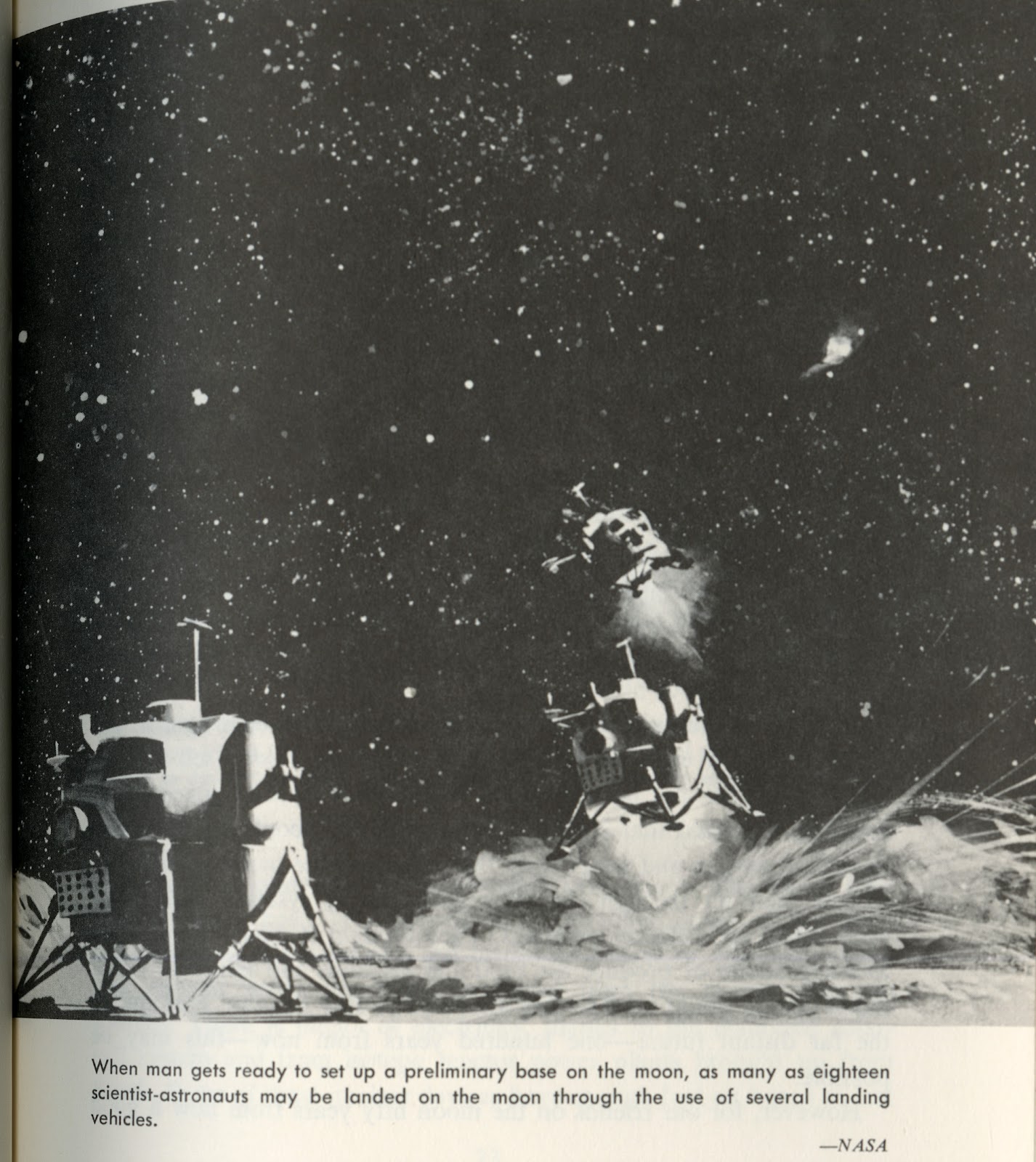
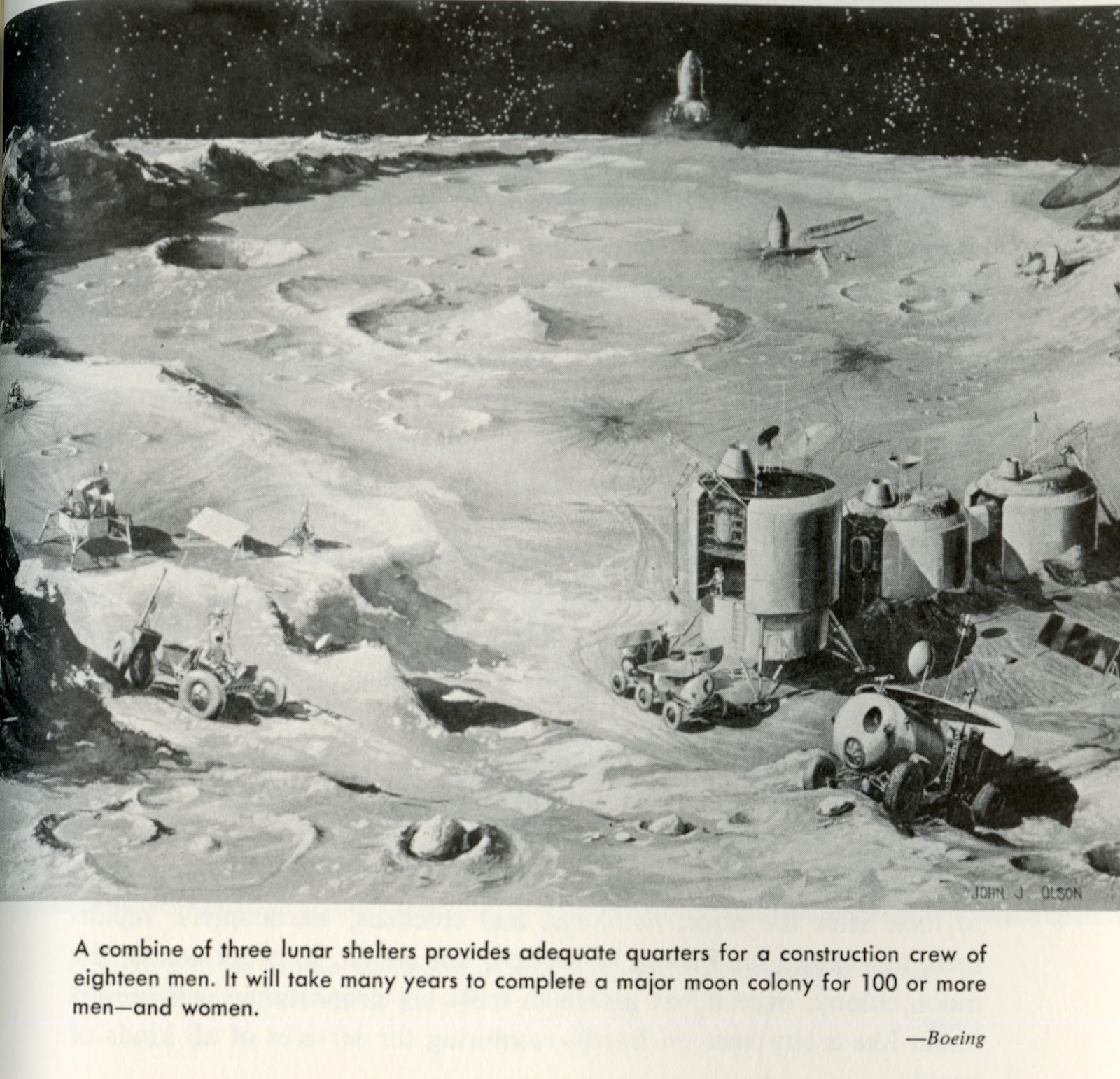
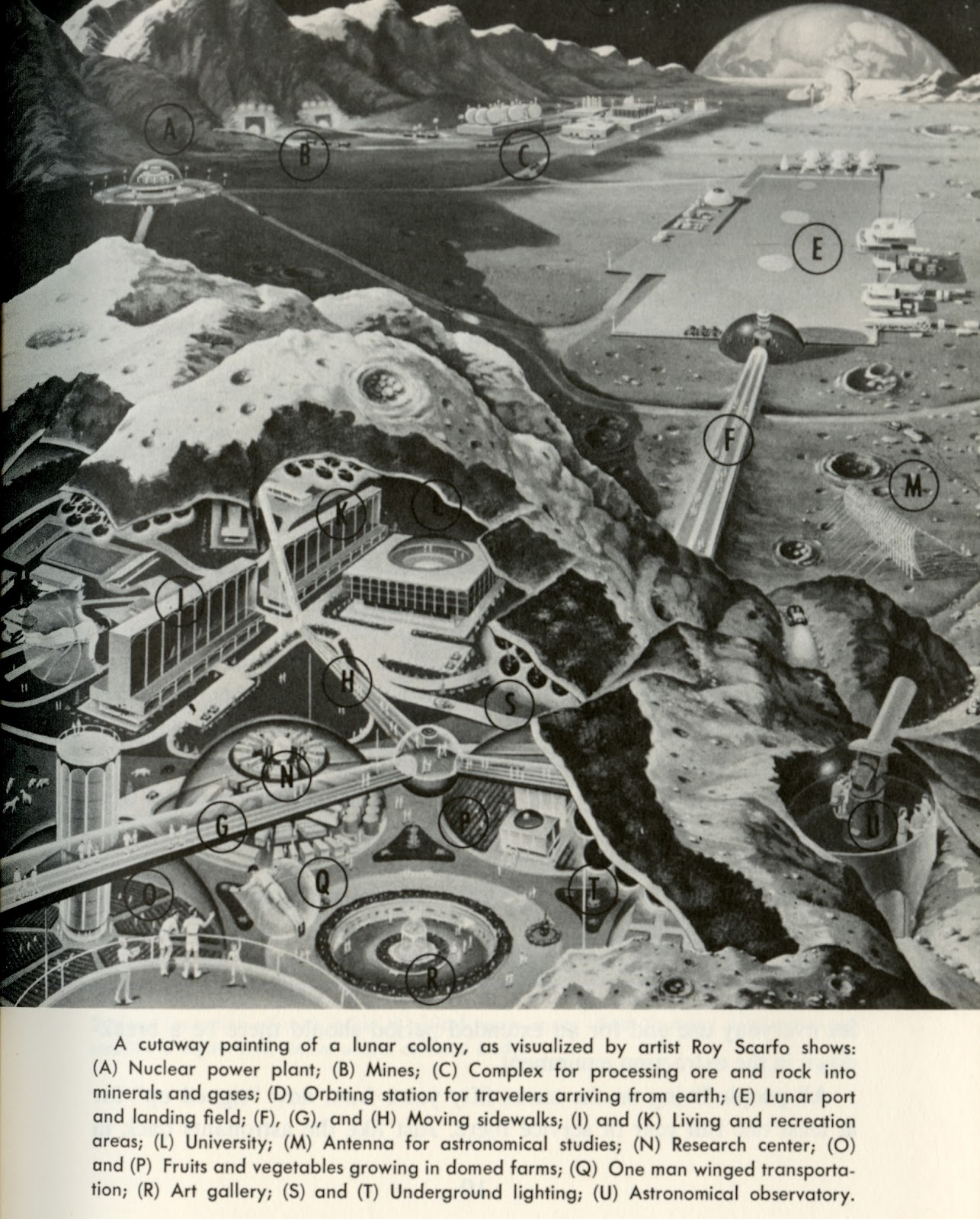
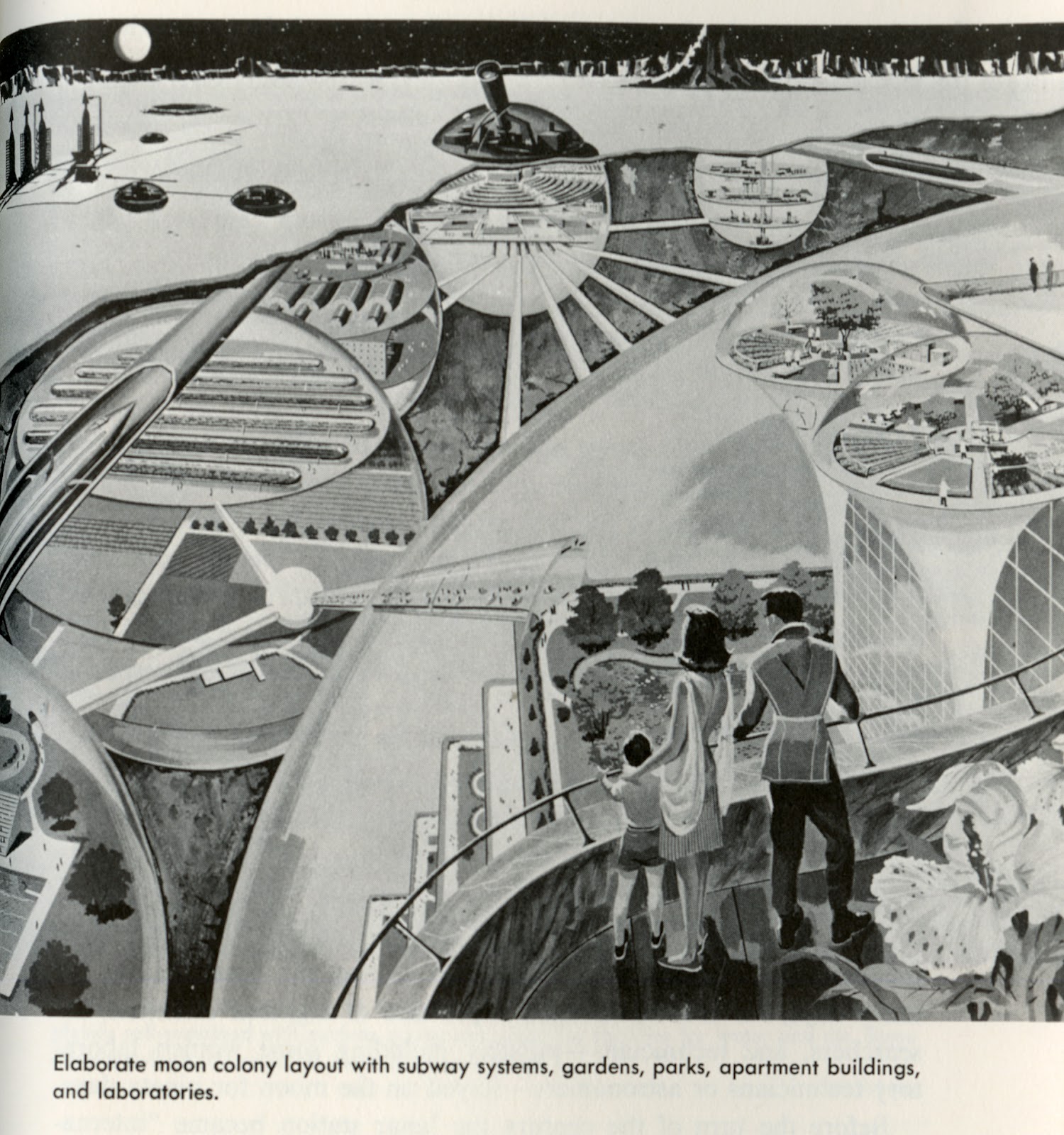
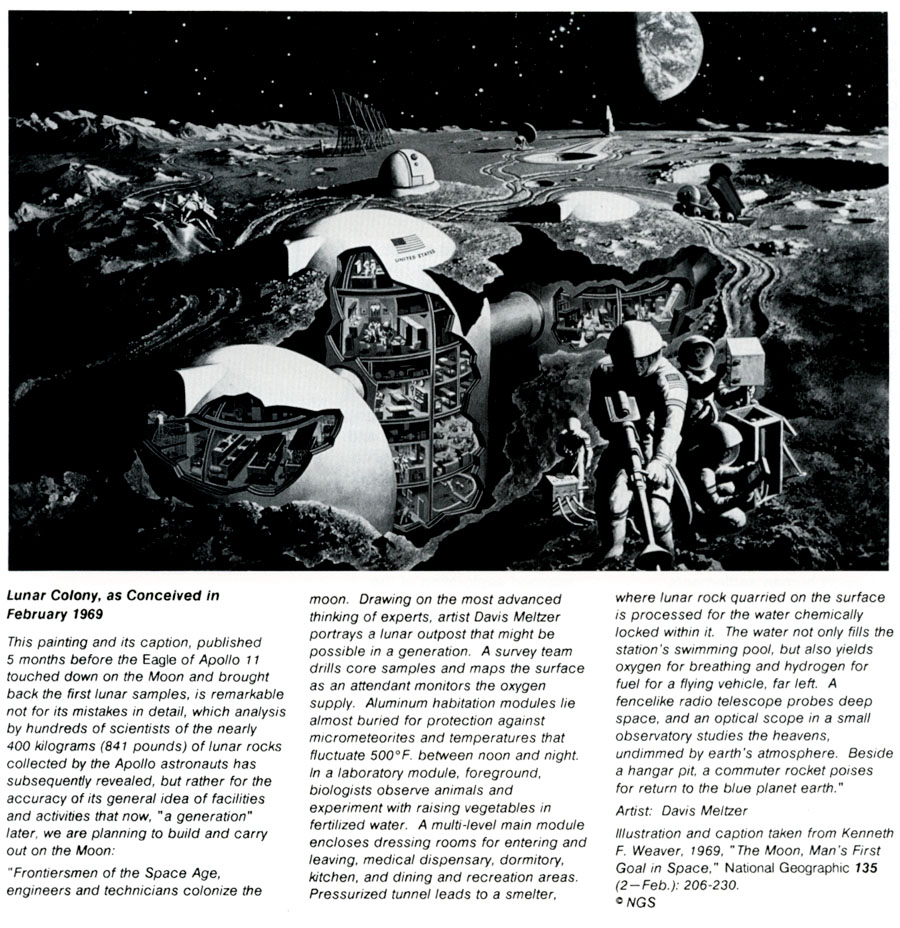
Dreams of Lunar Outposts
Published September 1, 2012 Sci-Fi/Space Art , Space Travel/Exploration , What the Future Looked Like 1 CommentThe illustration above was taken from a 1969 National Geographic story (“The Moon, Man’s First Goal in Space”) and used in a NASA report on space resources developed in 1984 and published in 1992. Below is a 1985 depiction of the advanced lunar base we’re supposed to have by 2015. Dennis Davidson is the artist.
Mars, ’50s Style
Published August 6, 2012 Sci-Fi/Space Art , Space Travel/Exploration , What the Future Looked Like Leave a CommentIn honor of the Curiosity Rover’s successful Mars landing, I give you these awesome shots from a series on space exploration that ran in Collier’s Magazine from 1952 to 1954. Get more pics and details of the series at Paleofuture, my new favorite blog.
T.A. Heppenheimer’s Colonies In Space (1977)
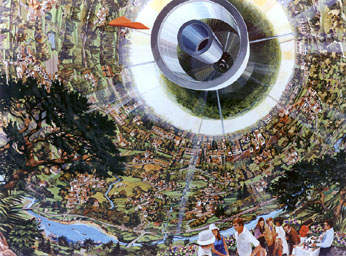
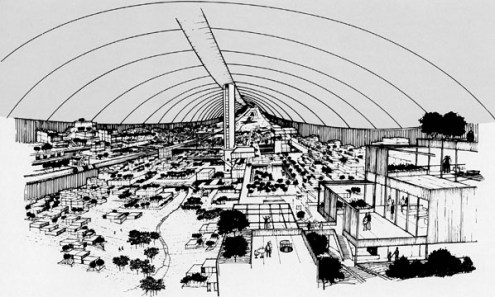
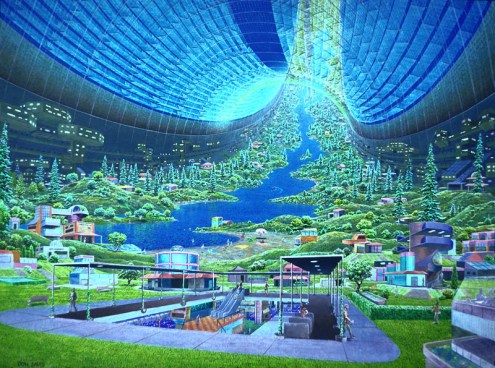
Published July 9, 2012 Books , Don Davis , Sci-Fi/Space Art , Space Travel/Exploration , What the Future Looked Like 6 CommentsAs I was searching eBay for all the Ray Bradbury books I read as a kid and somehow lost, I discovered this little gem, for which Bradbury provides an introduction. In 1969, Princeton physics professor Gerald O’Neill, “concerned over student disenchantment with science and engineering,” started seriously discussing space colonization with his brightest freshman students. He asked them, “Is the surface of a planet really the right place for an expanding technological civilization?” After much back and forth about atmosphere and energy requirements, “They concluded that the surface of a planet was not the best place for a technical civilization. The best places looked like new, artificial bodies in space, or inside-out planets.”
They kept at it. The ideas were discussed at a conference at Princeton, studies were conducted, and in 1975 O’Neill got a grant from NASA “to work full-time on space colonization.” That same year O’Neill testified before the space-science subcommittee of the House committee on science and technology, and the U.S. Congress increased NASA’s budget by 25% “to lay the foundation for advanced projects, such as moon bases and orbital colonies.” (Did you know there was a House Committee on Science, Space, and Technology? If not, don’t blame yourself.)
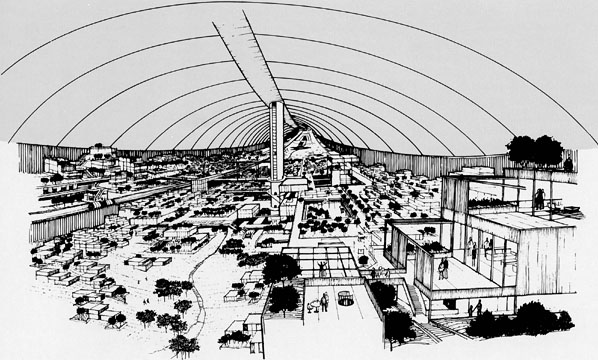
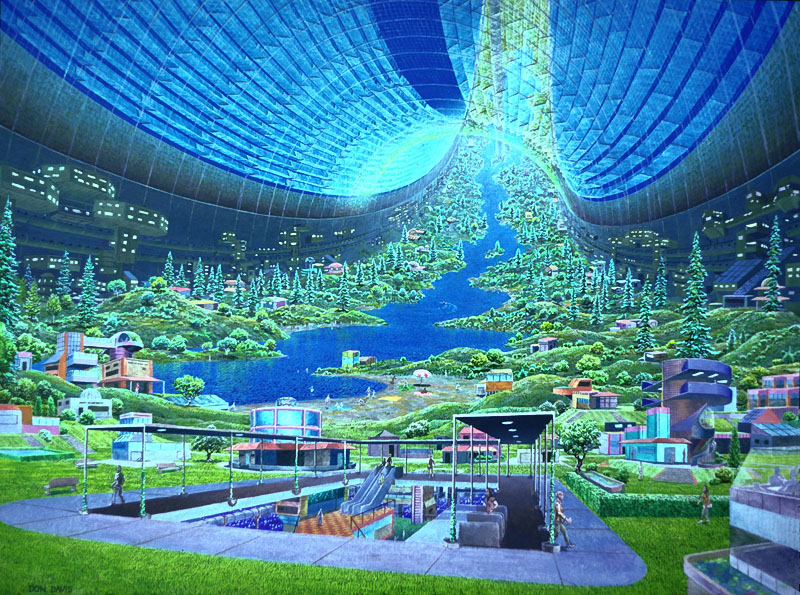
The book is absolutely fascinating, and lucky for us the whole thing is available online at The National Space Society, “an independent, educational, grassroots, non-profit organization dedicated to the creation of a spacefaring civilization.” Below are some of the amazing paintings and drawings included in the book (from Chapters 8, 10, and 15). The captions are exactly as they appear at the NSS. Also be sure to check out the Color Plates and all the beautiful Don Davis paintings in Chapter 15.
Thank you, NSS!

“Bernal Sphere” design for a space colony. The sphere is the central structure; the structure resembling coils of hose are where agriculture is conducted. The disks at either end are radiators for waste heat. (Courtesy NASA)
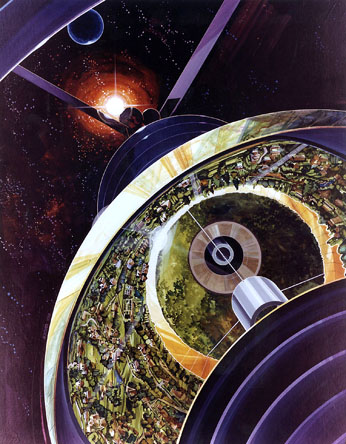
Cutaway view of “Bernal sphere” type of space colony. Some 10,000 people would live and work in the central sphere. A separate area, exposed to the intense sunlight of space, would be set aside for growing crops. (Courtesy NASA)