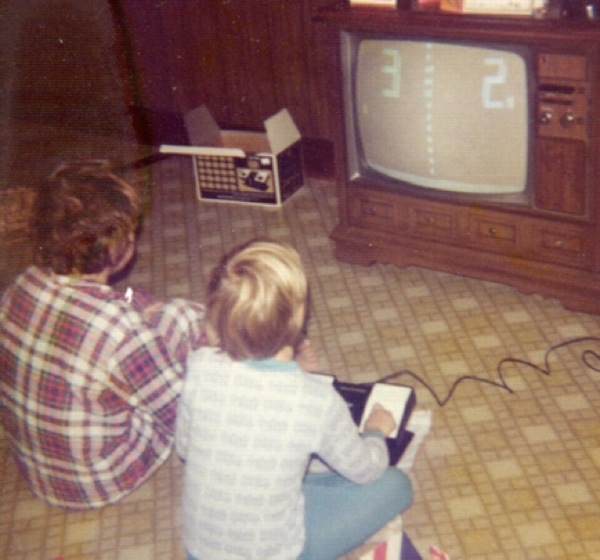
The first photo comes from DudesLife and shows the brothers playing the first commercial home version of Pong, the Sears-exclusive “Tele-Games” Pong.
In the second photo, via Michael Schroeder, dad and son play what looks like Atari’s C-100 Pong, released in 1976. (Pat Schroeder, seen in the poster on the wall, was the first woman from Colorado to be elected to Congress.)
The shot below (source unknown) shows the Super Pong (C-140) box on a Christmas morning in ’76 or ’77. Super Pong featured four games, while the other versions played only one. Compare all the versions at Pong Story.
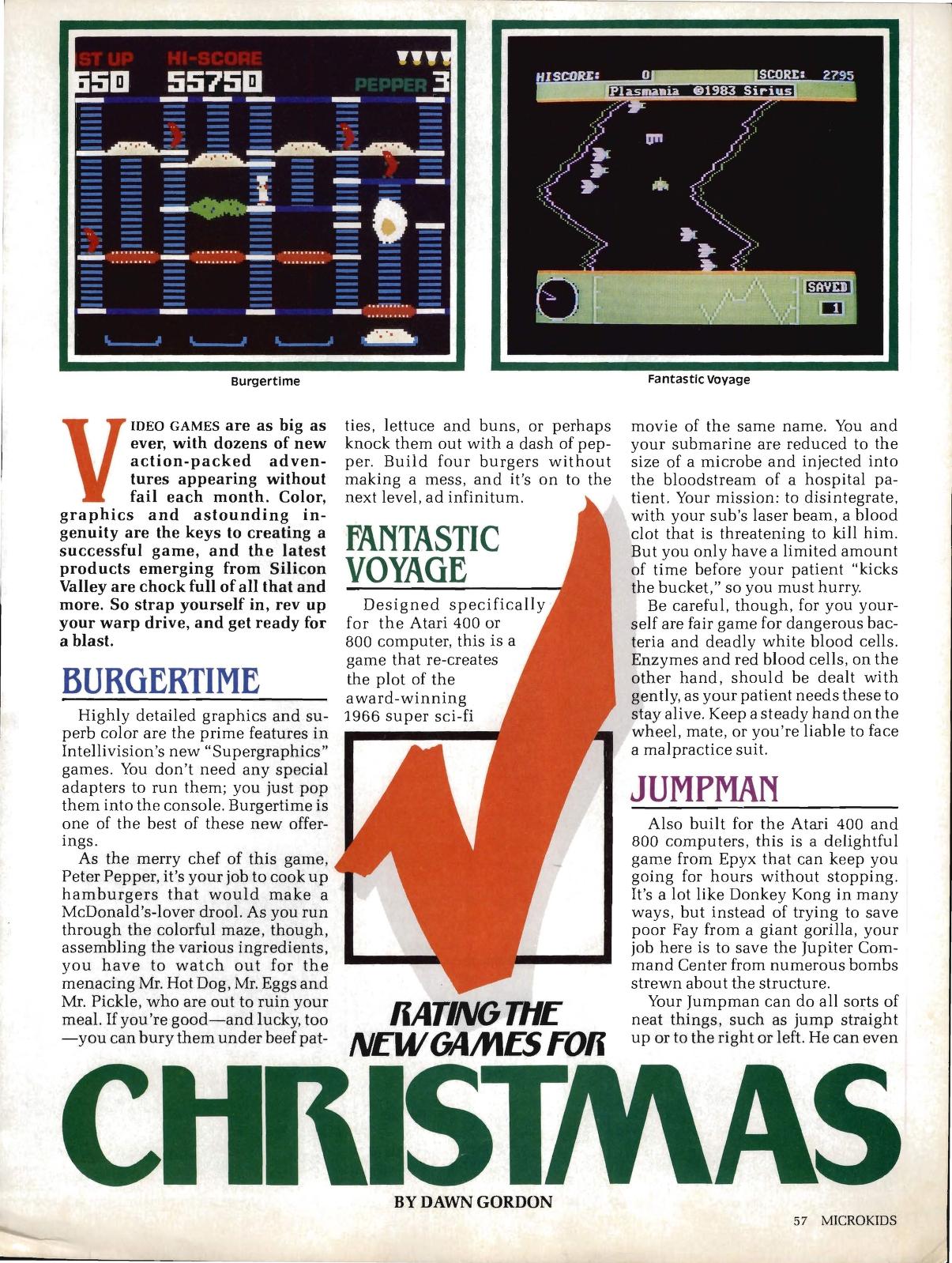
I know, I know. Your PS4 offers not games but “immersive experiences” that blur the boundary between fantasy and reality, creator and creation. I think that’s really cute! Now, how many screens can you clear on BurgerTime with three chefs, three shakes of pepper, and no way to save your progress?
Select pages only. I didn’t remember how unwaveringly creepy the Cabbage Patch Kids were/are until the catalog jogged my memory. The “anatomy” lesson seals the deal.
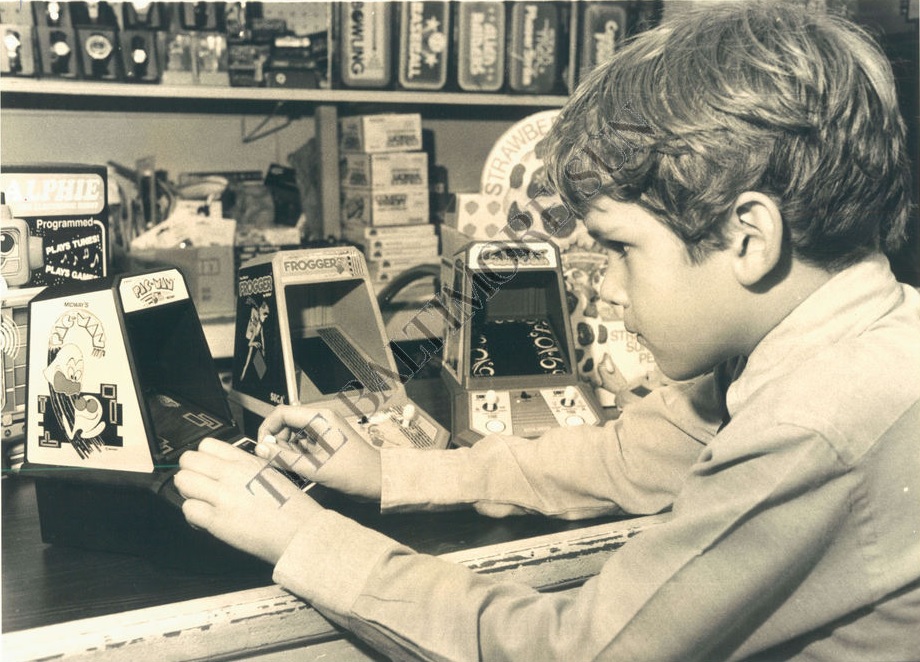
The Coleco tabletop arcade games were at the top of every kid’s holy grail list. Other handhelds were good, even great, but these looked like actual cabinets and you could take them anywhere, especially to school where the other kids (and some adults) followed you around like so many hungry puppy dogs. It didn’t really matter that the screen was so tiny—the idea that you had a real arcade at your fingertips melted the logic circuits. We had some sort of fundraising drive at my elementary school in ’82, and the grand prize was either the Coleco Galaxian or Pac-Man. The number of chocolate bars one had to sell to get the thing was impossibly large, but I have very tangible memories of knocking on doors around the neighborhood all day long with dreams of that little machine dancing in my head. It was not to be, but I did get my beloved Atari 800 shortly thereafter.
The E.T. Rider? No, Coleco. No.
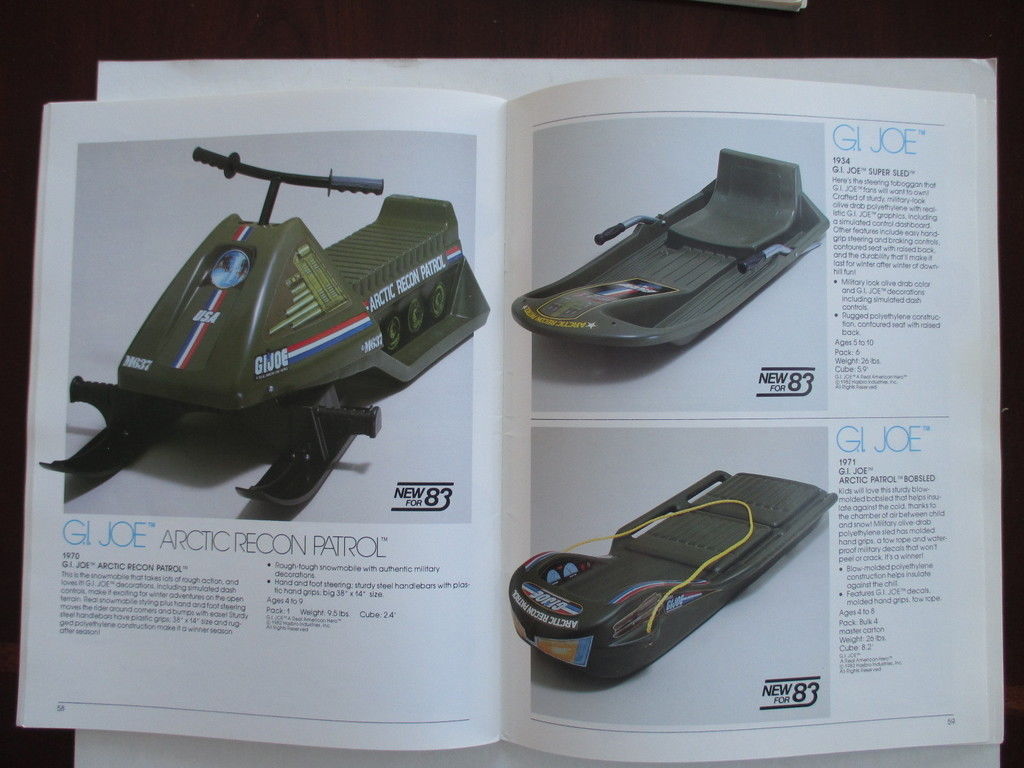
The G.I. Joe Arctic Recon Patrol? Yes. Very much yes.
I talked about Atari Adventure, or Atari Video Adventure, here and here. According to Atari, the centers would be “the premiere showcase for the newest innovations in computer learning and video excitement.” There were less than ten locations across the U.S., at least one of them a straight up arcade at the Disneyland Hotel. It was a costly, ambitious enterprise that lost steam after Atari’s E.T. the Extra-Terrestrial debacle (Christmas, 1982) that partially launched the video game crash of 1983.
The footage includes quite a bit of concept art I haven’t seen, and I love the line: “Atari is dedicated to exploring the human frontiers of high technology.” Nolan Bushnell once referred to his business as “leisure applications of technology,” another nice phrase that’s become an overriding preoccupation of the first world.
Parts of the video were taken from another Atari promo from 1981 called “Inside Atari: The Next Decade” (below). I like the intro about the importance of games reflecting the “politics, the wars, the economic systems of the societies that create them”—narrated over some artsy footage of two white dudes in suits playing Go, an ancient Chinese strategy game.
Full instructions at Atari Age. Here’s the synopsis:
A homicidal maniac has escaped from a mental institution. On Halloween night, the killer returns to his home town to wreak havoc! You are babysitting for a family in a large, two story house. Somehow the vengeful murderer has gotten inside! Can you protect the children and yourself from the fury of his knife?
Gameplay:
You control the babysitter character, and, at certain times, the child characters. As you move through the sixteen rooms of the two story house, avoid the killer when he appears. He will attempt to stab you and the children, so look for the knife with which to defend yourself.
Jack-o’-lantern icons at the top of the screen tell you how many lives you have left. Play the game at the Internet Archive.
The photos are from a 1982 Miami Herald story and show Adams inside and outside Adventure International’s Longwood, Florida headquarters. According to an interview I found in Antic, Adams moved into the “custom-built geodesic dome” in 1979. By summer of 1983 Adventure International had 40 employees and, according to The Free Lance-Star, was a “multi-million dollar company.” Many of Adams’ classic games appear in the second photo, including Adventureland.
The boys performed—I use the term loosely, as I don’t believe the cords on those instruments or that microphone are plugged into anything—on Solid Gold later that day: March 20, 1982.
It should not surprise you that R. Cade and the Video Victims only made the one album. Why not subject yourself to the whole thing on Spotify, like I did? R. Cade & The Video Victims – Get Victimized.
It’s not Arcade and the Video Victims, mind you. It’s R. Cade and the Video Victims. Get it?
“Video magic, you were there all the while. Put my quarter in, and you made me smile. Whoa-oh-oh-oh ah…”
If you own the copyright to any of the material on this site and would like said material to be removed, please contact 2warpstoneptune [at] gmail [dot] com.










 2 Warps to Neptune