

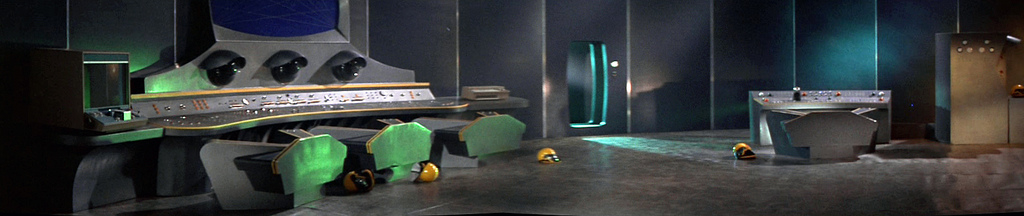
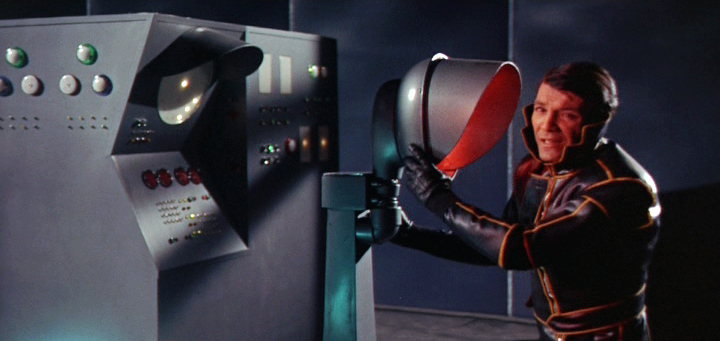
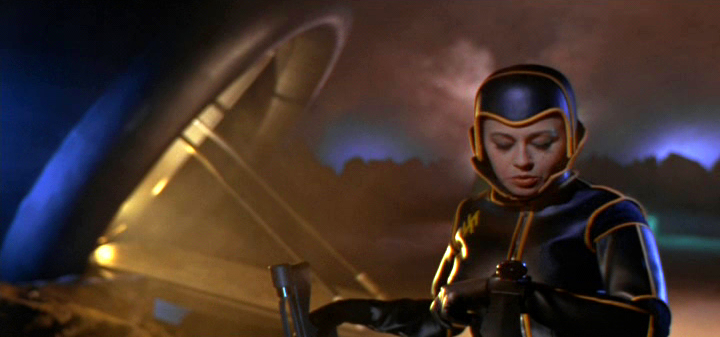


(Images largely via Dallas1200am’s Flickr, but a few shots are from Behind the Couch and Bloody Pit of Rod)
Surveying the Gen X landscape and the origins of geek
(Images largely via Dallas1200am’s Flickr, but a few shots are from Behind the Couch and Bloody Pit of Rod)
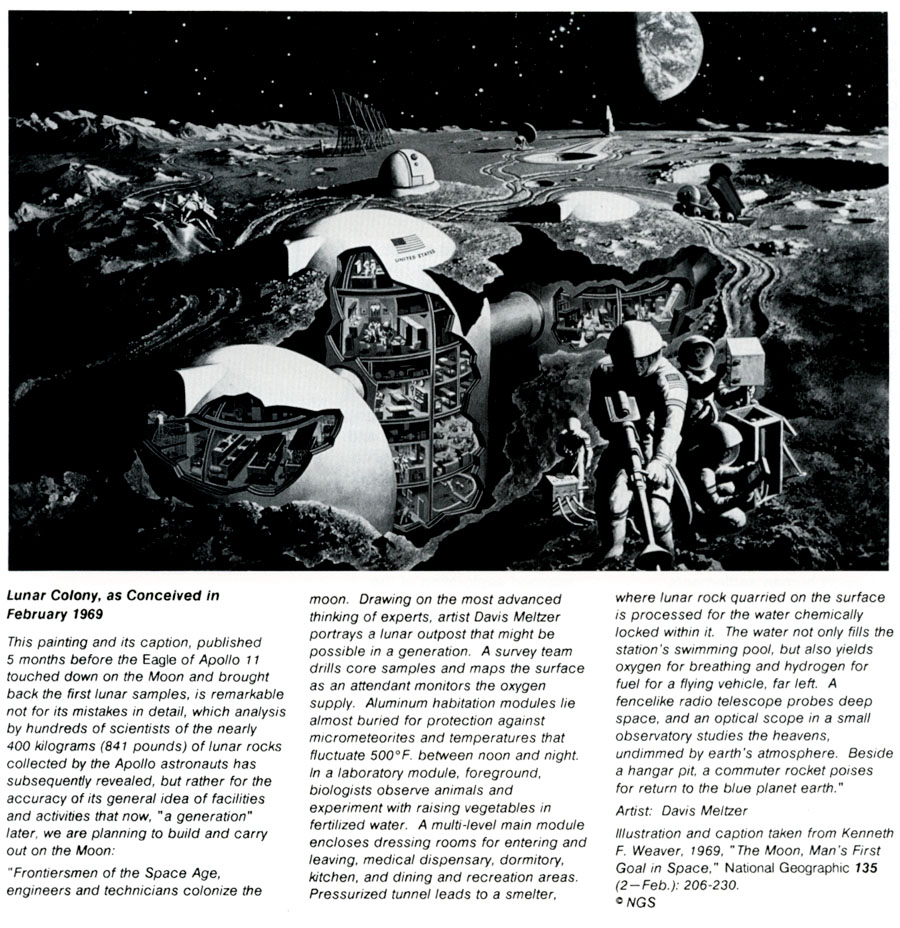
The illustration above was taken from a 1969 National Geographic story (“The Moon, Man’s First Goal in Space”) and used in a NASA report on space resources developed in 1984 and published in 1992. Below is a 1985 depiction of the advanced lunar base we’re supposed to have by 2015. Dennis Davidson is the artist.

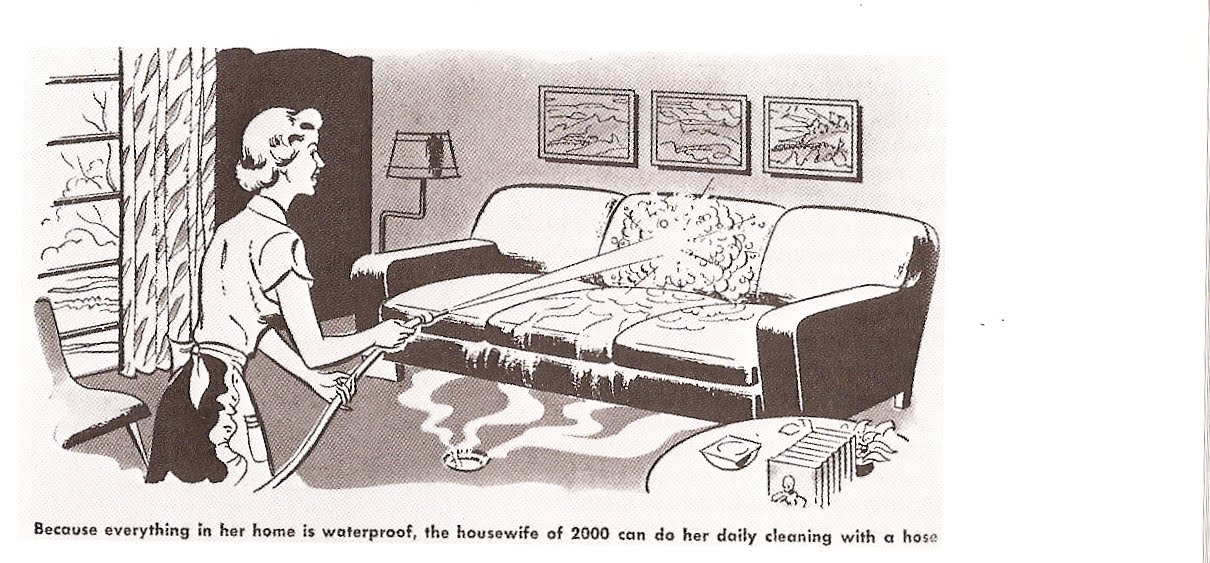
This is an illustration from a book I’d really like to get my hands on, Yesterday’s Tommorrows: Past Visions of the American Future. Written by Smithsonian curators Joseph Corn and Brian Horrigan as an accompaniment to a 1984 exhibit of the same name, Paleofuture’s Matt Novak calls it “the retro-futurism bible.”
What’s hilarious about so many of these conceptions is, of course, the idea that we would have—that we should have—great technological advancements while maintaining a social backwater in which white men make all the decisions and women are domestic slaves. I guess it’s not really hilarious, considering there are millions of people who still believe white men should make all the decisions and women should be domestic slaves.
Click the image to read caption. Via No Such Thing As Was.
I found these beauties via Visual News, and the book they came from is available online: Second Homes for Leisure Living (the Douglas Fir Plywood Association, 1960). Second home? How about only home? I’m sure I could get a job as a lumberjack or something.
If only I had a Mr. Miyagi who would ask me to choose one for my birthday. He’d be the best friend I ever had!


Illustration and excerpt from The Cities of the Future by Eugène Hénard for the Royal Institute of British Architects, Town Planning Conference, London, 10 – 15 October, 1910. Selected, scanned, edited, provided with headnotes, and formatted as a web document by John W. Reps, Professor Emeritus, Cornell University.
From out the centre of the city’s heart there will arise the colossal orientation tower, soaring to a height of five hundred metres, and crowned by a powerful beacon light. At the base of the tower the historical portion of the city will nestle, with its monuments of bygone days, its old houses, and all its artistic and traditional treasures.
Around this there will be a girdle of great towers–each one from two hundred and fifty to three hundred metres in height–to warn off aviators from the forbidden area. These erections, each of a very different form and readily to be distinguished the one from the other, might be eight in number and placed at the cardinal points of the compass. Beyond them would come an annular zone of flat-roofed houses, this zone measuring from two to three kilometres in width: and above it aeroplanes of the bee-type would be permitted to float from terrace to terrace. At the circumference of this area a second girdle, consisting of tall standards or metallic poles of a hundred and fifty to two hundred metres in height, will mark the limits of the city, and will serve to warn off the greater airships. These standards, with their crow’s-nest summits, will serve as observation stations, whence an unceasing look-out will be maintained by members of the aerial police force; each of whom, mounted on his light aeroplane, will be ready when occasion arises to prevent heavy machines from flying over the city, Beyond the ring of standards will be situated the great Landing stages which will constitute the termini of all the aerial high-roads. Still further afield there will be the enormous power stations required for the public service.
The city as a whole will be traversed by wide roads radiating from the centre, and partly occupied by elevated platforms kept continually in motion, so that by this means rapid intercommunication between the several zones will be assured. These platforms will be terminated by revolving turn-tables, erected over the point of intersection of the principal streets. Lastly, the city will be planted with large parks and flower gardens, forming centres wherein rest, health, and beauty may each-be pursued.
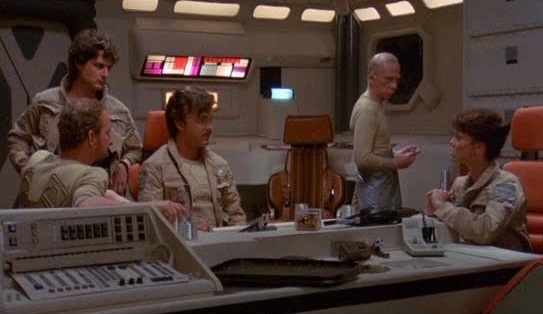

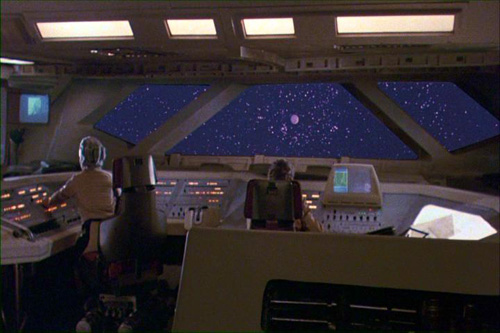


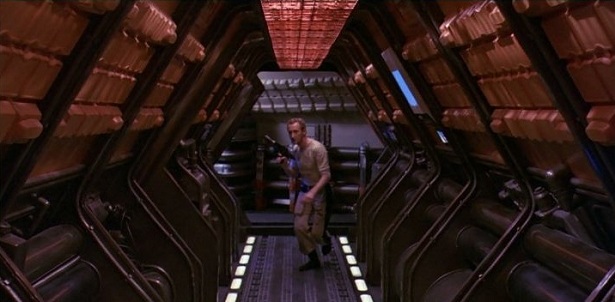
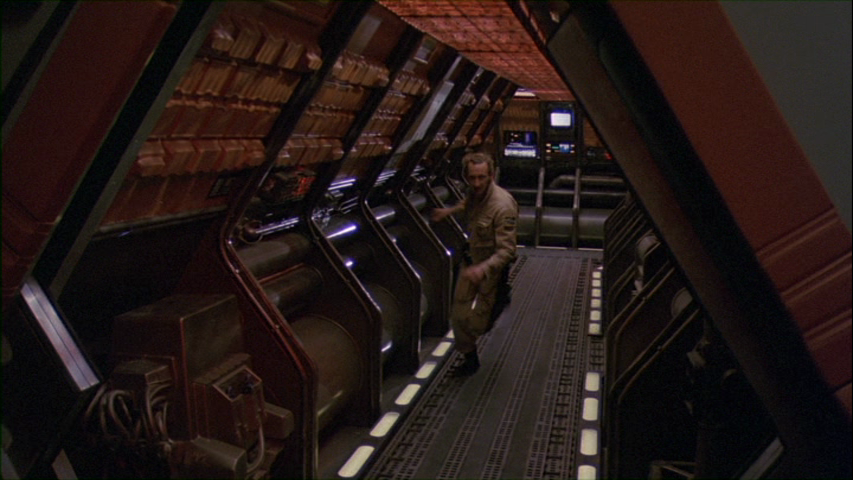


In honor of the Curiosity Rover’s successful Mars landing, I give you these awesome shots from a series on space exploration that ran in Collier’s Magazine from 1952 to 1954. Get more pics and details of the series at Paleofuture, my new favorite blog.

As I was searching eBay for all the Ray Bradbury books I read as a kid and somehow lost, I discovered this little gem, for which Bradbury provides an introduction. In 1969, Princeton physics professor Gerald O’Neill, “concerned over student disenchantment with science and engineering,” started seriously discussing space colonization with his brightest freshman students. He asked them, “Is the surface of a planet really the right place for an expanding technological civilization?” After much back and forth about atmosphere and energy requirements, “They concluded that the surface of a planet was not the best place for a technical civilization. The best places looked like new, artificial bodies in space, or inside-out planets.”
They kept at it. The ideas were discussed at a conference at Princeton, studies were conducted, and in 1975 O’Neill got a grant from NASA “to work full-time on space colonization.” That same year O’Neill testified before the space-science subcommittee of the House committee on science and technology, and the U.S. Congress increased NASA’s budget by 25% “to lay the foundation for advanced projects, such as moon bases and orbital colonies.” (Did you know there was a House Committee on Science, Space, and Technology? If not, don’t blame yourself.)
The book is absolutely fascinating, and lucky for us the whole thing is available online at The National Space Society, “an independent, educational, grassroots, non-profit organization dedicated to the creation of a spacefaring civilization.” Below are some of the amazing paintings and drawings included in the book (from Chapters 8, 10, and 15). The captions are exactly as they appear at the NSS. Also be sure to check out the Color Plates and all the beautiful Don Davis paintings in Chapter 15.
Thank you, NSS!

“Bernal Sphere” design for a space colony. The sphere is the central structure; the structure resembling coils of hose are where agriculture is conducted. The disks at either end are radiators for waste heat. (Courtesy NASA)

Cutaway view of “Bernal sphere” type of space colony. Some 10,000 people would live and work in the central sphere. A separate area, exposed to the intense sunlight of space, would be set aside for growing crops. (Courtesy NASA)
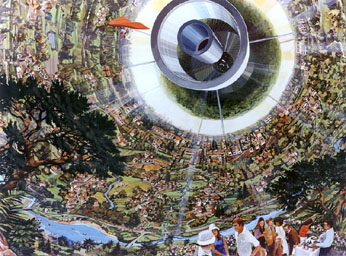
Interior of “Bernal sphere” colony. The hang-glider pilot actually is engaged in powered flight, which is possible in the low gravity of the colony center. He pedals a bicyclelike arrangement which drives the large propeller at his back.
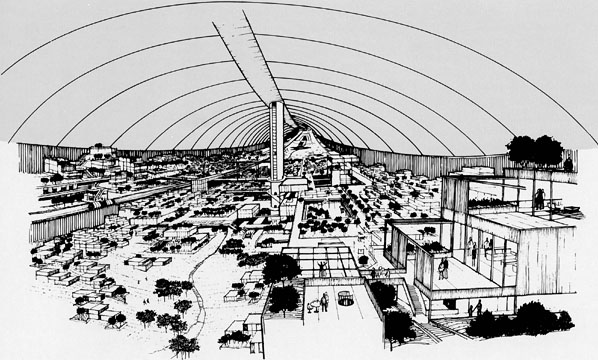
Residential district inside the colony. (Courtesy Pat Hill)

Downtown in a colony business district. (Courtesy Pat Hill)
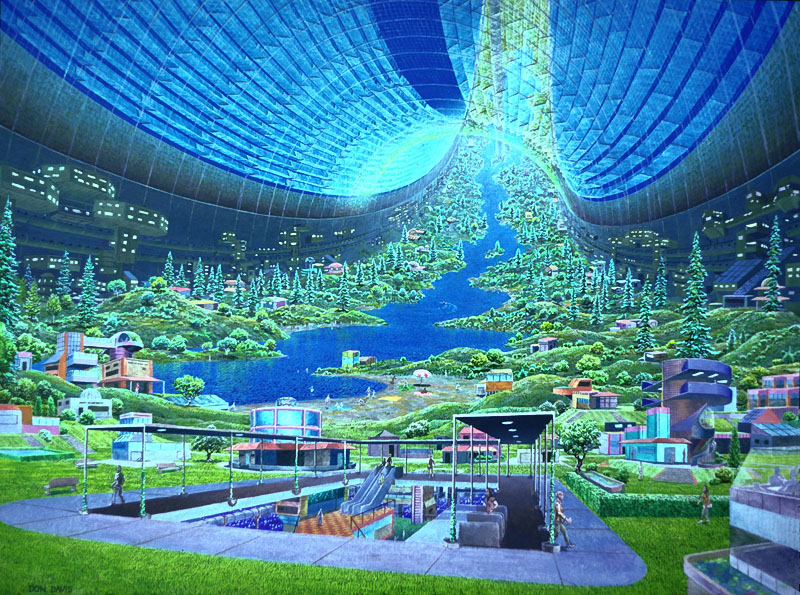
As the large colonies proliferate, the early Stanford toruses will still represent valuable living space. But their interiors will be rebuilt to suit the open, well-forested styles in vogue in the middle of the next century. (Donald E. Davis painting courtesy NASA)






 2 Warps to Neptune