Archive Page 137

T.A. Heppenheimer’s Colonies In Space (1977)

colonies in space

As I was searching eBay for all the Ray Bradbury books I read as a kid and somehow lost, I discovered this little gem, for which Bradbury provides an introduction. In 1969, Princeton physics professor Gerald O’Neill, “concerned over student disenchantment with science and engineering,” started seriously discussing space colonization with his brightest freshman students. He asked them, “Is the surface of a planet really the right place for an expanding technological civilization?” After much back and forth about atmosphere and energy requirements, “They concluded that the surface of a planet was not the best place for a technical civilization. The best places looked like new, artificial bodies in space, or inside-out planets.”

They kept at it. The ideas were discussed at a conference at Princeton, studies were conducted, and in 1975 O’Neill got a grant from NASA “to work full-time on space colonization.” That same year O’Neill testified before the space-science subcommittee of the House committee on science and technology, and the U.S. Congress increased NASA’s budget by 25% “to lay the foundation for advanced projects, such as moon bases and orbital colonies.” (Did you know there was a House Committee on Science, Space, and Technology? If not, don’t blame yourself.)

The book is absolutely fascinating, and lucky for us the whole thing is available online at The National Space Society, “an independent, educational, grassroots, non-profit organization dedicated to the creation of a spacefaring civilization.” Below are some of the amazing paintings and drawings included in the book (from Chapters 8, 10, and 15). The captions are exactly as they appear at the NSS. Also be sure to check out the Color Plates and all the beautiful Don Davis paintings in Chapter 15.

Thank you, NSS!

bernal sphere

“Bernal Sphere” design for a space colony. The sphere is the central structure; the structure resembling coils of hose are where agriculture is conducted. The disks at either end are radiators for waste heat. (Courtesy NASA)

bernal sphere-2

Cutaway view of “Bernal sphere” type of space colony. Some 10,000 people would live and work in the central sphere. A separate area, exposed to the intense sunlight of space, would be set aside for growing crops. (Courtesy NASA)
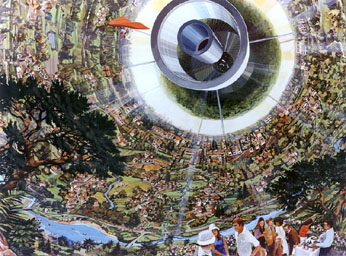
bernal sphere-3

Interior of “Bernal sphere” colony. The hang-glider pilot actually is engaged in powered flight, which is possible in the low gravity of the colony center. He pedals a bicyclelike arrangement which drives the large propeller at his back.
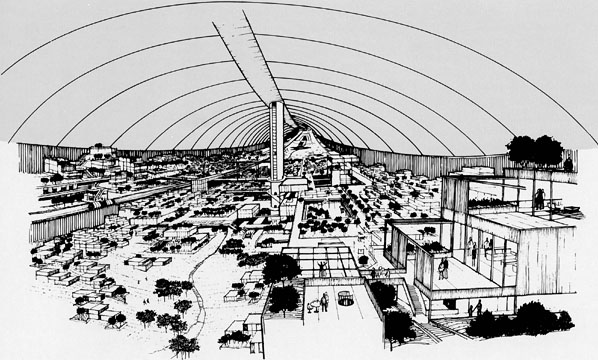
residential district colony

Residential district inside the colony. (Courtesy Pat Hill)

business district colony

Downtown in a colony business district. (Courtesy Pat Hill)
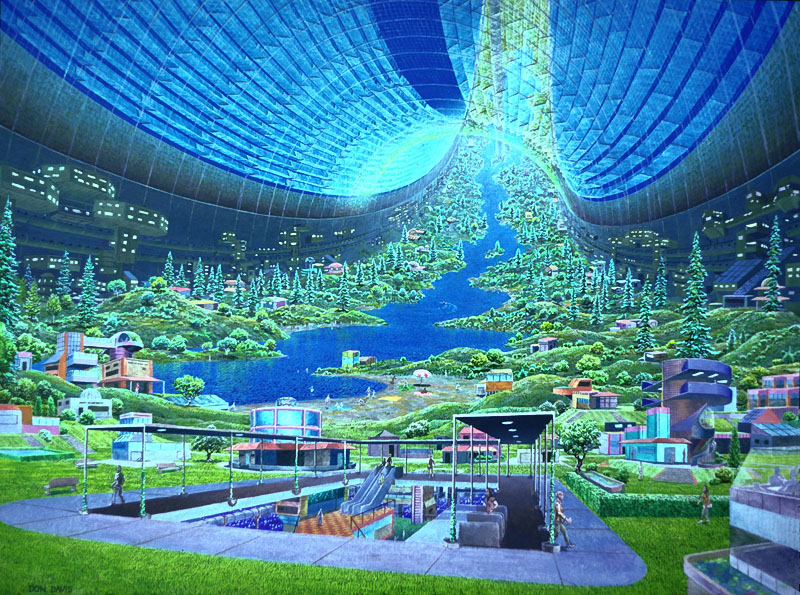
stanford taurus

As the large colonies proliferate, the early Stanford toruses will still represent valuable living space. But their interiors will be rebuilt to suit the open, well-forested styles in vogue in the middle of the next century. (Donald E. Davis painting courtesy NASA)

Atari’s C-380 Video Pinball (1977)

Speaking of Atari, this is the first console I ever had, the C-380. My dad found it in the garage when we moved into our new house and dropped it in my lap—my eyes might have actually boggled. This is the second version of the C-380; the first had a tacky wood finish, like most everything else in the ’70s.

There were 7 games total: 6 variations on Breakout and Pinball, and 1 basketball game. (Screenshots via www.old-computers.com.)

It’s hard to believe I squeezed so much fun out of this thing. I never had a 2600, so it held me over until I scored my Atari 800. I salute you this day, Video Pinball! Gaming Gods willing, we shall meet again.

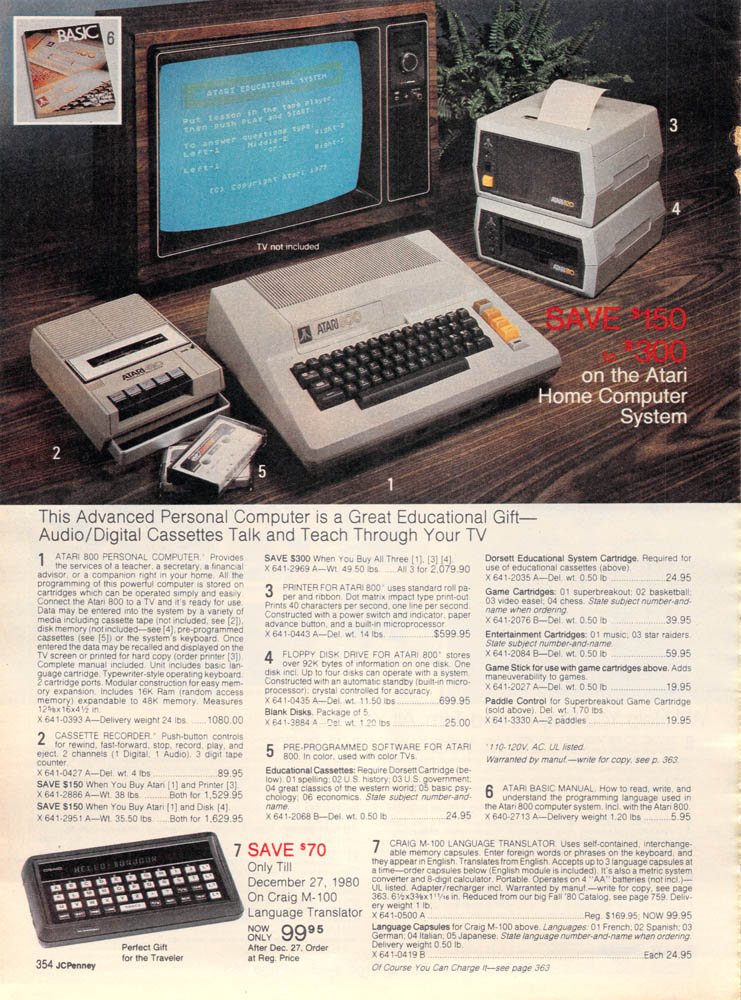
1980 J.C. Penney Christmas Catalog: Atari 800

1980 JCPenny Christmas page354

Oh my holy grail. This is the best gift I ever got, although it was between $200 and $300 when my dad told me, out of the blue, to grab one off the shelves—was it ’82, ’83? That was a lot of money then, and here it’s bloody $1,080! Mine came with Pac-Man, Donkey Kong, and the Basic cartridge. I didn’t have any of the peripherals, and at some point after War Games came out I started to long for a more sophisticated system: the IBM PC XT. That never happened, but I did get to borrow one from my dad’s friend, who went out of town for a weekend. I was on that thing all night, man, just sitting in the dark, my face lit up by the glare of that beautiful green text.

The 800 was my first love, though. And you never forget your first love.

(Image via WishbookWeb. Click to enlarge.)

Quick Movie Reviews: The Boy Who Could Fly (1986)

Yeah, I watched it. So what? It’s from the ’80s and I’m 40. These days, that’s all it takes.

Anyway, Mindy Cohn’s character, the obnoxious neighbor, sums this one up after the 14-year-old female protagonist gets hammered and starts to get horny for the kid who sits in his window all day not saying anything and pretending he’s an airplane: “You can’t be in love with a retard. It’s just not done!”

Also, spoiler alert, the title is not a metaphor. The kid actually flies at the end, and it’s really, really stupid.

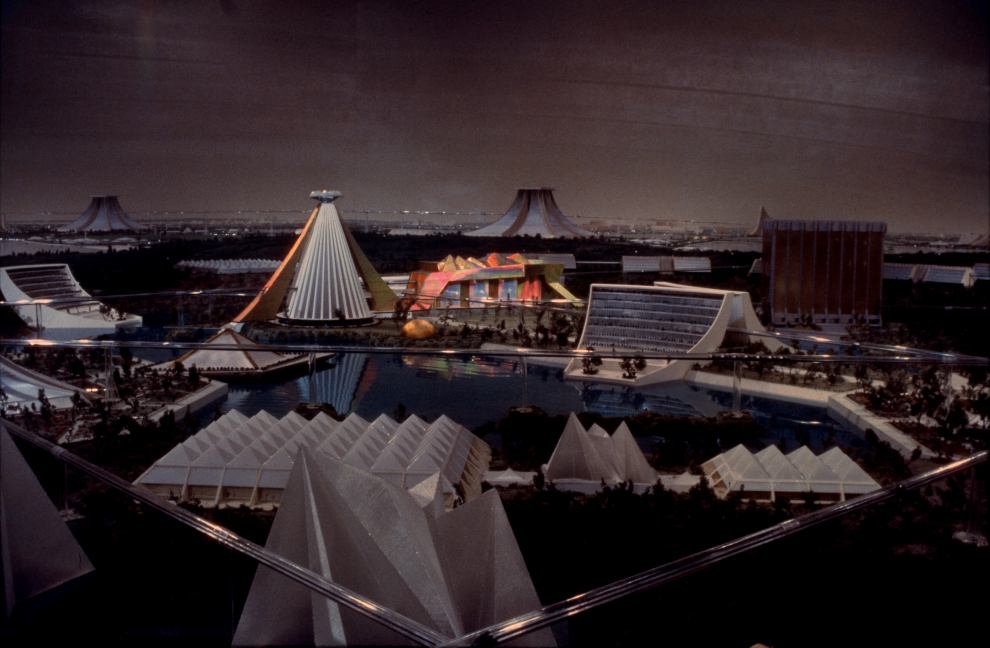
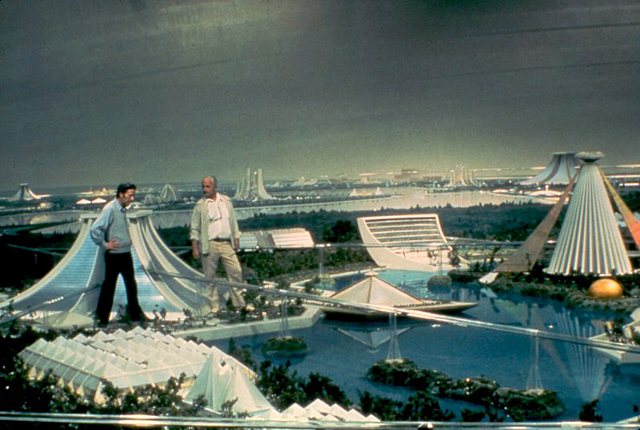
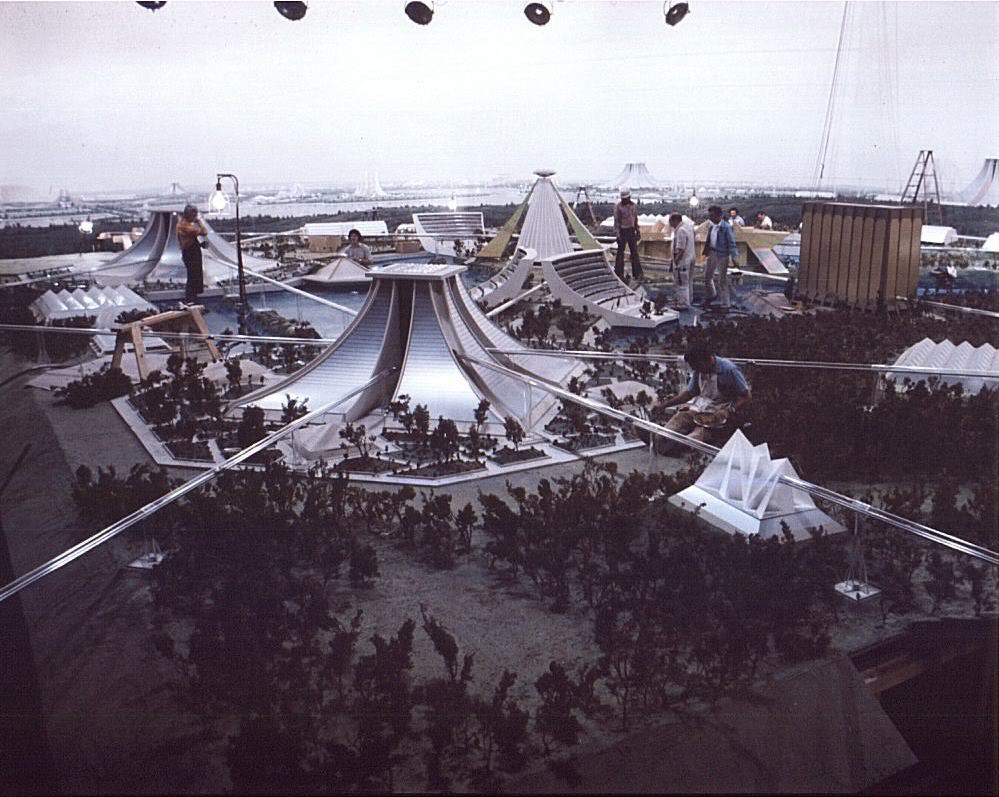
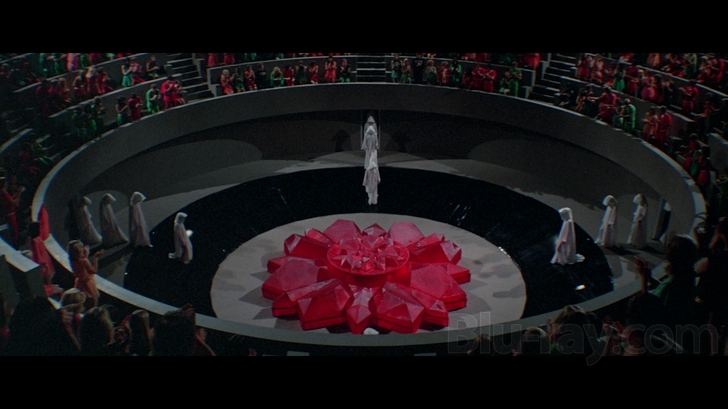
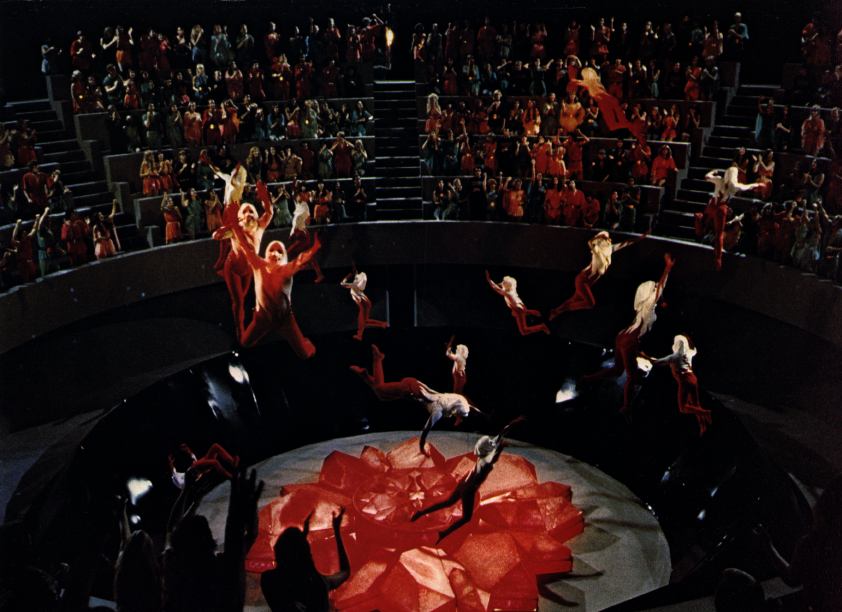
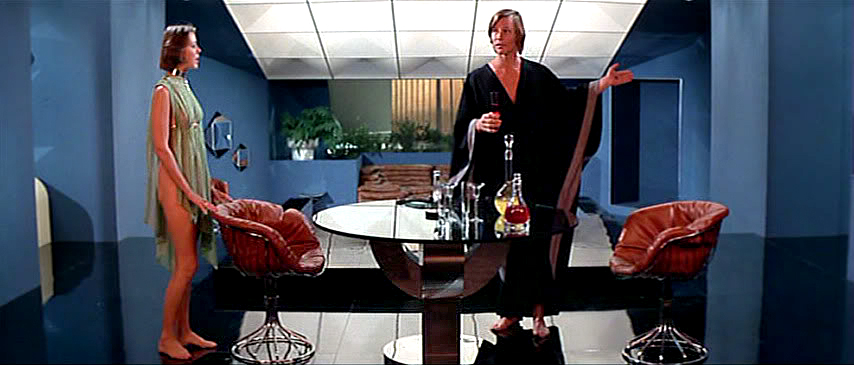
What the Future Looked Like: Logan’s Run (1976)

logan's run city

logan's run city-3

logan's run city-4

logan's run city-5

logan's run city-2

logan's run design-8

logan's run design-9

logan's run design-7

logan's run design-3

logan's run design-4

logan's run city-6

logan's run design-5

(Images via Voices of East Anglia, Deep Down Genre Hound, Snowcrest, Space: 1970, Death to CGI, Reflections on Cult Movies and Classic Television, Ultra Modern Style, Art DepartMENTAL, Ouno Design, Ultra Modern Style)

Ten Forward on the USS Enterprise-D

This is where I would like to be if I were in space. I would get a drink (none of that synthohol shit), have a seat by the windows, and listen to the steady hum of the galaxy class starship on its way to discover new worlds.

Movie Theater Marquees, 1977 – 1984

Rights reserved by Drive-In Mike

Kansas City, Missouri, 1984. Remember that boring movie Ralph Macchio did after the The Karate Kid where he plays a troubled kid and Nick Nolte is the long suffering, pure-hearted high school teacher fighting the nasty school board and trying to reform all the troubled kids?Congratulations if you do. It was called Teachers. I can’t find a movie called Soldiers, but A Soldier’s Story came out in ’84. Places may refer to Places in the Heart, also from ’84, or possibly Trading Places, but that came out in ’83. I guess these folks had a limited number of marquee letters to work with?

Rights reserved by HaarFager

Harrisburg, Illinois, 1977.

Rights reserved by vaticanus

Times Square, New York City, circa 1980. No shortage of letters here! The Goodbye Bruce Lee (1975) on the background marquee refers to an exploitation flick about a martial artist called in to finish an unfinished Bruce Lee flick.

Rights reserved by David Lee Guss

New York City, 1977. Another beautiful shot from David Lee Guss. Note the connection between the old man holding the sign invoking the crucifixion—“The blood of Jesus Christ God’s Son cleanses us from all sin”—and the depiction of Orca suffering a crucifixion of his own.

1980 J.C. Penney Christmas Catalog: Roller Derby Skates and Playsuits

1980 JCPenny Christmas page539

1980 JCPenny Christmas page511

“Low cut” disco skates? A skate tote? That rules.

If you had to go to the grocery store today in one of these playsuits, which playsuit would it be? I’d take the space deal, obviously.

(Images from the deliciously nostalgic Wishbook Web.)

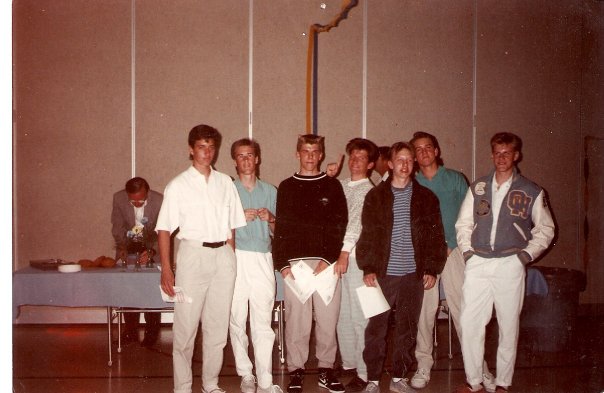
May I Have Some Bad Hair With My Pegged Pants, Please?

Pegged Pants

What a fantastic shot via welcome to my miss-adventures. Why did we do this, again? I remember getting really frustrated when the pinch roll wouldn’t come out just right.

G.I. Joe U.S.S. Flagg Commercial and Box (1985)

g.i. joe u.s.s. flagg

(Video and image via Yo Joe!)


Pages

Archives

Categories

Donate Button

Join 1,118 other subscribers