Archive Page 144

Arcade Zen

These pics are all via from a righteous Flickr pool called Growing Up In Arcades: 1979-1989. I’m going through the entire series and posting my faves, adding commentary where I see fit. Here’s the first installment.

AaronCaldwell/Flickr

May 24, 1983. Love the moonscape and the Berzerk marquee, but especially the moonscape. What’s an arcade but a series of trips to other worlds?

AaronCaldwell/Flickr

Homeboy on the left reminds me of the funny fat kid on The Cosby Show (what was his name?). Le Tigre dude is grabbing his balls or something; dude next to him is taking a shit in his pants; and dude next to him (the birthday boy in the previous pic) is sporting a killer E.T. shirt that I would wear today, if I could find one that fit.

David Atkins/Flickr

Another one from 1983. The socks. My God, the socks. And another Le Tigre polo (those were the shit back then). And the cut-off jean shorts. And a green t-shirt tucked into green, elastic banded P.E. shorts. Why not? It’s 1983, and we were there, and it was awesome.

Rad Arcade/Flickr

In the arcade cocoon we were kept warm by the fantasies our quarters bought us.

Rad Arcade/Flickr

Dad watches on, bemused by these newfangled games, but secure in the comfort of his pocket protector.

Rad Arcade/Flickr

Put those dice away, players! No gambling zone.

Rad Arcade/Flickr

Oh my sweet heaven. A Space Port.

Mall Shots

Rights reserved by Patricksmercy

Image via mall hall of fame

Rights reserved by Andrew T...


Starcade Prizes: Spectravideo and the Aquarius Home Computer System

“Spectravideo: The personal computer you grow into and not out of.” Built in joystick? Bad Idea Jeans.

The Aquarius system, released in 1983, was Mattel’s attempt to get into the home computer game.  It didn’t do so well, which is why they had to give the damn things away every week on Starcade.

Frank Frazetta: American Romantic

Lancer/Ace Edition (1967), cover art by Frank Frazetta

American artist Frank Frazetta (1928-2010) has almost single-handedly defined the fantasy genre from the late ’60s on. Even if you haven’t heard his name before, you’ve seen many of his paintings (check them out here). I say almost single-handedly out of respect for J.R.R. Tolkien, Robert E. Howard, Edgar Rice Burroughs, and Ray Harryhausen. John Milius’s Conan the Barbarian (1982), which capitalized on the Tolkien surge and the popularity of D&D, directly emulated the Frazetta style, as did almost all ’80s D&D art (Elmore, Parkinson, Easley) and a staggering amount of comic book art. Look at anything fantasy-related today and you’ll see Frazetta’s influence.

He’s probably best known for his spectacular Conan and Edgar Rice Burroughs (Tarzan of the Apes, John Carter of Mars, At the Earth’s Core) paintings, which were commissioned by various publishers. The New York Times reported in 1977 that “Paperback publishers have been known to buy one of his paintings for use as a cover, then commission a writer to turn out a novel to go with it.” (The only illustrator I can think of who might have done as much for book sales was the 19th century artist/engraver Gustav Doré.) His work is intricately articulate, deeply colorful, weird, erotic, violent, almost Romantic. His heroes are grim and bloody, his heroines scantily clad but often anything but helpless.

Here’s the Conan vs. giant snake scene by a different artist around the same time:

Lancer Edition (1968), cover art by John Duillo

And here’s one of the original Conan covers:

Gnome Press Edition (1955), cover art by Ed Emshwiller

There’s just no comparison.

I was a little surprised to find out that Frazetta was in no way the artsy type. He grew up a Brooklyn tough, nearly became a pro baseball player, barely eked out a living as an artist, and in later life suffered multiple strokes before one finally killed him. (For more, see the 2003 documentary, Frazetta: Painting with Fire.)

The art establishment never paid him any respect and never will. But he transcended his genres. When I look at Frazetta’s work, I see shades of J.M.W. Turner, Henry Fuseli, Caspar David Friedrich, John Martin. When I look at contemporary art I see lines and shapes that have no heart and signify nothing.

Vintage D&D Ads

d&d ad

d&d ad-2

d&d ad-3

(Via Cyclopeatron)

Tyrannosaurus Betamax!

This son of a bitch was heavier than a Bantha and about as slow, but couldn’t carry nearly as many sand people. I got a later edition as a gift from someone who worked in a video store. Or maybe I gave him a gift by taking it. I think I had to roll the thing into the house on a couple of skateboards and rig a pulley system to get it onto my desk (or whatever the hell I ended up putting it on). I recall watching one of those terrible ’80s ninja movies on it, but mostly it just sat there daring me to remove it from the premises, taunting me with its uselessness.

The timer is “easy to operate”? Go fuck yourself!

Portrait of a Young Geek Playing D&D

Expert Set

That’s the D&D Expert Set, you’ll notice. In ’83 TSR released the revised Basic Set (red cover) and Expert Set (blue cover), followed in ’84 by the new Master Set (black cover) and in ’85 by the Immortals Set (gold cover). Each consecutive set was geared for higher level characters, but it was super confusing because Advanced Dungeons and Dragons was going on at the same time and had different rules, so if one of us brought the Expert Set to the party, and someone else brought the AD&D Player’s Handbook, the shit really hit the fan.

Not that it mattered in the end. Sometimes we’d get a game off, but mostly we’d just roll characters for a couple of hours, draw some viciously perilous dungeons that not even a Conan-Christ multiclass would survive, chase Ding Dongs and Twinkies with several tall glasses of ice cold Pepsi, and pop Alien (or something more lascivious) into the VCR after the parental units went to bed.

(Image via Big Lee’s Miniature Adventures)

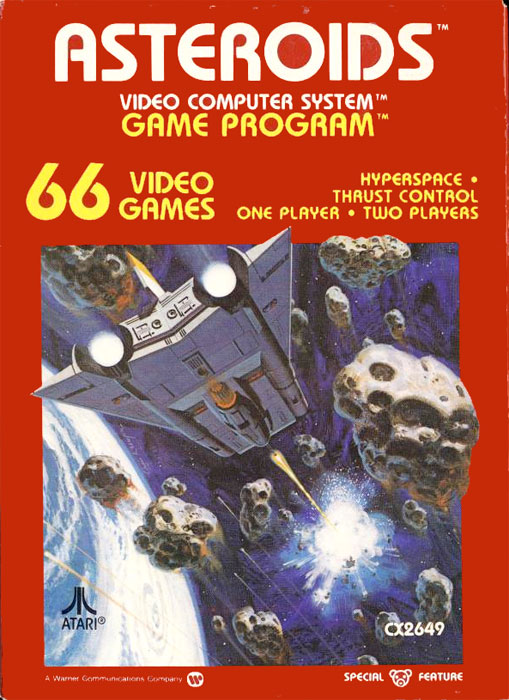
Games, Imagination, and Reality: The Power of Early Video Game Art

asteroids box

asteroids screenshot

LeftyLimbo made a good point on my Intellivision post about the box art on all these old games being so much more awesome than the actual game play. There’s nothing new about the importance of cover art in marketing, especially when marketing to kids (think of fantasy and sci-fi pulps, comics, RPG modules, toys, etc.), but I thought it would be interesting to make a comparison. Above is the cover of Asteroids for the Atari 2600 and a screenshot of the game:

Now here’s the cover to Halo 2 and a screenshot.

halo 2 box

halo 2 screenshot

The in-game graphics have caught up to the box art, have surpassed the box art, even. There’s no longer a need to use the imagination to fill in the gaps left by all those 8-bit games. It’s all about emulating reality now, or rather emulating the perception of a reality in which we’re protected by magic armor and moving at hyperspeed.

I’m not saying the old games are superior (we would have literally died of ecstasy if we’d seen and played Halo 2 in ’82, even ’90), though many of them are much more challenging as games. You can’t save your progress in Donkey Kong or Super Zaxxon. When your little men are gone, that’s it; you start from scratch. That’s why the high score meant so much.

The gaming industry, now and then, is in the escape business. It does what it has to do to get us to put more coins in the escape machines. The difference is that the escape is much more pervasive today. The time I spent in the arcades or on my Atari 800 simply doesn’t compare with the hours kids and adults today spend on World of Warcraft and StarCraft.

Another thing: adults didn’t used to play, at least not the way they play now. Parents would occasionally indulge, but they were usually embarrassed; they had “something more important to do.” I’m not sure that any activity post-internet is more important than keeping and staying entertained. Escapism in moderation is a good thing, but gamers tend to have a different idea of moderation than non-gamers and dabblers.

Mall Shots

Image via pinkshirtsandcarwrecks

Image via Urban Neighborhood


Video Game Cabinet Art: Defender (1981)


Pages

Archives

Categories

Donate Button

Join 1,118 other subscribers