Courtesy of csdigiorgio1, here’s a lovely, silent 8mm home movie of a world that no longer exists.
Surveying the Gen X landscape and the origins of geek
Courtesy of csdigiorgio1, here’s a lovely, silent 8mm home movie of a world that no longer exists.
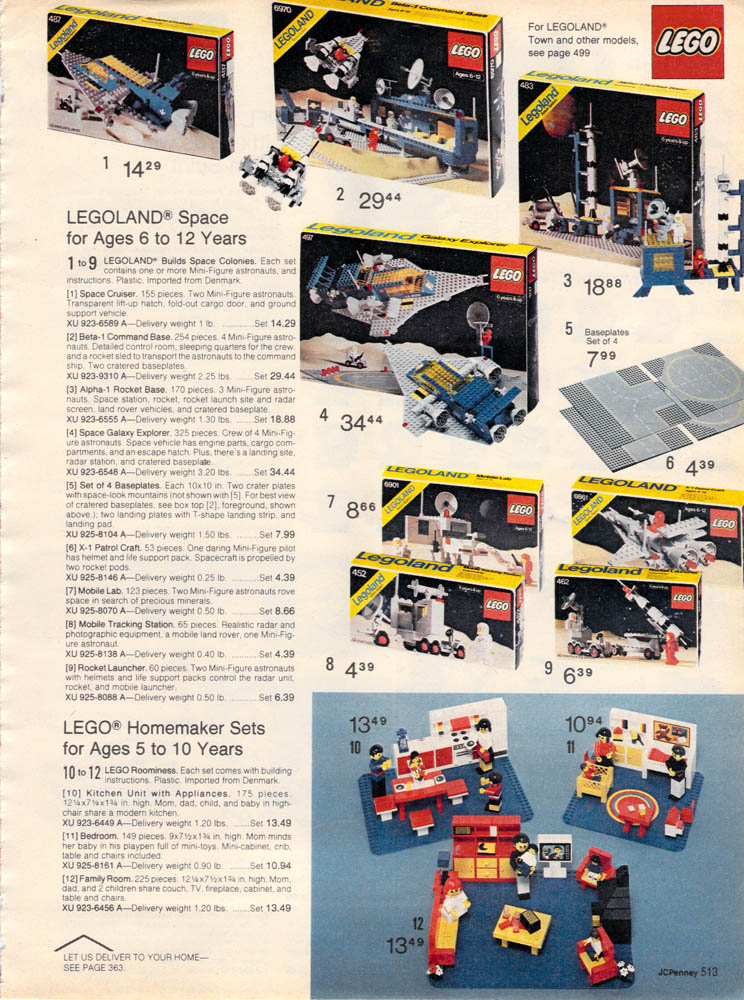

As I’ve said before, Lego Space may be the best toy line ever. Beta-1 Command Base, I would like to stroke your box. Come hither.
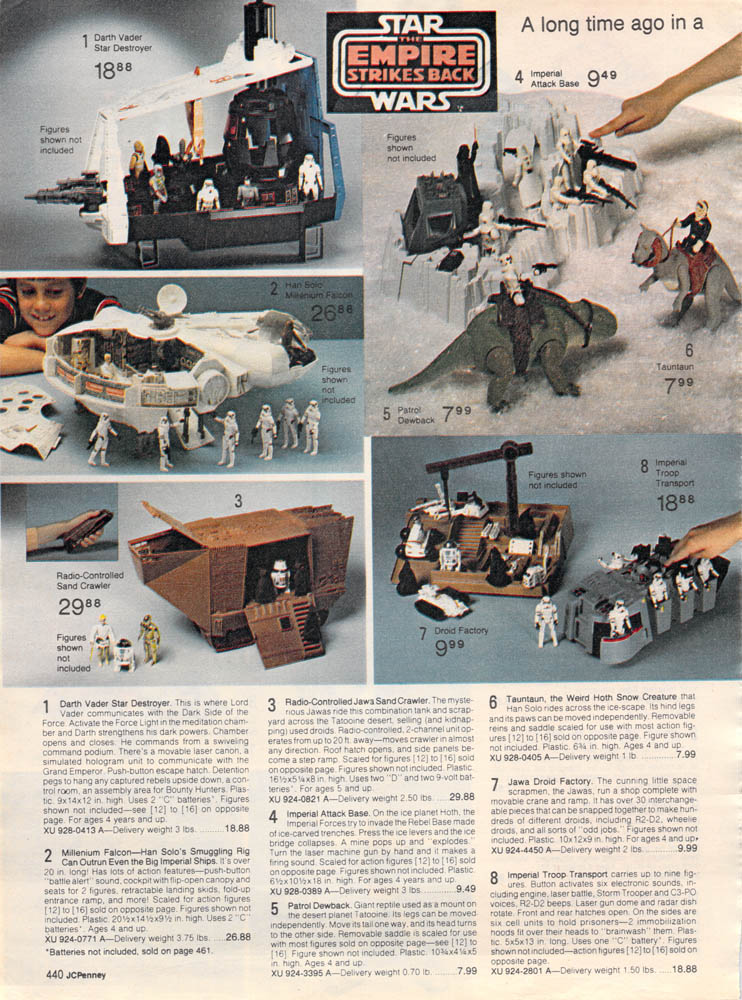
As for Empire, I had the Imperial Attack Base, the Tauntaun (subtitled “the Weird Hoth Snow Creature” in the catalog), and the Snowspeeder. I guess I opted for the all-Hoth experience.
I remember hearing that the radio-controlled Sand Crawler was a flop, but I don’t think I ever saw it in action. It was way too expensive, and clearly a gimmick.
(All images via WishbookWeb. Click to enlarge.)
Dig these trippy sci-fi tunes, man. I’ve been listening to Leonard Nimoy jams on Spotify (Spaced Out: The Best of Leonard Nimoy and William Shatner) and loving every minute of it. Nimoy put out several albums in the ’60s, the first one (and half of the second one) in his Mr. Spock persona. You can listen to many of the tracks via Synthasia.
If you dig this, then you absolutely must check out Song of the Second Moon, by Thomas Dissevelt and Kid Baltan. The album was originally released in 1957 and is considered the first popular synth/electronica album: “The soundtrack to a charming and utopian future (that has yet to arrive).” I just bought the 2012 reissue, but have a listen courtesy of manfromuranus.

Microvision, first released in 1979, was “the very first handheld game console that used interchangeable cartridges.” I don’t even remember this thing being on my radar as a kid, but it looks fun, and you can play some games at The Microvision Simulation Project.
Benj Edwards has more photos and details at his great site, Vintage Computing and Gaming. Also check out Benj’s cool slideshow on the history of handhelds at PCWorld.
Thanks to Steve Austin’s bionic eye for identifying this artifact in my last post.
(Image via the Handheld Museum)

Via Joey Hack/Flickr. Location not given. I spy with my little eye not one but two briefcases (one of them doubling as a DM screen), a Champion vest jacket, a reel-to-reel tape machine, a turntable, a black cowboy hat (DM’s prerogative), carpet wall art, and I do believe that’s an open carton of cigarettes on the ashtray on top of the TV. Kid in blue is holding Milton Bradley’s MicroVision, the first handheld video game console.
All images via www.movieposter.com.
Question: What is with all the awful paintings on these posters (especially The Color of Money)? It’s embarrassing. They couldn’t just slap on a scene from the movie?

Surely you remember the Stompers commercial (via oscartripe):
I also remember the Master Caster (#7 in the catalog) commercial, although I can’t find it anywhere. See the set at Toys You Had.

These hand cranked dirt bikes were bloody fantastic. They tumbled head over heels, righted themselves, jumped, tumbled, bowled over action figures, and kept right on going. Check it (via MrVintageToy).
(Catalog images via WishbookWeb. Click to enlarge.)
 In my ongoing quest to watch every single sword and sorcery movie from the ’80s, no matter how irredeemably sleazy, I present this quadruple-feature from the Roger Corman’s Cult Classics series.
In the opening scene of Deathstalker, our hero rescues a maiden from a gang of lusty cutthroats and then proceeds to get it on with said maiden. Before they can finish (don’t you hate when this happens?), an old man drags “Stalker” to a witch who needs his urgent assistance to unite a magic sword with some other magic doodads to stop the evil wizard and save the princess. The awesome looking ogre-thing in the poster isn’t in the movie, so don’t get excited. I’ve already said too much. Just watch this clip so we can move on.
Deathstalker II is fun. I don’t really remember what happens (more of the same), but everything is so poorly done, everyone knows it, and everyone seems to be having fun with it—and that’s really what makes a bad B movie good: it has what I call a “recess” flavor. In other words, it gleefully creates the kinds of spontaneous, silly action-dramas we made up during our recess/lunch periods at school. Here’s a taste of the awesome soundtrack and the terrible acting.
The best thing I can say about The Warrior and the Sorceress is that David Carradine is pretty slick as the hooded bad-ass, but it’s nothing he hadn’t already done, and done much better, by that point. The story revolves around two warring factions fighting over the only water source on a planet with two suns. In better hands, it might have been fun. No clip for you. Next.
Barbarian Queen (a.k.a. Queen of the Naked Steel) is a cult classic and my favorite in this lot. Lana Clarkson, who Phil Spector was convicted of murdering in 2009, is so tall and hot and charismatic that she pulls off a quasi-feminist barbarian hero despite the shoddy production and all the cheap, predictable rape scenes. The Queen’s man is taken prisoner by the evil Romans, and she and her band of women warriors are damn well going to get him back! The trailer is fantastic.

As I was searching eBay for all the Ray Bradbury books I read as a kid and somehow lost, I discovered this little gem, for which Bradbury provides an introduction. In 1969, Princeton physics professor Gerald O’Neill, “concerned over student disenchantment with science and engineering,” started seriously discussing space colonization with his brightest freshman students. He asked them, “Is the surface of a planet really the right place for an expanding technological civilization?” After much back and forth about atmosphere and energy requirements, “They concluded that the surface of a planet was not the best place for a technical civilization. The best places looked like new, artificial bodies in space, or inside-out planets.”
They kept at it. The ideas were discussed at a conference at Princeton, studies were conducted, and in 1975 O’Neill got a grant from NASA “to work full-time on space colonization.” That same year O’Neill testified before the space-science subcommittee of the House committee on science and technology, and the U.S. Congress increased NASA’s budget by 25% “to lay the foundation for advanced projects, such as moon bases and orbital colonies.” (Did you know there was a House Committee on Science, Space, and Technology? If not, don’t blame yourself.)
The book is absolutely fascinating, and lucky for us the whole thing is available online at The National Space Society, “an independent, educational, grassroots, non-profit organization dedicated to the creation of a spacefaring civilization.” Below are some of the amazing paintings and drawings included in the book (from Chapters 8, 10, and 15). The captions are exactly as they appear at the NSS. Also be sure to check out the Color Plates and all the beautiful Don Davis paintings in Chapter 15.
Thank you, NSS!

“Bernal Sphere” design for a space colony. The sphere is the central structure; the structure resembling coils of hose are where agriculture is conducted. The disks at either end are radiators for waste heat. (Courtesy NASA)

Cutaway view of “Bernal sphere” type of space colony. Some 10,000 people would live and work in the central sphere. A separate area, exposed to the intense sunlight of space, would be set aside for growing crops. (Courtesy NASA)
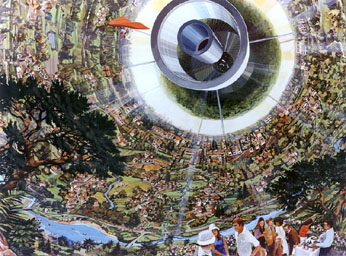
Interior of “Bernal sphere” colony. The hang-glider pilot actually is engaged in powered flight, which is possible in the low gravity of the colony center. He pedals a bicyclelike arrangement which drives the large propeller at his back.
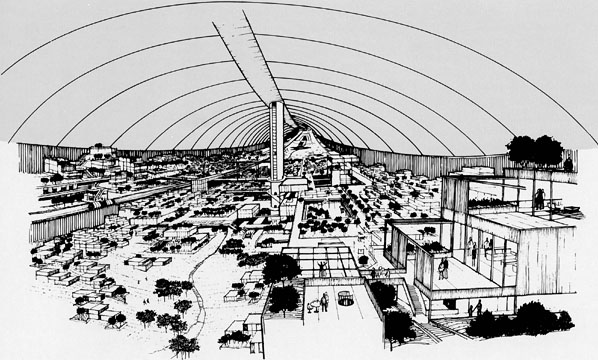
Residential district inside the colony. (Courtesy Pat Hill)

Downtown in a colony business district. (Courtesy Pat Hill)

As the large colonies proliferate, the early Stanford toruses will still represent valuable living space. But their interiors will be rebuilt to suit the open, well-forested styles in vogue in the middle of the next century. (Donald E. Davis painting courtesy NASA)


 2 Warps to Neptune