—Review by Richard McKenna
Beware: spoilers ahead.
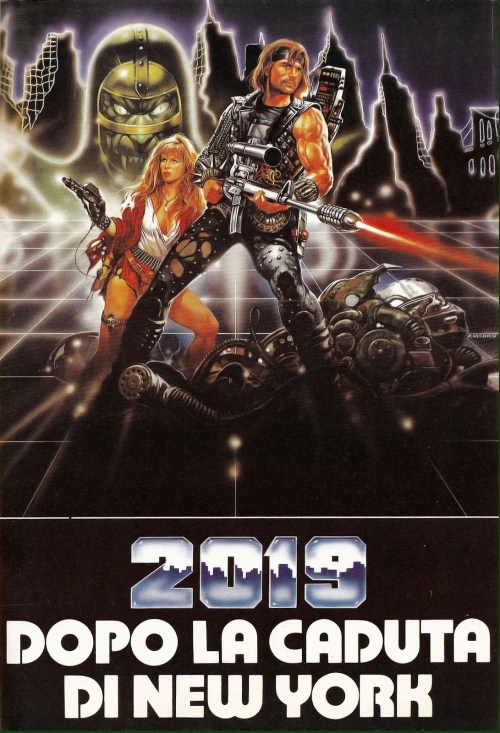
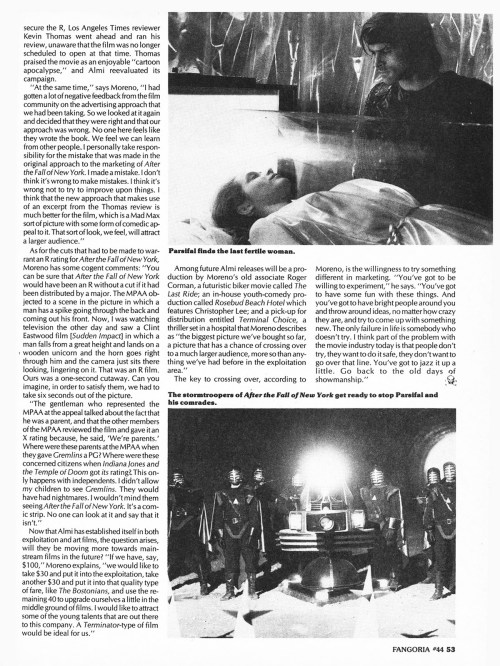
In 1983, as low-rent filmmakers scrabbled about for suitably desolate locations to double as nuked-out future deserts, quarry owners across Italy continued to rub their greedy hands in glee at the post-apocalyptic cinematic windfall Brezhnev and Reagan had unwittingly—or, in retrospect, wittingly—guaranteed them. Smelling money in the irradiated water, director Sergio Martino decided to take a break from his usual domestic sex comedies to give the world 2019: After the Fall of New York (hereafter just 2019).
According to Martino, who comes off as a nice guy in interviews, and would make a reassuringly avuncular vet or dentist, 2019 was inspired by viewings of Blade Runner (1982) and Escape From New York (1981), though not, intriguingly, by Mad Max (1979) or Mad Max 2 (1981). In an alternate, even more unlikely version of the story, he claims that 2019 was written before the release of Escape From New York. I don’t know how many plutonium isotopes you’d have to absorb to believe that.
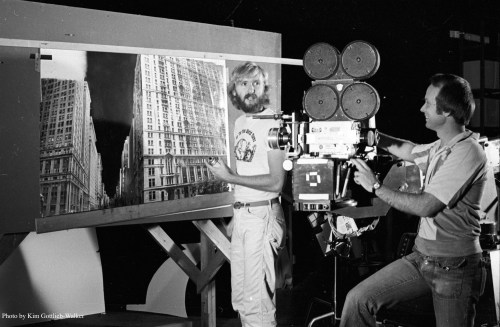
The film opens with a jazzman, his face scarred by gluey, suppurating pustules (of which we will see many more over the course of the film), standing by a lamppost on the Brooklyn waterfront, somehow getting an elegiac synth riff to come out of his trumpet. In the background, across the small pond standing in for the Hudson, we see the ruins of New York. The camera tracks through the city, giving us a good reminder of why the scale models in films were called miniatures: it would be hard to make them look any smaller if you tried. On Italian TV some years ago, Martino claimed that the ruined skeletons of the skyscrapers—easily the most convincing special effect in the film—were made of burned and painted fruit crates, which sounds more than credible.
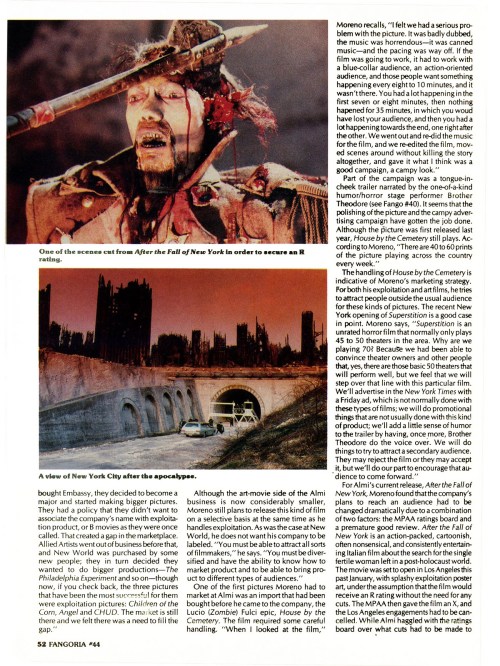
 We’re told that ever since somebody pressed the “fatal button” that unleashed nuclear holocaust, the human race has been completely sterile and no more children have been born (understandably, since “the radiation could not have been worse”). New York is now controlled by the evil Euraks, sadistic Europeans who dress like Darth Vadered-up versions of the crew in Mario Bava’s Planet of the Vampires (1965). The Euraks spend their time chasing down and collecting mutants for vivisection, and dwell in a base which looks suspiciously like an industrial wine-making facility. The Eurak commander is an unnamed bald guy whose office wall is a replica of Picasso’s Guernica, and his lieutenant is the predictably cruel and sensual Ania, played by Anna Kanakis, who’s strangely cute in this, and her acting has been worse—a lot worse.*
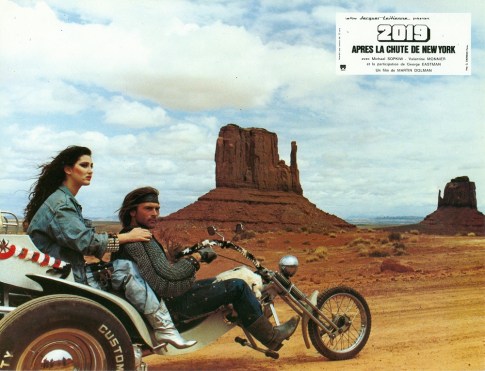
Next, we’re introduced to our hero, Parsifal (played by Michael Sopkiw, who Italian genre-hounds repeatedly describe as a double of Kurt Russell, although the man looks nothing like Kurt Russell). Parsifal, tellingly if absurdly sharing the name of an Arthurian Grail-seeker featured in Wagner’s final opera, wears butcher’s mesh gloves and a leather headband, and when we meet him, he’s taking part in a Deathsport-like duel called The Nevada Race, driving an armored car with a shield welded to the passenger door and a cannon on the roof. When he wins, to the acclaim of the well-behaved crowd of pustule-covered punks and new wavers in attendance, he is awarded a license to kill, twenty ounces of gold, and a sex-slave called Flower. The couple head off on a pretty cool motorcycle trike across Monument Valley, which is dotted with the inert corpses of androids. Flower tells Parsifal that she once knew an android, adding, “I didn’t know what he was until I had made love with him!”
Parsifal liberates Flower, but soon after is kidnapped by agents of the rebel Pan-American Confederacy, who stun him with a gun from Barbarella and take him to their headquarters in Alaska. Here he’s informed that the Confederacy has located the world’s one remaining fertile woman, and that, partnered with a mopey guy sporting a robot claw and a strongman wearing an eyepatch, he must bring her back from New York so that she can be sent to Alpha Centauri to restart the human race.
Cue a lot of running about in a scrapyard and a tatty, one-street New York set—built for another film due to be shot in Rome, actually, and inherited by Martino after it caught fire. The trio encounter a member of a tribe of dwarfs—called “Shorty, what else?”—as well as the Needle People, a gang of scavengers who live off the rats they manage to spike. Shorty and a tired-looking blonde from the Needle People join the gang, and together they stumble upon the theater inhabited by Big Ape (George Eastman) and his gang of mutant monkeys.
Big Ape joins the crusade, the group finds the world’s only fertile woman, Melissa, preserved inside what looks like a gigantic croissant display case by her long dead scientist father, and they break out of the city. Their escape takes them down a walled-up tunnel that, for no clear reason, is protected by a mechanical portcullis, multiple waves of luminous spikes rising from the ground (with enough room to drive a car through, luckily), dozens of Eurak soldiers who leap out of alcoves, and an inappropriately extravagant-looking laser cannon styled like Syd Mead’s interpretation of a hostess trolley.
 By the time they make it to the desert to rendezvous with the Confederacy, only Parsifal and Melissa are alive. They board the ship and prepare to depart for Alpha Centauri.
2019 is basically just a heap of what the Italians call trovate—cool, gimmicky, derivative ideas piled higgledy-piggledy on top of one another and embellished to the point of absurdity: blood is gummy and orange; the dwarf commits the most unlikely suicide ever as he cries out, “Stupid bastards!”; rats attack as if they’re hell spawn (a customary occurrence in Italian genre films); skin is lasered off; someone says, “Careful, there’s something weird about this” about the weirdest thing that’s ever happened anywhere, at any time.
What stands out most to me now, after watching the film for the first time in 20 years, is how noisy it is—constantly, deafeningly, arbitrarily noisy. There’s a compressed noise for everything that happens: kicks make plastic-sounding punch noises, punches sound like a drum machine snare, a stabbing sounds like somebody kicking a sack of potatoes. And, Christ alive, there’s the endless repetition of the echoey laser noise the baddies’ bow-casters make!
The film was a French-Italian co-production, hence the transalpine nature of the cast, and the need to fit English dialogue onto the multilingual, labial gurnings of the actors results in peculiar ejaculations and a very loose way with prepositions (the aforementioned “I didn’t know what he was until I had made love with him,” for instance). Like many films from the same period and genre, 2019 is an amazing halfway house: there obviously wasn’t a huge budget, but there was, inexplicably, a budget, and one spent in a totally inconsistent way.
Martino claims the film was financially successful in Italy and around Europe in its day, something he admits would be unthinkable now, and he claims it was one of the last genre films the country produced before industry shortsightedness—or, he hints, political machinations (presumably the anti-genre intellectuals)—sabotaged the national film business by hindering the technological improvements that were already the norm elsewhere. Genre films were often categorized as being automatically right-wing at the time (escapism and imperialist, U.S.-individualist machismo being signifiers of crypto-fascist leanings), and the national film criticism industry was dominated by figures like Goffredo Foffi, whose strict Marxist rigor left little room for leather-clad rocker survivalists laser-blasting S&M mutants in the face while driving muscle cars.

2019 is creative as opposed to inventive, in the sense that you can almost hear the crew manically nailing stuff together, painting bits of plyboard and attaching spikes to the front of old cars, without there actually being much sense of novelty or surprise about any of it. The film is amazingly childish, and much of it actually resembles improvised play, appearing as it does to have been made up when the cameras started rolling. What can I say? My mistake! It’s immensely enjoyable—immensely stupid, often boring, totally ridiculous, and immensely enjoyable.
What it reminds me of most are the times I managed to persuade other, sportier, more outgoing kids to stop playing war and instead play games based around my 2000 AD-fueled sci-fi fantasies, only to feel the action quickly drifting out of my control—yes, we were in the future, or on the moon, but all they wanted to do was run fast, shout, and knock each other over anyway, and I, prissy obsessive that I was, would become increasingly irked and sidelined by the lack of genre respect. And I was obviously not going to be Parsifal. More like the mopey guy with the robot claw.
(Images via Wrong Side of the Art)
__________________________________________________________________________________
*Kanakis was Miss Italy in 1977 (famously at age 15, cultural relativity fans!) and was married briefly to Claudio Simonetti from Goblin. She used to be nicknamed Lady Ribaltone (“Lady Turncoat,” loosely translated) for her perceived habit of constantly changing political allegiances. That probably wouldn’t mean much in most places, but this is Italy, the country where one of the best-known songs of the late Giorgio Gaber (a sort of cross between Leonard Cohen, Phil Ochs, and Mr. Rogers) is “Destra-Sinistra” (“Right-Left”), a light-hearted attempt to tackle the decidedly not-light-hearted national obsession with assigning an absolute political connotation to anyone and anything (sample lyric: “By its nature the potato is left-wing; mashed into purée, it’s right-wing”). Even 10 years ago Kanakis was still a fixture on talk shows, her I’m-half-Greek-I-speak-my-mind shtick and penchant for clingy clothes quite the compelling combo. Her star seems to have faded over the last decade.
_________________________________________________________________________________
Richard McKenna grew up in the visionary utopia of 1970s South Yorkshire and now ekes out a living as a translator among the crumbling ruins of Rome. He dreams of being one day rescued by the Terran Trade Authority.







 2 Warps to Neptune