Archive for the 'Magazines/Zines' Category


The Lovecraft Files: Upcoming Interviews with Byron Craft and Tom Sullivan

Sullivan Cthulhu 1977

A few months ago I wrote about The Cry of Cthulhu, a movie based on H.P. Lovecraft’s mythos that, very unfortunately, never got made. The film’s screenplay was uniquely weird and true to the source, unlike every other movie based on Lovecraft’s work up to that point, and a number of future special effects icons were involved in the project. The blurb above is from Starlog #15 (August, 1978) and features concept art by Tom Sullivan, who went on to do ground-breaking special effects for The Evil Dead and The Evil Dead 2, among other notable accomplishments.

I’m excited to announce that I had the chance to interview both Byron Craft, who wrote The Cry of Cthulhu screenplay (and its recent novelization, The Alchemist’s Notebook), and Tom Sullivan about the almost famous film and their past and current projects. Byron’s interview will run this Thursday, October 23, and my interview with Tom will run on the following Thursday, October 30. Be there!

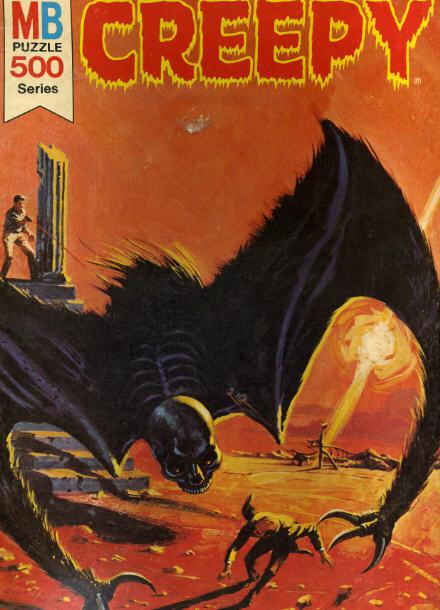
Creepy Jigsaw Puzzle (Milton Bradley, 1977)

Creepy Jigsaw 1977

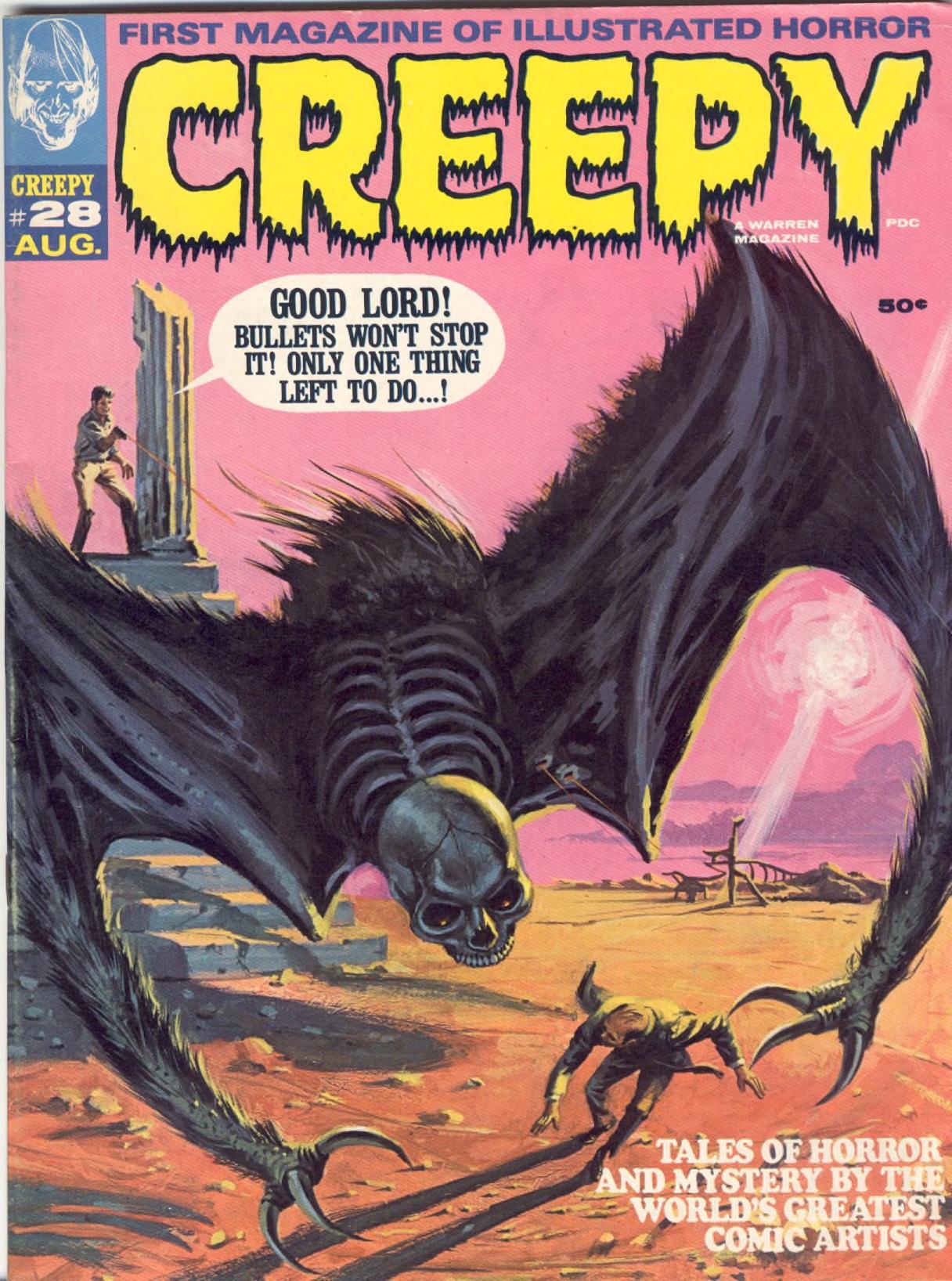
Creepy #28 8-1969

According to a post at The Magic Robot, Milton Bradley released three puzzles featuring art from Creepy covers, and three featuring art from sister magazine Eerie. I’ve seen a couple on eBay and both had a copyright date of 1977. I’m not a collector, but I might make an exception for these. It’s a brilliant idea, and I find it telling that a major, family friendly corporation like Milton Bradley would license the lurid output of Warren Publishing.

You can read Creepy #28 at the Internet Archive. The cover artist is Vic Prezio, who contributed to Eerie and Famous Monsters of Filmland as well. He also worked extensively in the men’s action-adventure pulps of the 1960s. See more of his work at Flickr.

Many of the original Warren titles are online now. If you’re interested in reviewing issues, drop me a line. I think that would be a fun, worthwhile project.

Big Kid Reading Horror Pulp, 1941

Horror Stories April 1941-2

Horror Stories April 1941

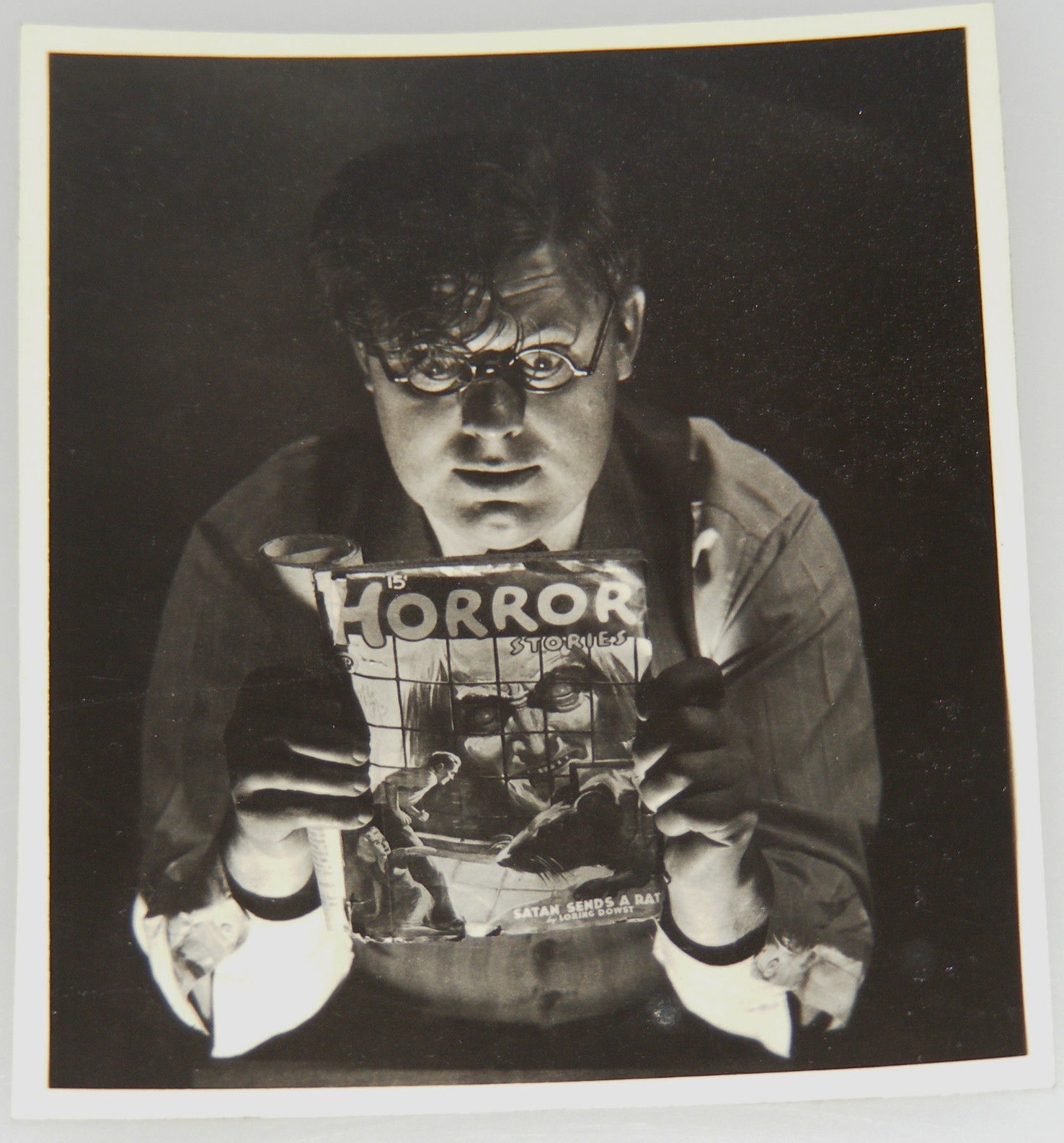
The first photo was found at an estate sale and sold on eBay. It looks like a press photo of some sort, but I can’t identify the gent holding the magazine.

Horror Stories was a forerunner of the horror comics boom ignited by EC Comics. This particular issue was published in April 1941.

(Cover image via Fantasy Ink)

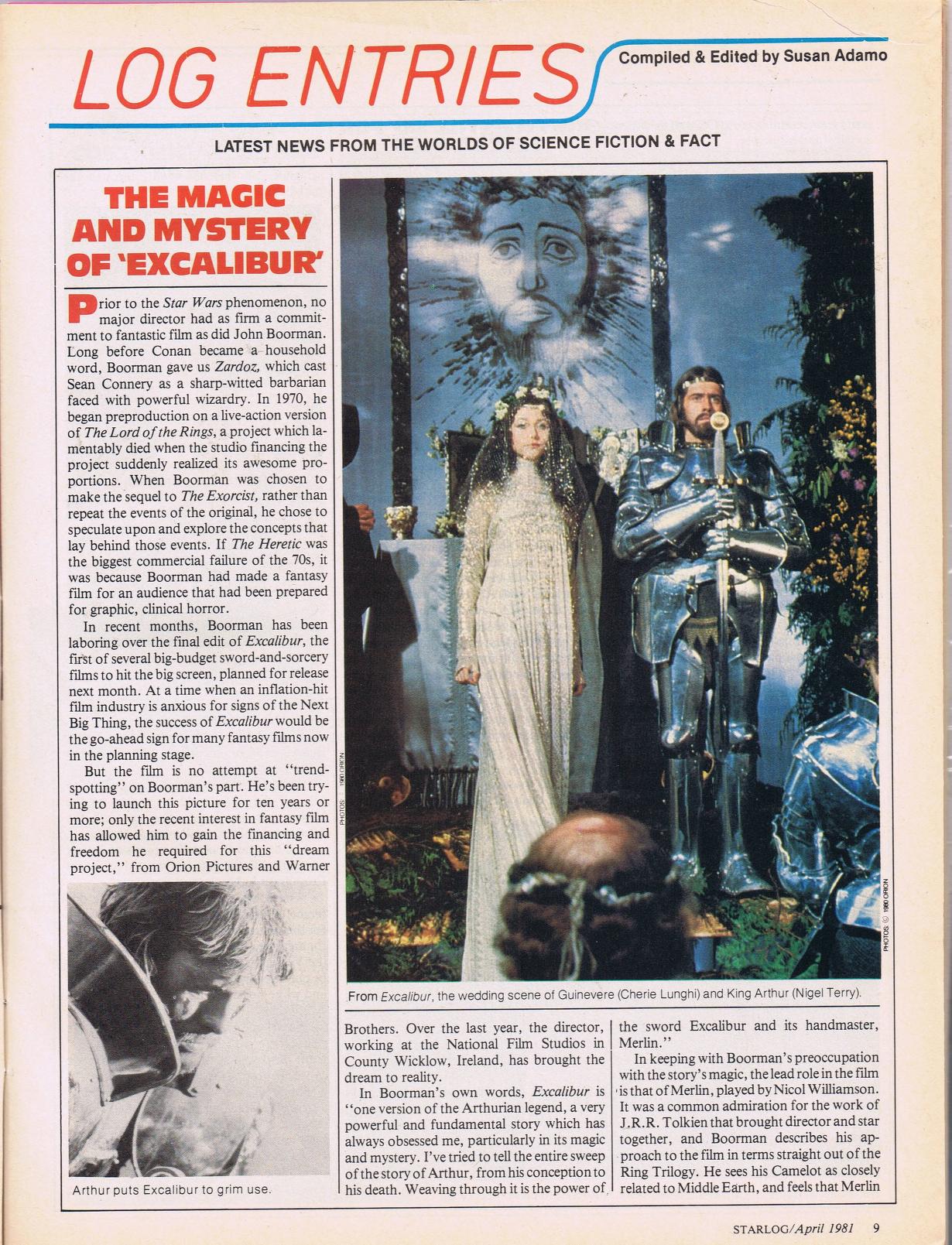
Starlog #45 (April, 1981): ‘The Magic and Mystery of Excalibur’

Starlog 45 1981-1

Starlog 45 1981-2

Boorman gets the kid gloves here, especially where Exorcist II: The Heretic is concerned—an awful, unwatchable movie. (Excalibur is not much better, to be honest: a beautifully shot film ravaged by pretentiousness.) Again we have the Lord of the RingsStar Wars connection:

Boorman describes his approach to the film in terms straight out of the Ring Trilogy […]

The British-born director sees Star Wars, in particular, as subject to Arthurian interpretation. “Think of Obi-Wan Kenobi as Merlin, Luke Skywalker as young Arthur, Han Solo as Lancelot and Princess Leia as Queen Guinevere.”

Read the whole issue at the Internet Archive.

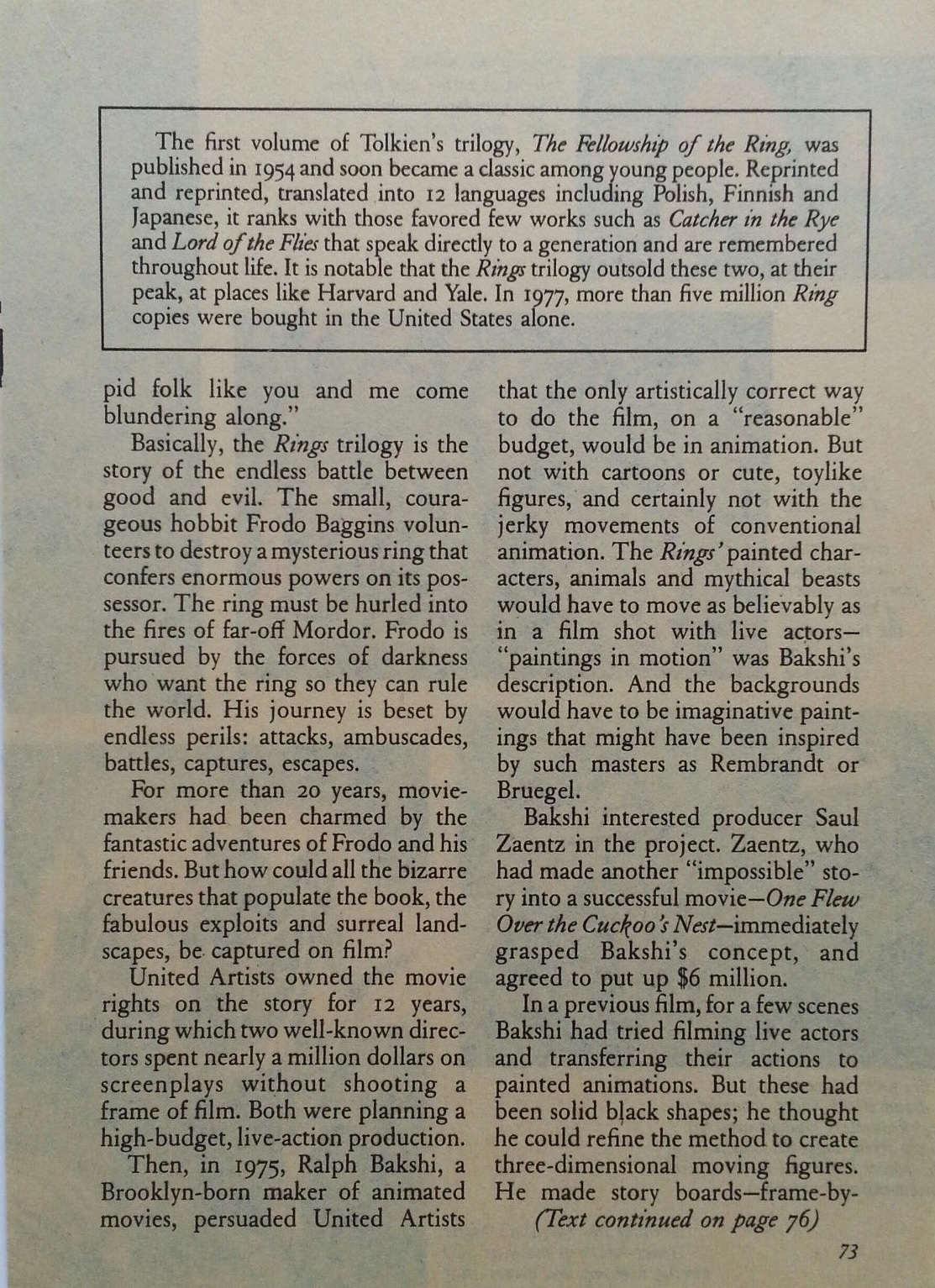
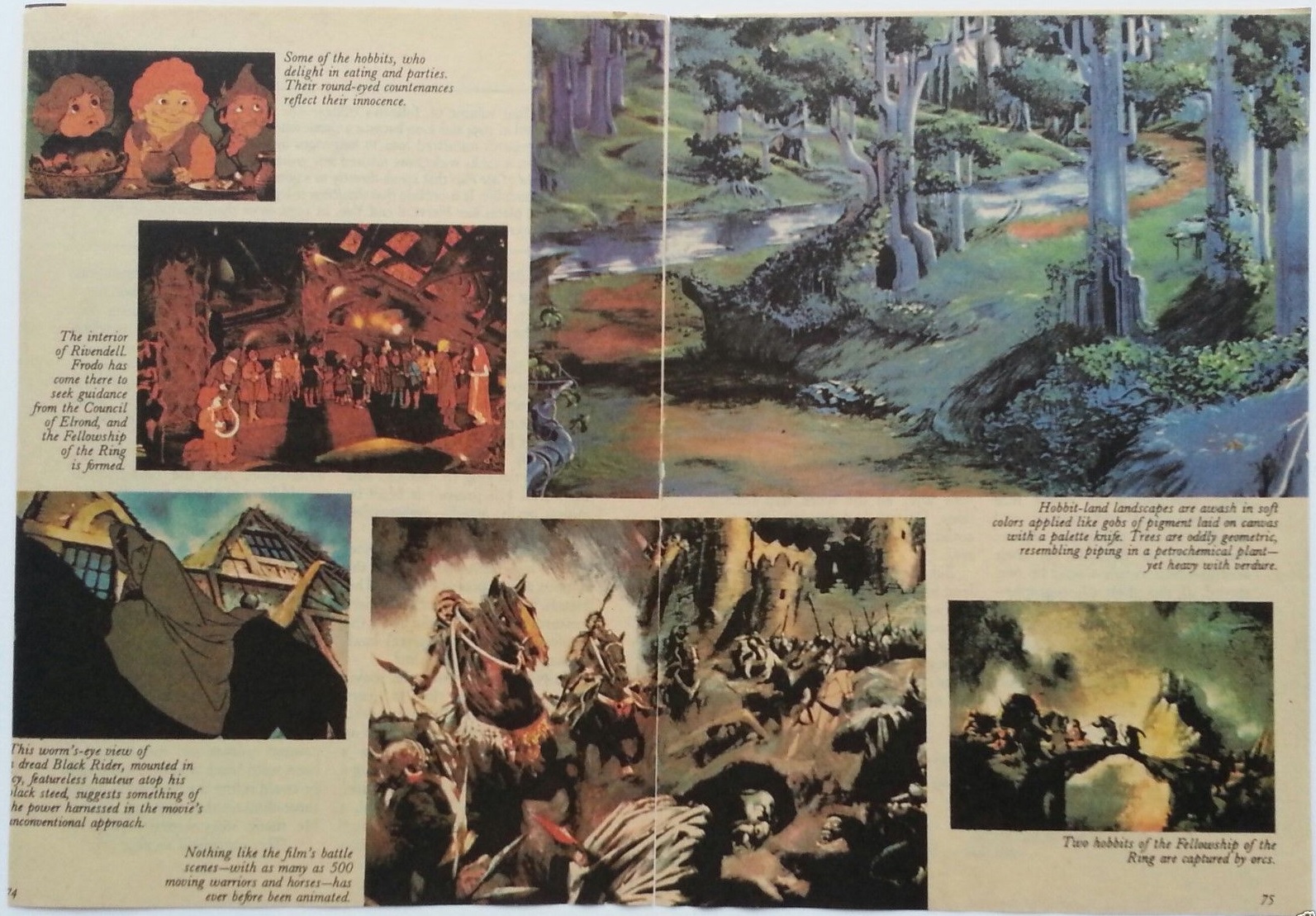
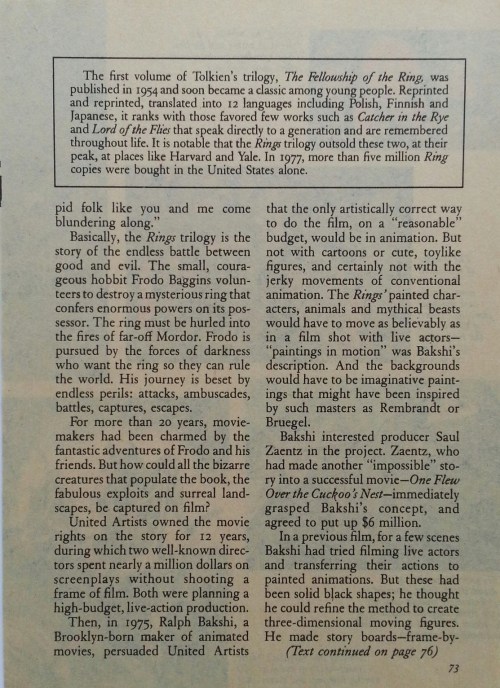
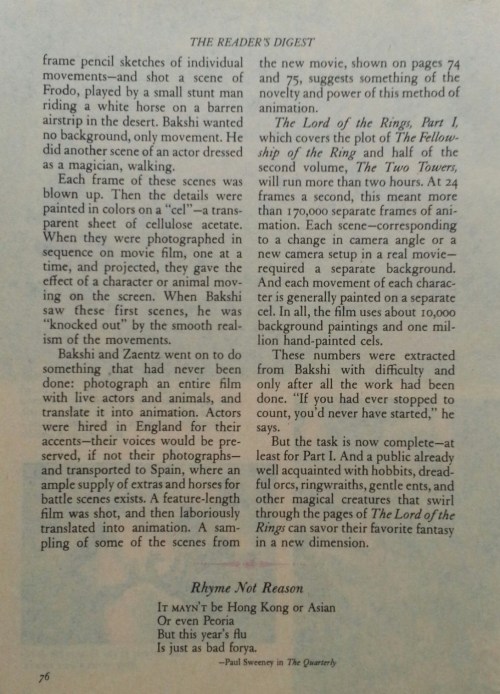
Reader’s Digest Article on Ralph Bakshi’s The Lord of the Rings (January, 1979)

LOTR 1979-1

LOTR 1979-2

LOTR 1979-4

LOTR 1979-3

A couple of notable excerpts:

The first volume of Tolkien’s trilogy, The Fellowship of the Ring… ranks with those favored few works such as Catcher in the Rye and Lord of the Flies that speak directly to a generation and are remembered throughout life. It is notable that the Rings trilogy outsold these two, at their peak, at places like Harvard and Yale […]

United Artists owned the movie rights on the story for 12 years, during which two well-known directors spent nearly a million dollars on screenplays without shooting a frame of film. Both were planning a high-budget, live-action production.

The two directors were Stanley Kubrick and John Boorman, although Kubrick’s involvement is largely apocryphal. I have yet to find a reliable source for the legend, but here’s how it goes: The Beatles wanted to make a Rings movie, with John as Gollum, Paul as Frodo, George as Gandalf, and Ringo as Sam. John Lennon, a great fan of 2001: A Space Odyssey, supposedly met with Kubrick about directing, but nothing came of the project.

UPDATE: The Beatles wanting to do a Lord of the Rings movie, similar in style to Yellow Submarine, appears to be true, according to Stuart Lee’s A Companion to J.R.R. Tolkien (2014) and Nigel Cawthorne’s A Brief Guide to J.R.R. Tolkien (2012). Kubrick is not mentioned by either source, but he is mentioned in the J.R.R. Tolkien Encyclopedia (2007), which cites Apple Records film executive Denis O’Dell: The Beatles’ 1968 “plans… to make a film out of The Lord of the Rings with a two-record soundtrack… were shattered when designated director Stanley Kubrick declared that a cinematic adaptation… was ‘unmakable’.” It’s also widely reported that Tolkien, who would sell the film rights to The Lord of the Rings to United Artists in 1969, got wind of the Beatles project and instantly nixed it.

John Boorman (Deliverance, Excalibur) was the first director with a legitimate shot at getting a live-action Lord of the Rings film done. More on that tomorrow.

(Images via Artwork and Olde Paper/eBay)

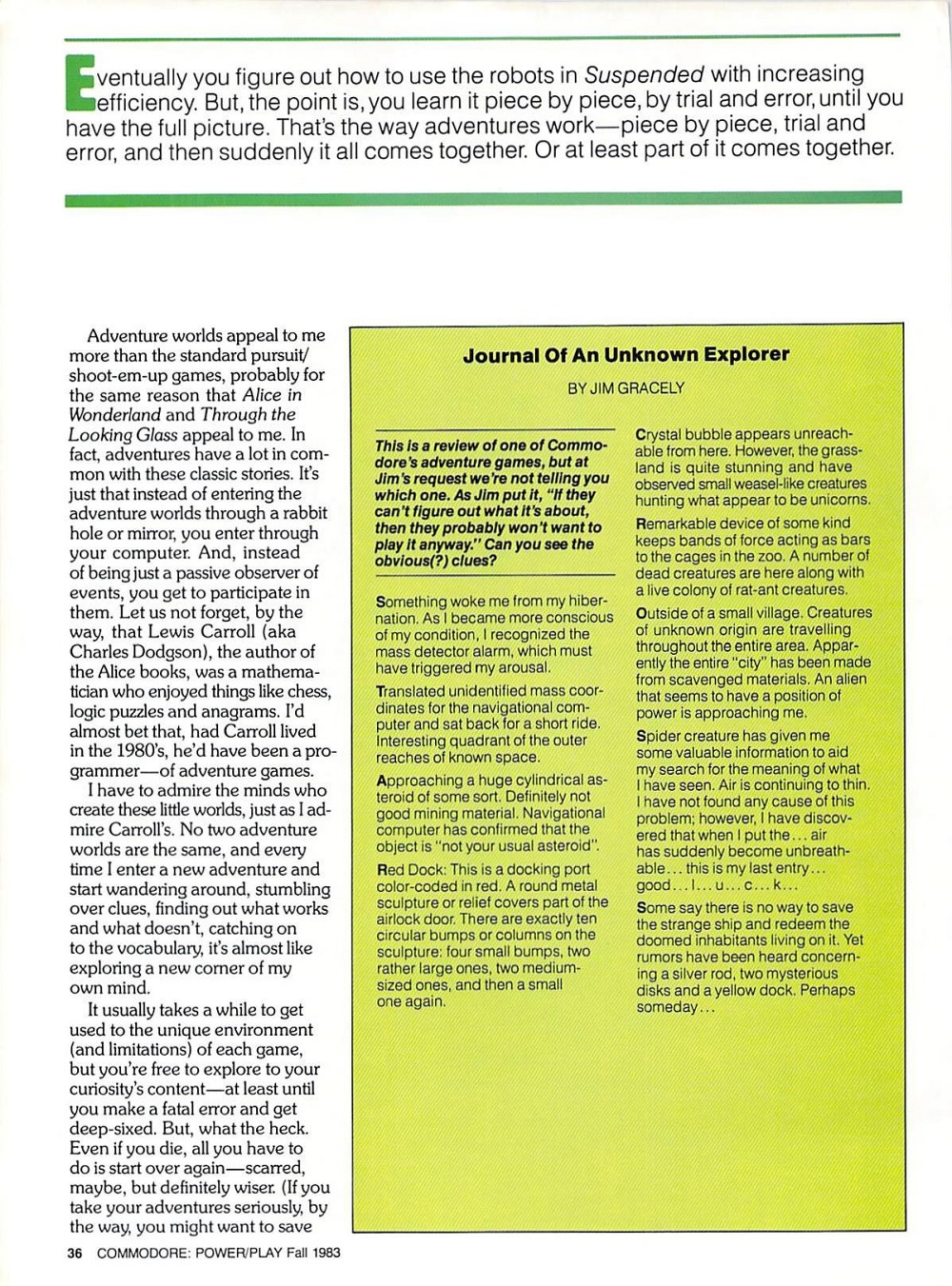
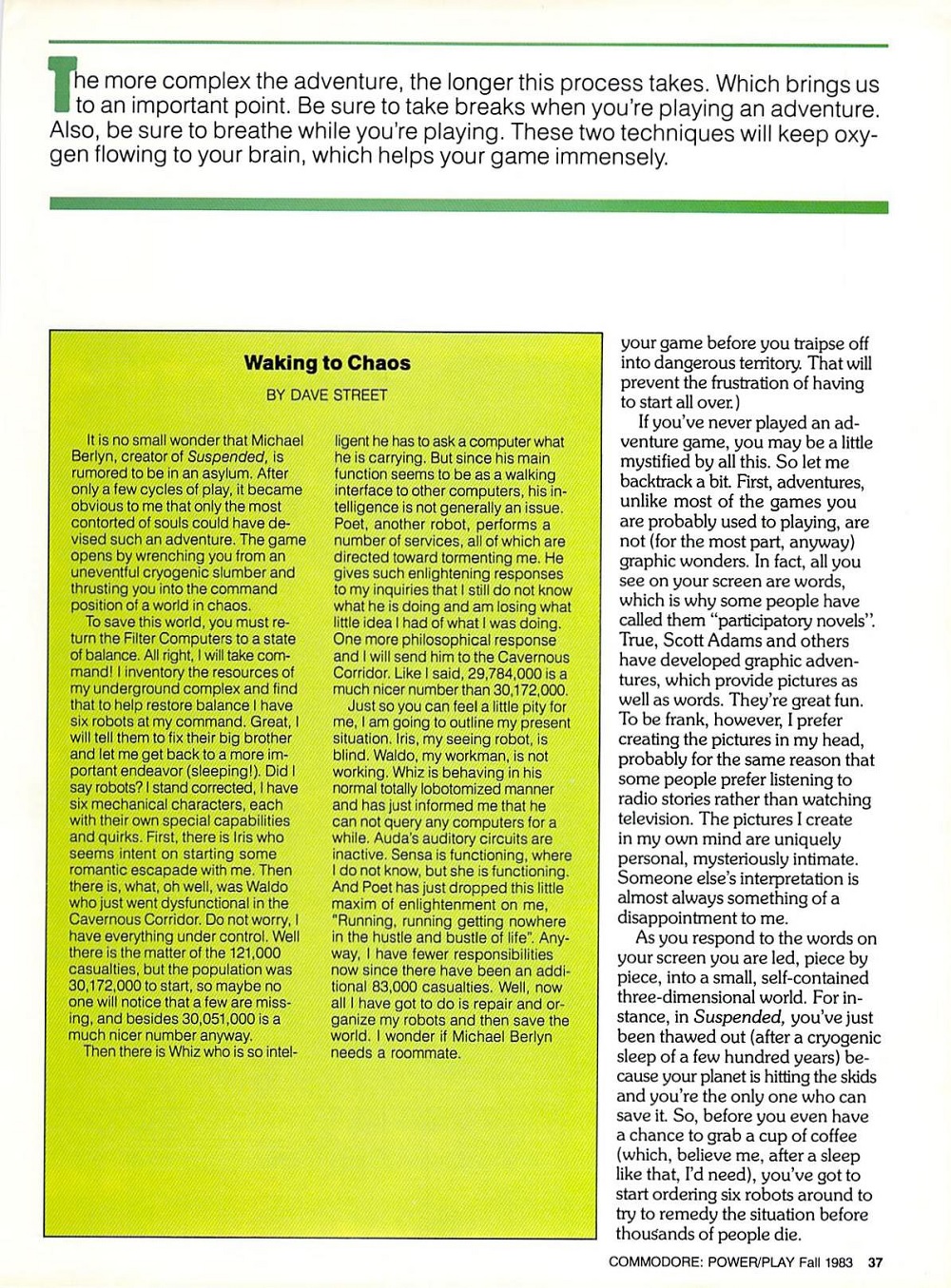
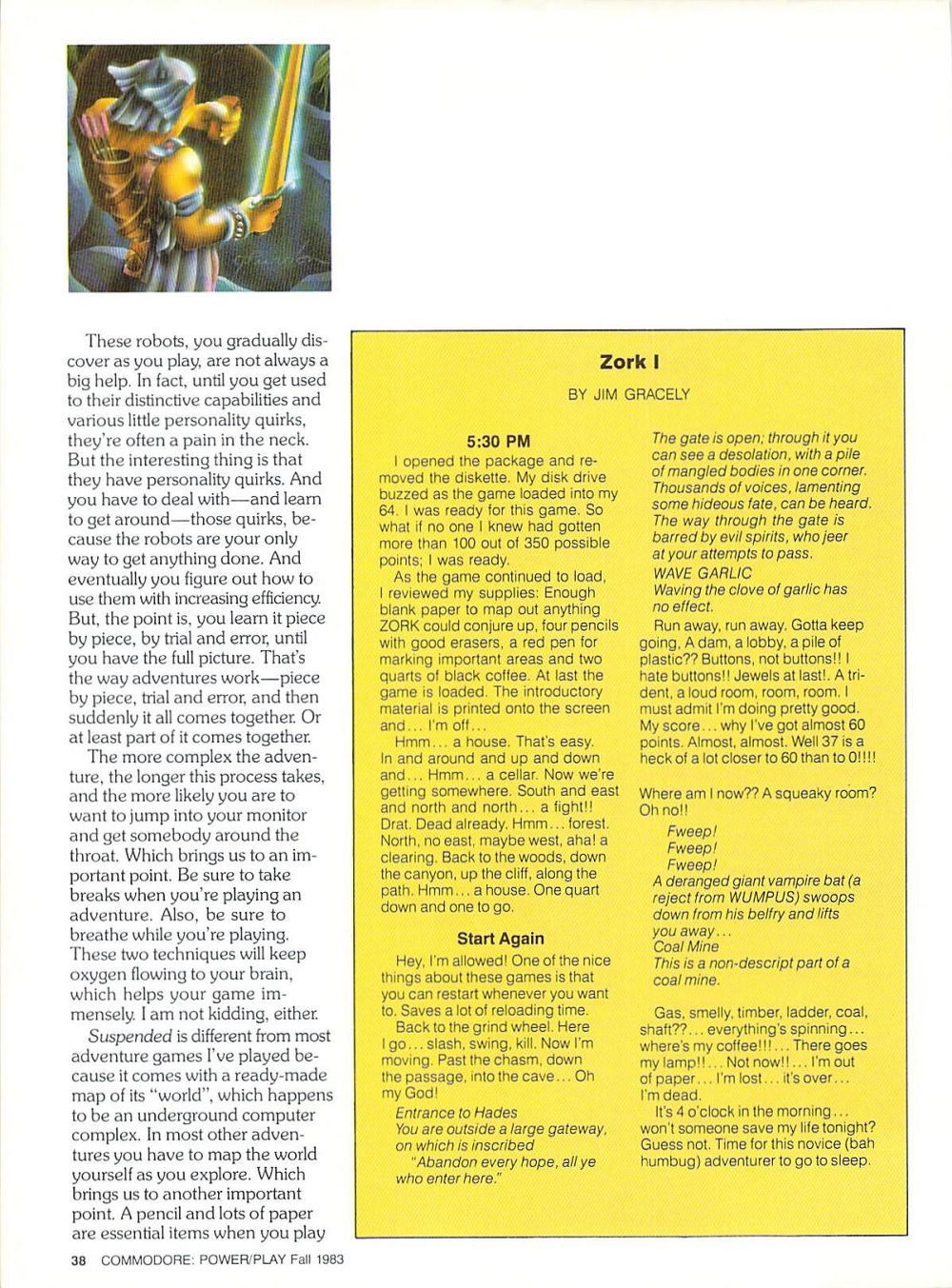
Commodore Power/Play #6 (1983): ‘Are You An Adventurer?’

Comm 1983-1Comm 1983-2


Comm 1983-3

Comm 1983-4


Comm 1983-5Comm 1983-6


Comm 1983-7Comm 1983-8


The Scott Adams mentioned in the article wrote the first adventure game for the PC, Adventureland (1978), and went on to found Adventure International. Here’s how Diane LeBold, who started Power/Play in 1982, describes the game genre.

If you’ve never played an adventure game, you may be a little mystified by all this. So let me backtrack a bit. First, adventures, unlike most of the games you are probably used to playing, are not… graphic wonders. In fact, all you see on your screen are words… True, Scott Adams and others have developed graphic adventures, which provide pictures as well as words. They’re great fun. To be frank, however, I prefer creating the pictures in my head… the pictures I create in my mind are uniquely personal, mysteriously intimate. Someone else’s interpretation is almost always something of a disappointment to me.

As you respond to the words on your screen you are led, piece by piece, into a small, self contained three-dimensional world.

Some day some genius programmer could create a game that’s so believable you may have a hard time separating it from the real world…

It’s interesting that she talks about graphics getting in the way of the gaming experience as early as 1983. In a 2012 post I compared old school box art to old school games and talked about how “There’s no longer a need to use the imagination to fill in the gaps left by all those 8-bit games.” Greg at Lefty Limbo expanded on the idea in a post called Filling in the Blanks (a much neater phrase). The same point was made in a Verge article published over a year after my original post, and the author used almost exactly the same language: “Because of her [Atari cover artist Susan Jaeckel] painting on the cover of the box, you knew that you were actually venturing through a hedge maze with three huge dragons lurking inside. It filled in the gaps left by the game’s rudimentary graphics…”)

I have some early press photos of Scott Adams I’ll post a little later. If you want to read more about adventure games, Gaming After 40 has hundreds of smart, comprehensive reviews and walkthroughs, along with other cool stuff related to golden age gaming.

You can read full issues of Commodore Power/Play magazine at the Internet Archive.

Advanced Dungeons & Dragons Monster Manual Ad, 1978

Monster Manual Dragon #13 April 1978

From The Dragon #13, April 1978.

TSR’s Days of the Dragon 1980 Calendar

Days Calendar 1980

Days Calendar Ad 1980

The cover image is via Tome of Treasures. The ad is from Dragon #33 (January, 1980). I don’t have any of the interior art, unfortunately, but the art credits are as follows:

John Barnes: April and January (1981).

Dale Carlson: January (1980), May, September, and December.

Elladan Ellrohir (real name: Kenneth Rahman): February and November. Rahman, apart from artwork under several different guises, co-designed TSR’s Divine Right and Knights of Camelot games.

Phil Foglio: June.

Bill Hannan: front cover (from Dragon #1), July, and October.

Dean Morrisey: March and August.

The incomparable Darlene did the titles and title illustrations. With due respect to the other artists, that’s what I want to see most.

I thought the first Dragon calendar came out in ’79, but I can’t seem to find any evidence.

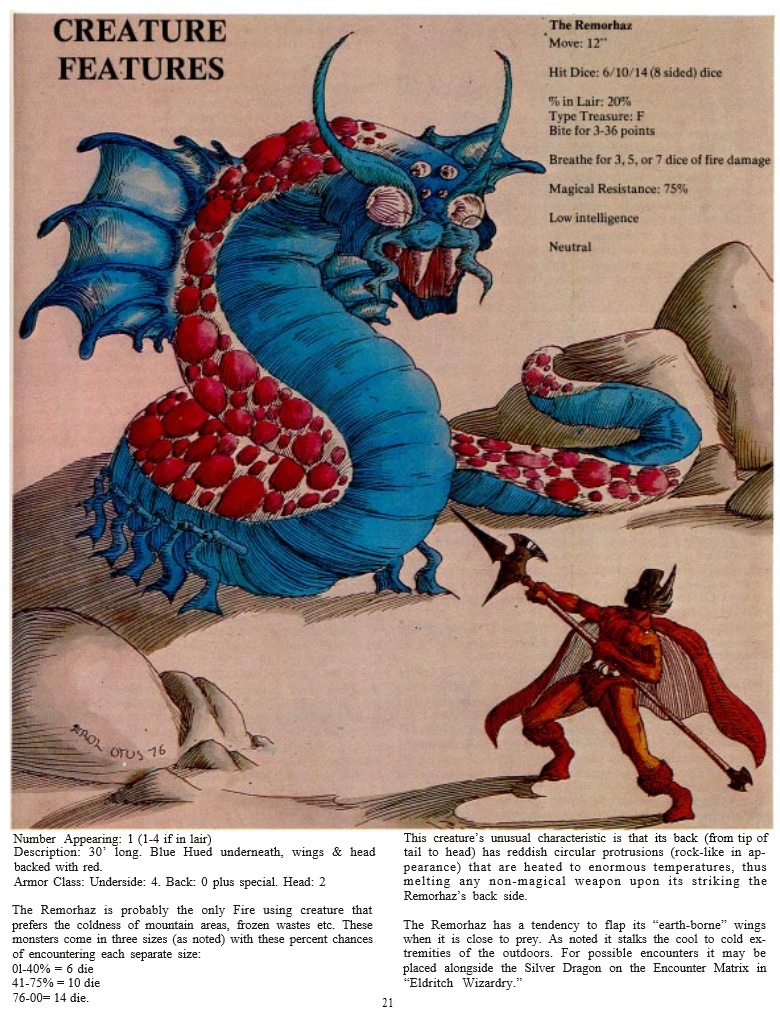
Early Erol Otus Art from The Dragon (1976 – 1977)

Otus Dragon #2 1976

Otus Dragon #5 1976

Otus Dragon #7 1977

Otus Dragon #7 1977-2

Otus Dragon #8 1977

Otus’ “Featured Creatures” from issues #2, #5, #7, and #8, respectively. He’s experimenting with different mediums here, trying to find his style.

More on my persistent admiration of Otus here.

Read Magazine #13 (February, 1975): Interview with Stan Lee

Read 1975

Read 1975-2

Read 1975-3

Read 1975-4

I haven’t been able to find much on Read magazine yet, but it seems to have run from the early to late 1970s, and focused on giving young readers fun, relevant stories and articles.

Lots of good stuff in the interview about what does and doesn’t constitute “serious culture.”

 “The public accepts all the media more now,” explained Stan. “Take movies. Thirty years ago movies were considered frivolous and unimportant. Now they’re taught in schools and colleges, analyzed, etc.”

The literary novel was also considered frivolous until at least the first quarter of the 20th Century. Today, graphic novels and comics are taught in schools and colleges, and many universities offer degrees in Pop Culture.

Stan again on “why Marvel’s heroes had so many failings”:

“We’ve always felt that if readers could accept the fairy tale quality that this person has green skin or can burst into flames or whatever, then everything else should be realistic… We can write much more interesting stories with human heroes than with unreal ones who never lose their cool.”

Lee, Kirby, and Ditko created a series of interconnected myths that are just as powerful in their way to the modern world as the stories of Zeus and Odysseus were to the ancient Greeks.

(Images via Steven Casteel/eBay)


Pages

Archives

Categories

Donate Button

Join 1,117 other subscribers