Archive Page 107

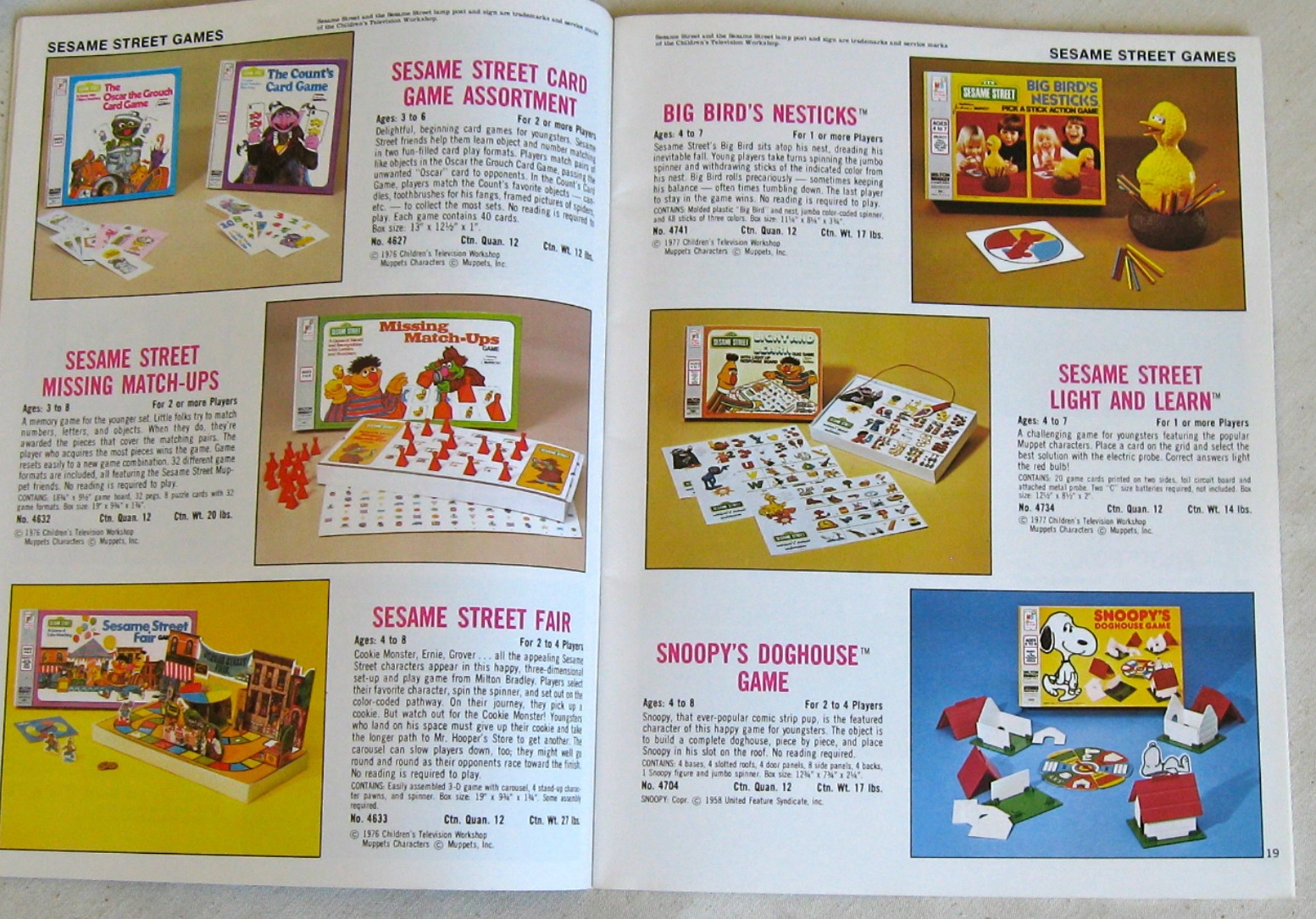
1978 Milton Bradley ‘Super Staples’ Catalog

MB Catalog 78

MB Catalog 78-2

MB Catalog 78-3

MB Catalog 78-4

MB Catalog 78-5

MB Catalog 78-6

More and more, it’s the board games I want.

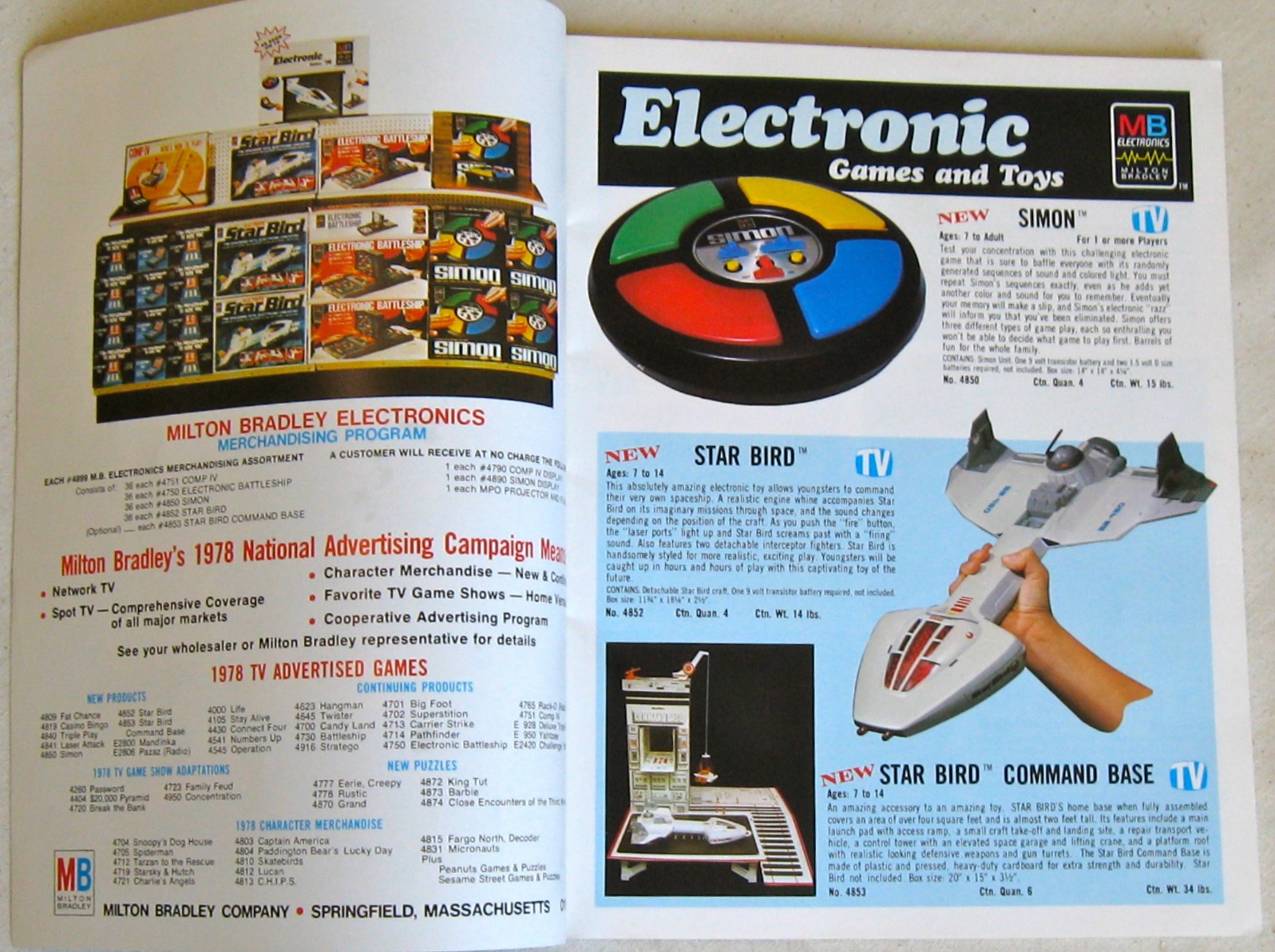
The live-action Amazing Spider-Man pilot premiered in September, 1977, and the series didn’t resume until April of 1978. The live-action Captain America TV movie was heading into production for an early 1979 release. Hence the “heaviest promotional support ever” for the games.

Starsky and Hutch was in the last year of its four-year run. The Scooby-Doo game is from ’73, and Casper is from 1959. Talk about staples. Scooby has turned out to be as enduring a character as Spidey.

I’m still not feeling the Star Bird. It’s so aseptic. Cool noises or no, ships by themselves have no personalities. I think a little plastic guy came with it, but it’s not the same. Same reason I never understood the Star Wars die cast vehicles.

The corporate letter is a nice prize: “I am certain that your sales will reflect a commensurate increase.”

(Images via eBay)

TV Guide Ads for TV Movies (1980 – 1982)

The Baby Sitter 1980

Blinded Ad 1980

Honeyboy 1982

Hotline 1982

The Babysitter (November 28, 1980): Shatner being Shatner about sums this one up: “You know nothing about her. It’s kerAAAzy! Bringing a total stranger. Into your house.” Enter gorgeous, creepy Stephanie Zimbalist (Remington Steele) giving him the googly eyes. Enter the tawdry I-do-believe-I’ve-just-been-instantly-seduced music. Shatner’s face at the end of the clip is must-see bad TV.

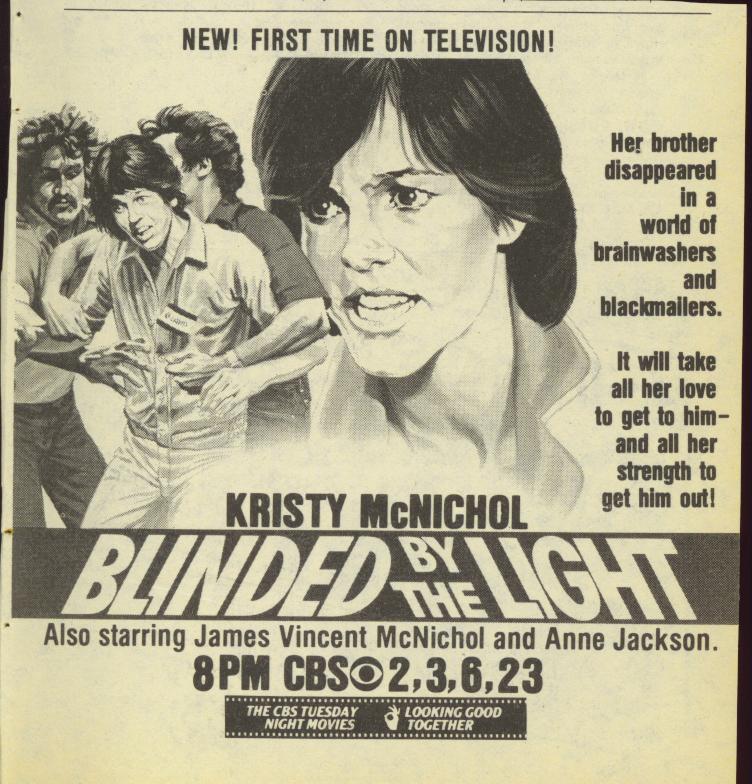
Blinded by the Light (December 16, 1980): Girl (Kristy McNichol) tries to rescue brother (Jimmy McNichol) from religious cult, but in the process begins to swallow the Kool-Aid herself. The terrible art makes Kristy look 40, but she was only 18 at the time. I can’t find a clip, and you don’t want to see it anyway, so check her out with Matt Dillon in my favorite scene from Little Darlings (also from 1980).

Honeyboy (October 17, 1982): One of the more important steps to becoming a responsible adult is accepting the fact that CHiPs made everyone dumber on a weekly basis, largely because Eric Estrada had no business being in front of a camera. As for Morgan Fairchild, I can’t even say the name without disintegrating into a puddle of adolescent sexual desire. Watch the trailer for Honeyboy, if you must.

Hotline (October 16, 1982): That dark, shiny, curvy hair. Those eyes. Those lips. That voice. God, I had such a crush on Steve Forrest from S.W.A.T. (Sorry, I can’t find anything on Hotline. I talk about the psycho-stalking-young-women genre here.)

(Images via Nostalgic Collections/eBay)

Kids Playing Portable Pac-Man, 1982

Pac-Man 1982-2

Pac-Man 1982

1982 - Jim, David, and Pac Man

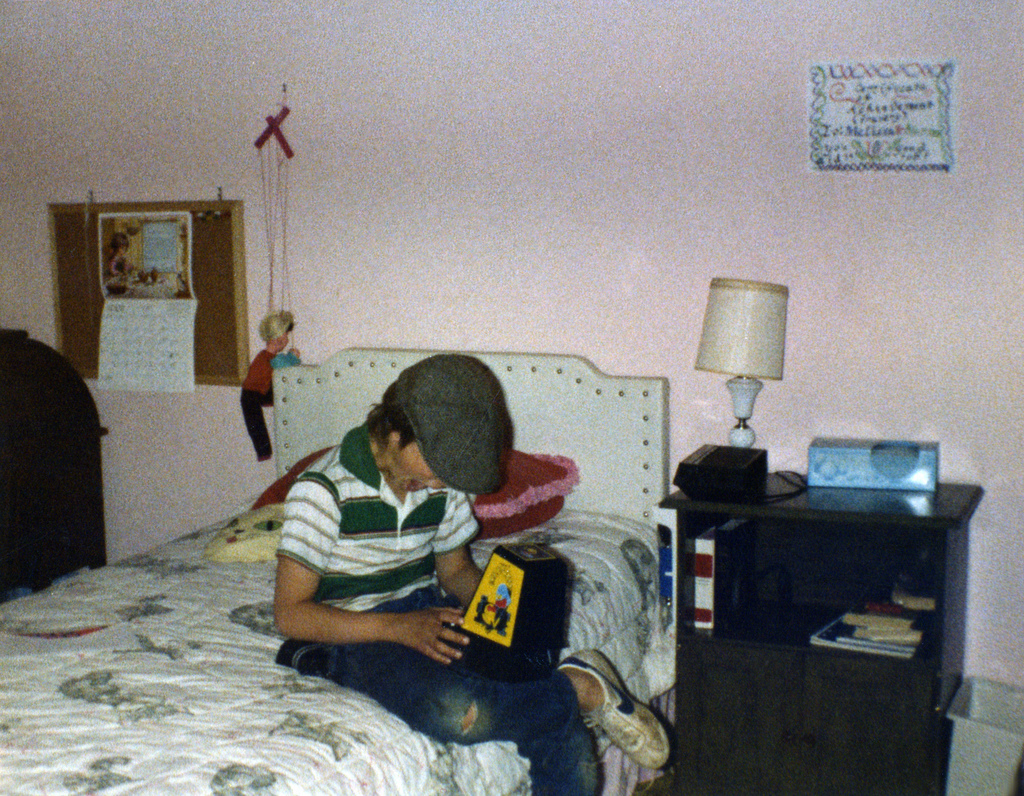
The first two photos are from Melissa Wilkins. That’s her in the first photo, and a neighborhood friend in the second. She describes the scenes here and here.

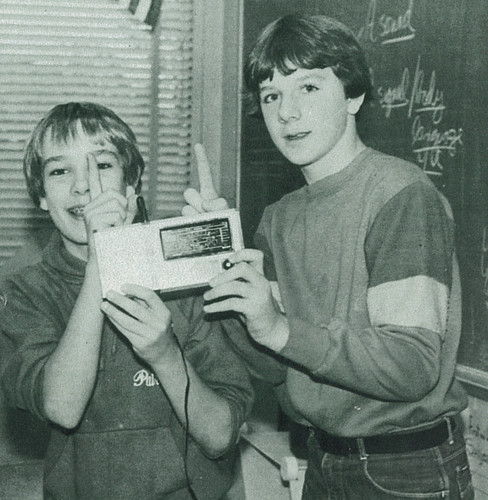
That’s Bandai’s Packri Monster in the last shot, a Pac-Man clone (duh). The photo is from jlkwak, who talks about the game and the kids who had it:

EVERYONE in the school wanted a shot at playing it. Students would literally line up in front of their table for a chance to play a round. These two fellows were the coolest kids in the middle school wing for a week.

I got my chance to play the game, once. Like the real Pac-Man, I was terrible. My turn was up very quickly.

Truth. The kids who owned these games were superstars, and turns were scarce and short.

Tomytronic 3-D (1983)

Tomy 3-D 1983

Tomy SA-1

Tomy SA-2

Tomy SA-4

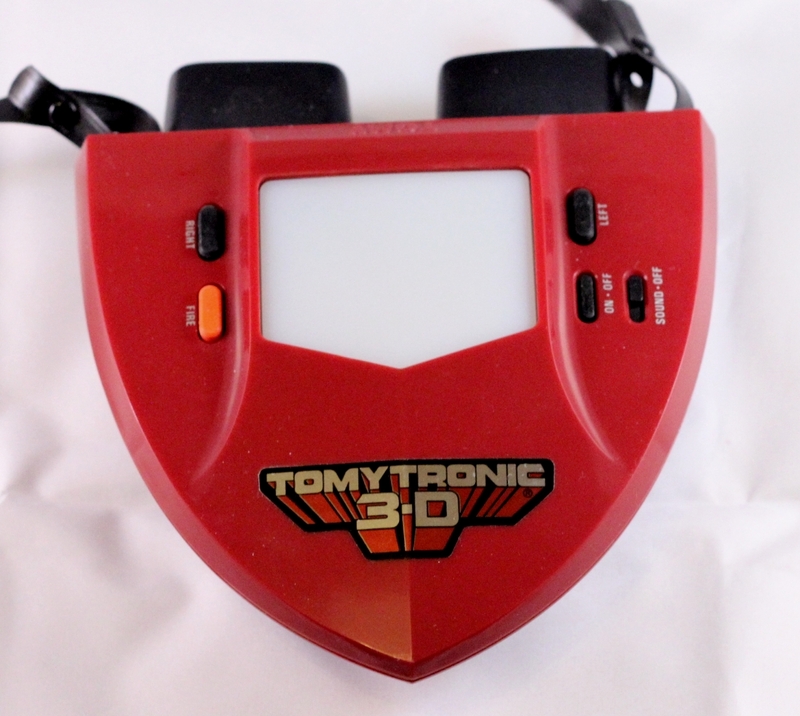
Tomytronic 3-D ranks very high up on my wanted-badly-but-never-got list. The games weren’t very good, in my opinion, but the gimmick was irresistible. For the very first time, kids could play a video game they didn’t own in complete privacy. It almost felt like we were doing something wrong.

At arcades there was always someone watching and/or waiting to play. Ditto for electronic handhelds on the playground. That sensation of always being watched, for me, was distracting. I wanted to explore whatever world the game was offering me alone and undisturbed. In retrospect, maybe it wasn’t a gimmick. Maybe the singular spaceship-binocular design was the game.

The downside was that every “pair of binoculars” was 30 bucks. That’s more than most of the non-brand LCD games, but almost $20 less than the big name tabletop arcade games. Here’s Tomytronic somewhat buried in the 1983 Sears Wishbook. I found nothing in the available 1984 catalogs.

Tomy 3-D 1983-4

There’s a good overview of the Tomoytronic 3-D system at Modojo that covers the privacy angle, along with technical details and individual games. And here’s a demo of Thundering Turbo. My favorite was Planet Zeon, the Star Wars clone, but the Tron-like Sky Attack was a close second.

(Images via Wil Falcon, eBay, and WishbookWeb)

Somebody Out There is Inappropriately Interested in Thundarr

Searching Thundarr

He’s not naked enough for you already?

Immortals of Change Battle Set (1985)

Immortals 1985

Immortals 1985-2

Immortals of Change Sears Catalog 1985

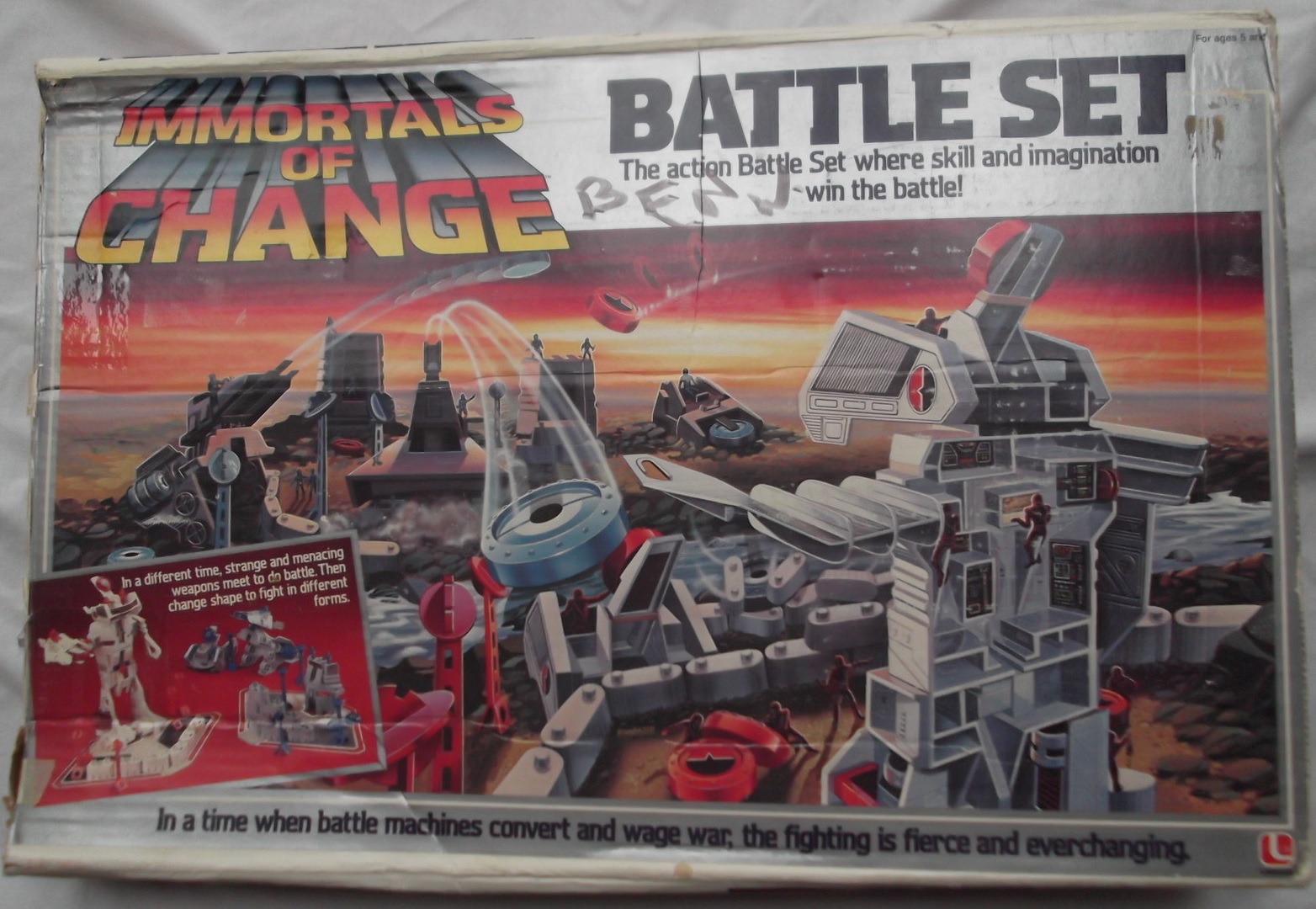
It’s Crossbows and Catapults, but in the future, and with shape-changing robots. Lakeside Games made both sets. Crossbows came out in 1983, a pretty brilliant concept that successfully cashed in on the D&D action. Immortals of Change came out in 1985, a cool-looking bomb that badly wanted to sop up some Transformers spillover.

Why did it tank? The name is awful, first of all. What the hell does it mean? Second, the game was overly complicated and didn’t work the way it was supposed to (the glider in particular, as I recall). Third, the concept made no sense the second time around.

The cool thing about Crossbows was that armies actually used giant crossbows and catapults in the Dark Ages. Why would immortal “battle machines” from the future hurl rocks at one another? Transformable robots have lasers and stuff. Everybody knows that.

The commercial below is very low quality, but it’s the only one I can find. You can tell they’re really trying to give the game an edgy feel. The volcanic landscape, the red lights, the smoke—it looks great.

(Images via eBay and Wishbook Web; video via xntryk1/YouTube)

‘Press Any Key To Begin Your Mission’: Space Assault Lives!

Space Assault 1

Space Assault 2

Space Assault 3

Space Assault 4

Space Assault 5

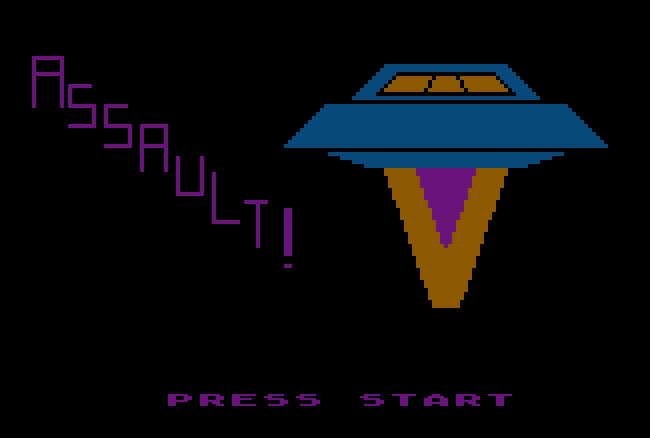
If you read my interview with Mikey Walters last month, you’ll know that he wrote an Atari BASIC game called Space Assault in 1983 that was published in A.N.A.L.O.G. magazine.

Well, Lefty Limbo and I basically begged him to get it up and running again, so he retyped all that code, plugged it into an emulator, and bam!—the Clovis Aliens are back!   

I’d say we were all in the process of kicking old school alien ass (last I heard, friend J. was up to 8500 points), but in my case, the aliens are the ones doing the ass-kicking. That’s okay. The ‘Game Over’ music is so cool, I don’t really mind.

If you want to give the game a try (you really should), send me an email and I’ll pass along the game file and instructions.

A profound thanks to Mikey for giving us back a piece of 1983, and for being awesome enough to create the game in the first place.

You can see more Space Assault screenshots on his Flickr.

Processor Technology’s Sol-20: ‘The Small Computer That Won’t Fence You In’

Sol-20 10-23-77

Press photo: October 23, 1977

sol computer 1977

The Sol-20 was introduced in the July 1976 issue of Popular Mechanics and released by Popular Technology Corporation in December of the same year.

The Popular Mechanics article breaks “video computer terminals” into “dumb” and “smart,” the Sol-20 being “one of the most advanced of intelligent terminals.” Why is it so advanced? Because it’s “possible for two SOL terminals to communicate with each other without human supervision.” Brilliant.
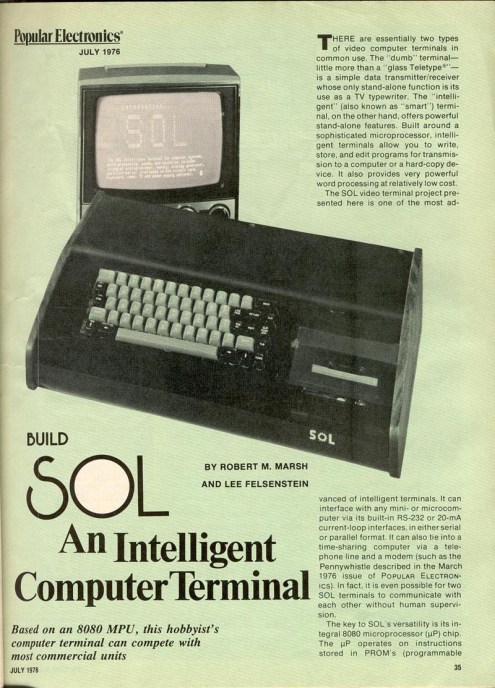
SOL-20 Article

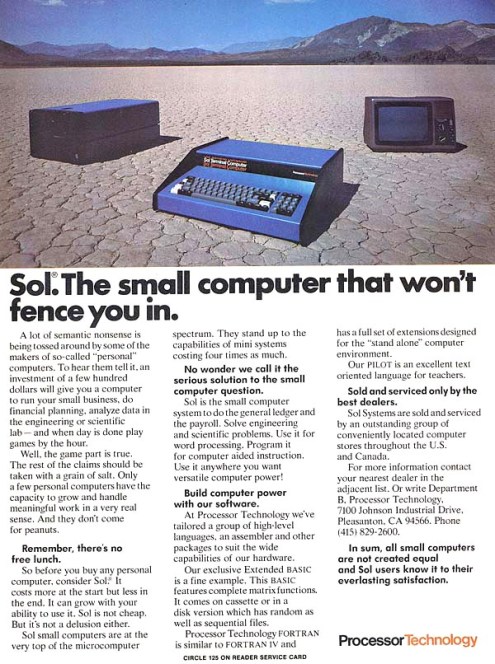
Sol-20 Ad

The ad is great too.

A lot of semantic nonsense is being tossed around by some of the makers of so-called “personal” computers. To hear them tell it, an investment of a few hundred dollars will give you a computer to run your small business… and when day is done play games by the hour.

But the few PCs that can handle “meaningful work… don’t come for peanuts.” Interesting how the company uses “small” instead of “personal”—small actually means bigger in this case, like a small pizza is bigger than a personal pizza. And how many Americans today would understand the phrase “semantic nonsense”?

Also, plunking the computer down in a hostile environment does not make it more attractive. The desert is a wide open space without fences because it’s so dessicated that nothing can live there.

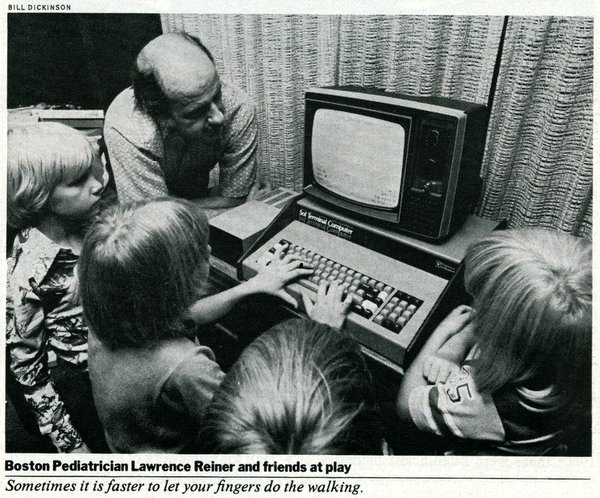
Anyway, the point of the ad is to justify the Sol-20’s price tag. There was a reason only pediatricians could afford this puppy. The Sol-20 retailed for over $2000 assembled, or about $1000 as a kit. $2000 in 1977 amounts to almost $8000 today.

Processor Technology failed to deliver a next generation, and by May of 1979 they were out of business.

Technology moved pretty fast at the dawn of the PC revolution. If you didn’t stop and rob a bank once in a while, you probably missed it.

(Images via eBay and oldcomputers.net)

Boys Reading Comic Books, 1981

Boys Reading Comics 1981

Press photo: September 26, 1981

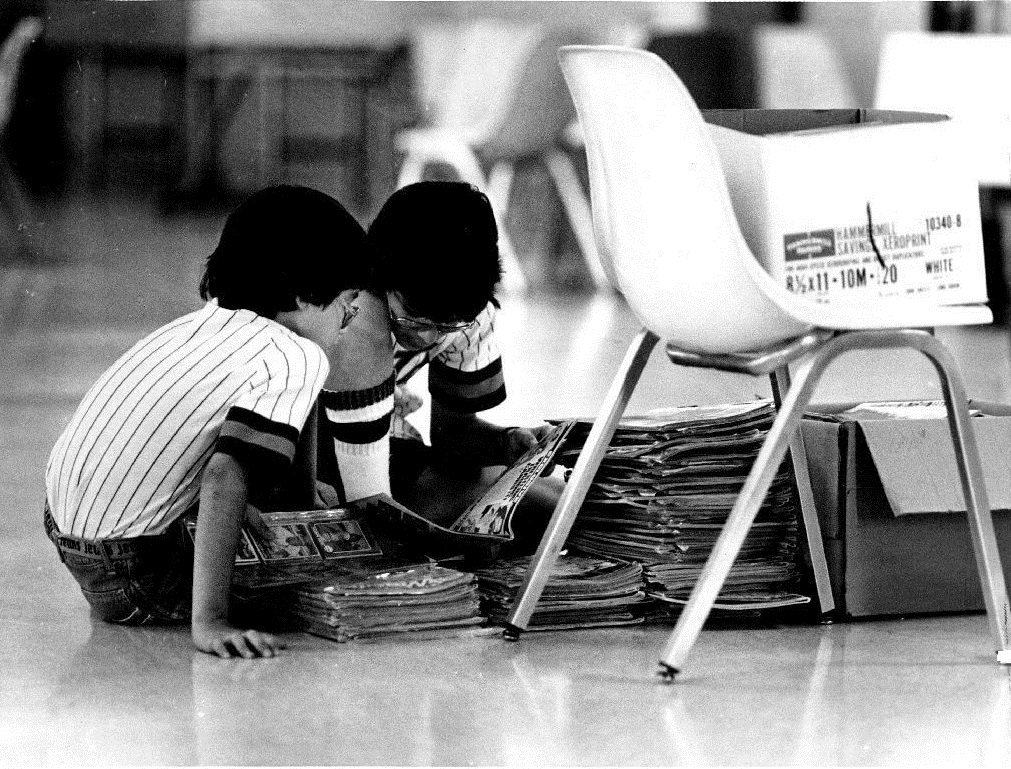
Looks like the kids are going to or coming from baseball practice. The collection they’re pulling out of the boxes is a mix of comics and magazines. The boy on the left is holding a sheet of baseball cards. I think the kid on the right might be reading Starlog.

(Photo via Big Ole Photos/eBay)

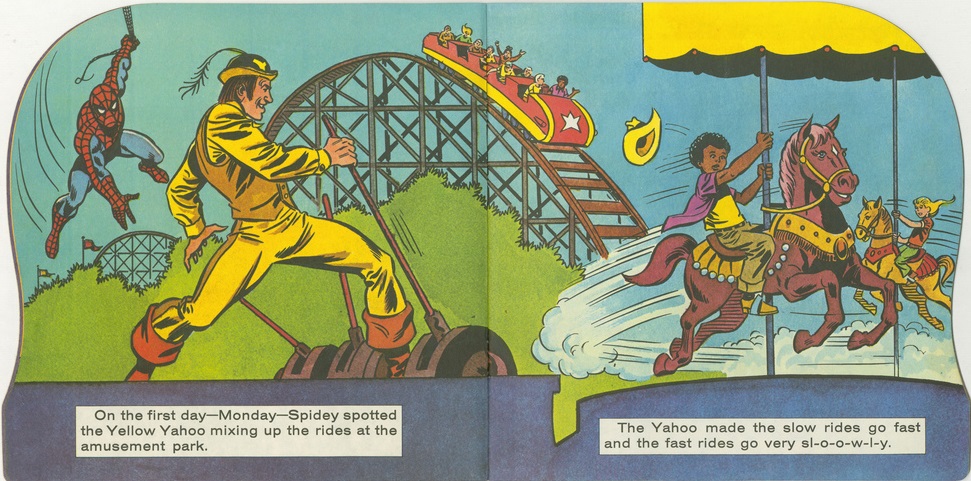
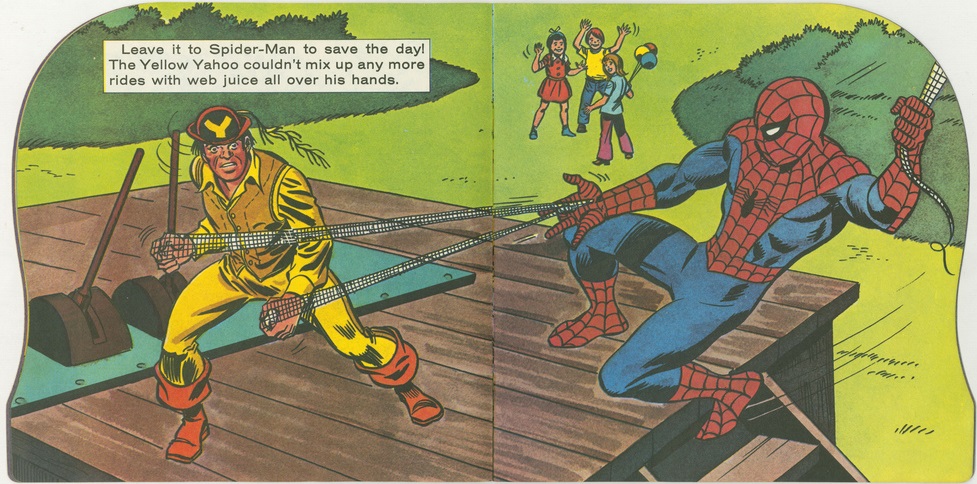
The Amazing Spider-Man: A Book of Colors and Days of the Week (1977)

ASM Book

ASM Book-2

ASM Book-3

ASM Book-4

ASM Book-5

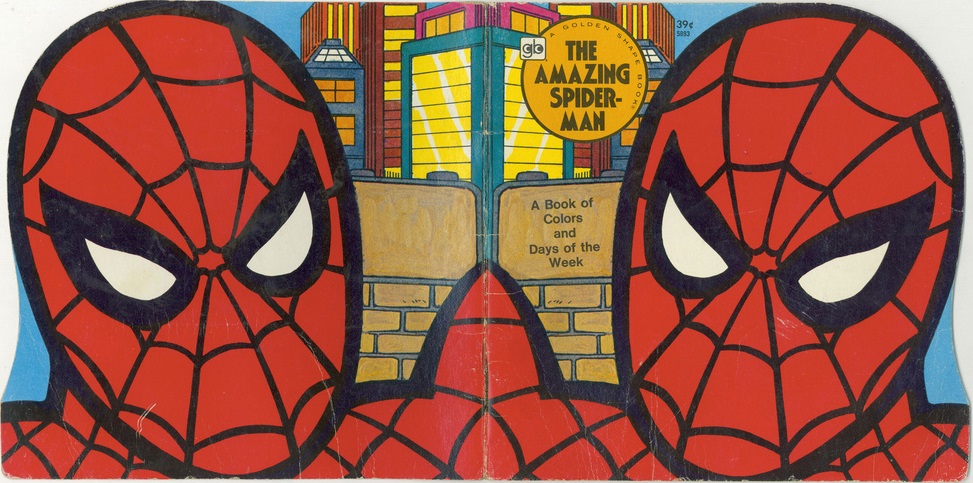
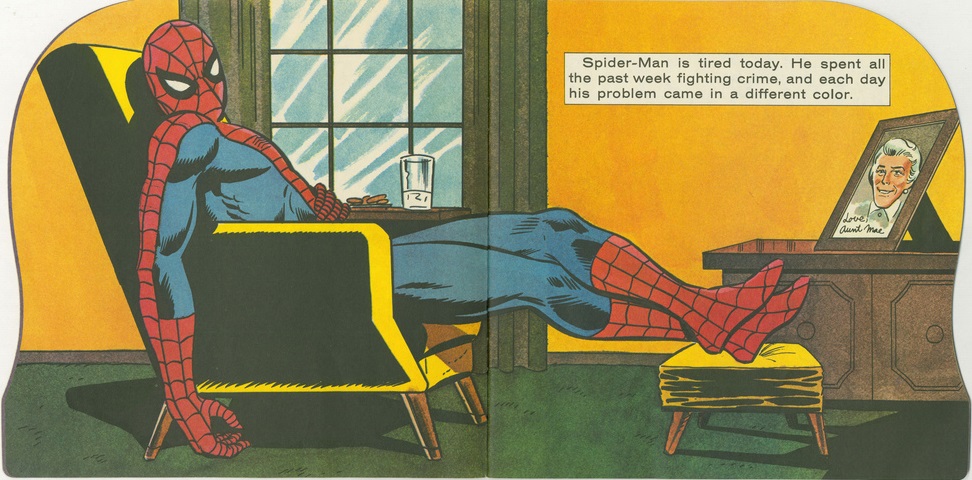
I dug this beauty out of storage with the rest of my old books when my daughter was born, and it’s currently her favorite. My copy is taking a severe beating, so I thank Greg M for saving it for future generations. (Only the first few pages are posted here.)

I can’t find anything about writer Donna Kelly, but the illustrators were well-known Marvel artists at the time, primarily inkers. Jim Mooney worked at DC for 22 years, coming to Marvel in 1968 to ink John Romita’s The Amazing Spider-Man. Mooney later penciled several books, and worked on Marvel merchandise like coloring books, children’s books, and children’s magazines. He died in 2008.

Mike Esposito (1927 – 2010) “inked virtually every major Marvel penciler on virtually every major Marvel title, from The Avengers to X-Men.”

George Roussos (1915 – 2000) was a longtime Marvel staffer best known for inking Jack Kirby on early issues of the Fantastic Four, The Avengers, and Captain America.

Remember, troops, “That web juice is sticky stuff, especially when you’re wearing feathers!”

(Note: Aunt May is spelled incorrectly—“Aunt Mae”—on Spidey’s photo of her on the book’s first page.)


Pages

Archives

Categories

Donate Button

Join 1,118 other subscribers