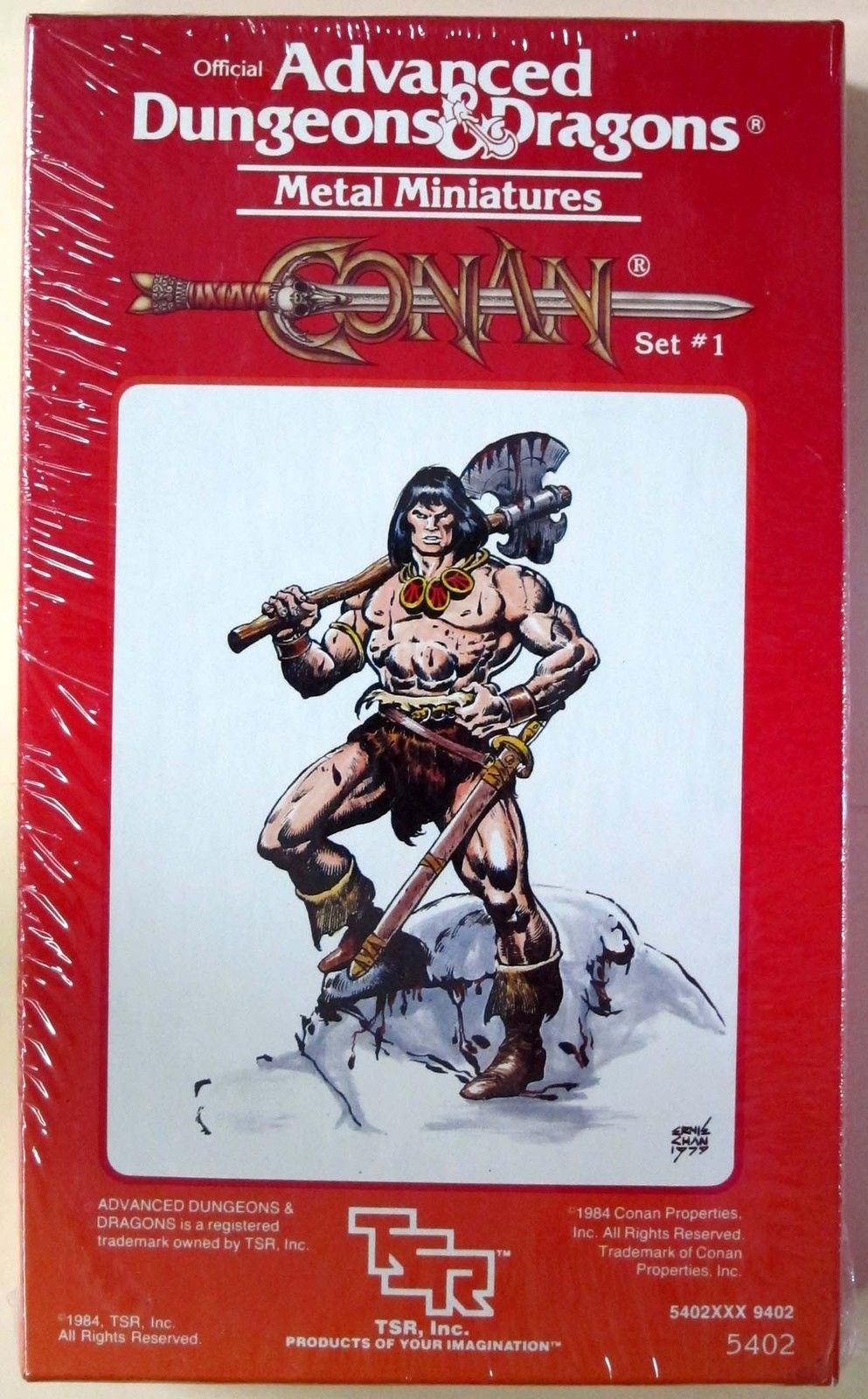
TSR released two Conan modules in 1984 (Conan Unchained! and Conan Against Darkness!) to coincide with the release of Conan the Destroyer. In 1985 TSR released, for obscure reasons, the Conan Role-Playing Game, with game mechanics based on the Marvel Super Heroes RPG. Chris Kutalik reviews the Conan RPG at Hill Cantons.
You can see some close-ups of the minis here and here.
The Hesperia Junior High D&D Club is playing The Keep on the Borderlands in the school library. Love that camo boonie hat. The photos are from the Hesperia Junior High Yearbook from 1982-1983 via Keith Sloane, who posted them in the comments at Joseph Bloch’s Greyhawk Grognard. I posted Bloch’s D&D Club photo here.
Since my last post about The Oracle reprint, Tim Hutchings has sent me a review copy of the reprint, and it does not disappoint. When Tim says that the zine was “almost single-handedly” created and published by teenager Christopher Bigelow, it’s not an exaggeration. Bigelow, who wrote a comprehensive introduction to the reprint, put the zine together with a word processor on loan from his dad’s secretary, served as the entire editorial staff, contracted all the contributing talent, and wrote many of the articles (under pseudonyms)—while still in high school!
The Kickstarter has 8 days to go and was fully funded many moons ago. However, there’s an incredible new stretch goal promising to recreate the sixth issue of The Oracle promised—but never delivered—at the end of 1983’s issue #5. Who will contribute the articles mentioned in that more than 30-year-old teaser? Here’s Tim:
The Medieval Town in Literature, Timothy Connelly, frequent contributor Gygax Magazine among others.
New AD&D Character Class… This is the one which makes me so invested in a sixth issue. A sadly departed gamer who wrote up a proposal for an Oracle article on the Empath character class will have his article finished by his son.
Expanded Crossbreed System, Erol Otus. Yes, THE Erol Otus. The man whose artwork defined D&D for me and maybe most of a generation. I grow giddy at the prospect. The Erol contribution will be based on his crossbreed rules for the Island Town game scenario.
Right. And all we need is “$100 of monthly contributions lined up” to keep the PlaGMaDA archive going. It’s a good cause, and you can go here to back and donate. A PDF copy of the reprint is only 5 bucks!
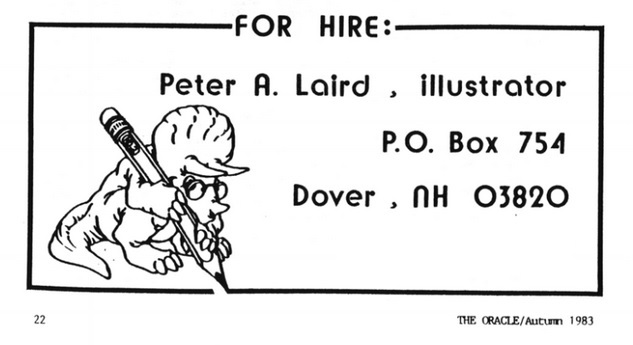
If you’re on the fence, here’s one more interesting note. As I was perusing my review copy, I ran across the below ad (phone number edited out) in the last two Oracle issues.
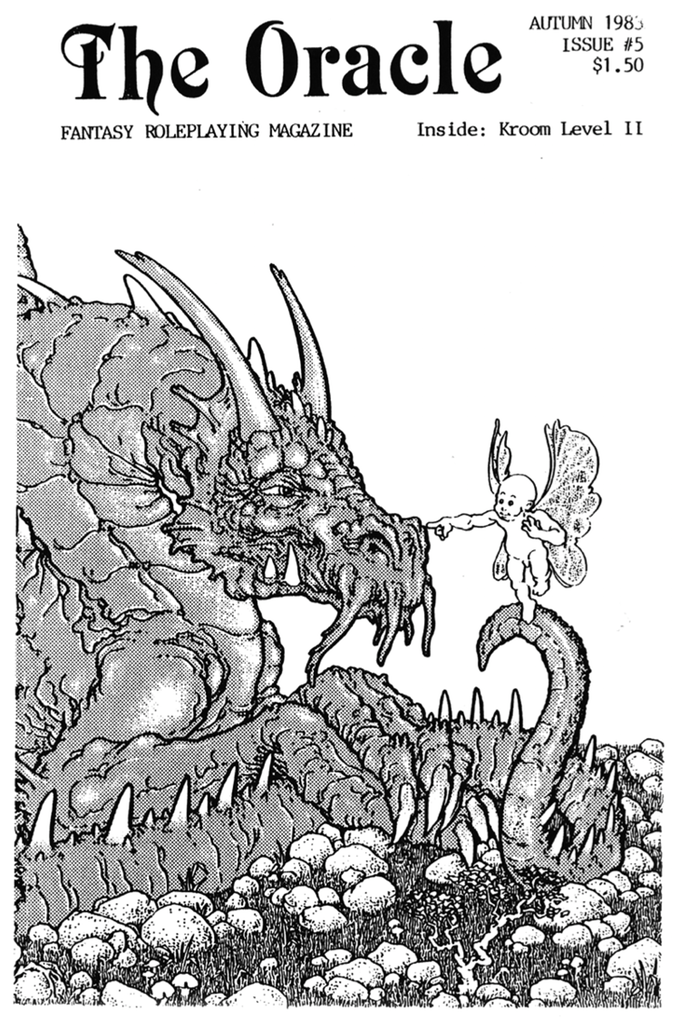
Laird is also credited with the cover of issue #5 (first image above), published in Autumn 1983. The name struck a chord, and I realized that Peter A. Laird is the co-creator (writer and artist) of the Teenage Mutant Ninja Turtles. The original black & white comic was published in May 1984, less than a year after his Oracle work. As if the project weren’t historical enough already…
The so-called “Satanic Panic” of the 1980s and early ’90s is generally dismissed today as a bizarre bout of Reagan-era excess, but it’s important to remember that (1) it was a morally reprehensible witch hunt that injured thousands and saved none, and (2) it was orchestrated by grievously irresponsible religious and civic leaders, incompetent mental health providers and law enforcement officials, sensation-chumming media, deadbeat parents, charlatans and con artists, and remorseless criminals to divert attention from the real degenerates—themselves. Sadly, despite all of our vaunted “progress,” witch hunts have a way of repeating themselves.
The panic began to surface with the 1980 publication of Michelle Remembers, a now-refuted chronicle of the alleged abuse of 5-year-old Michelle Smith by a satanic cult starting in 1954. The McMartin preschool trial, largely the result of allegations made by a paranoid schizophrenic, and tragically prolonged by “therapists” forcing false claims out of preschoolers, was pasted across TV screens and newspapers from 1984 to 1990, when the last two defendants were acquitted. Michelle Smith and Lawrence Pazder, the psychiatrist who “recovered” her “repressed” memories of abuse and then married her, acted as consultants for the prosecution and met with the alleged victims and their families. (The concept of repressed memory is extremely controversial and is not accepted by mainstream psychology)
Meanwhile, “Night Stalker” Richard Ramirez was terrorizing greater Los Angeles (including 12-year-old me), murdering 13 and assaulting and mutilating many more. At his 1988 sentencing he famously held up his hand, inscribed with a pentagram, and proclaimed, “Hail Satan.” By 1986, the media was calling Satanism an “unmeasurable force,” with the police investigating “as many as 800 crimes… linked to the devil.”
In 1988, as the McMartin trial was in full swing and Ramirez was being tried, Geraldo Rivera hosted a prime-time special called “Devil Worship: Exposing Satan’s Underground.” The special was very controversial and, predictably, hauled in huge ratings for NBC. In the special Rivera briefly interviews Sean Sellers, a then 19-year-old death row inmate who had murdered both of his parents and a convenience store clerk before he turned 17. Sellers claimed during his trial and afterwards that his actions were the result of demonic possession and converted to Christianity soon after he went to prison.*
I started to watch Escaping Satan’s Web on a whim and found myself unable to look away. It’s an extended (60-minute) interview with Sellers conducted by “Dr.” Fletcher Brothers, a pastor and founder of Freedom Village, a home for troubled teens “completely structured around the word of God.” The interview is intercut with warnings about the lures and dangers of Satanism and the occult. In his introduction, Brothers tells us that “Satanism is rampant in America and Canada” and that “young people by the millions now [are] captivated by something that can make killers out of them.” (Escaping Satan’s Web is dated 1987 by the YouTube poster, but Brothers mentions the Geraldo special [October 1988] and some footage from the show is used in the video, so the year has to be at least 1989.)
Among the animate and inanimate objects Sellers blames for his brutal crimes include his parents, comic books, the library (where he says his journey to Satan began), his babysitter, a “wild imagination,” Freddy Krueger, Zen Buddhism, a Catholic priest, heavy metal (“the lunatic fringe of music,” says Sellers), Dungeons & Dragons, and, of course, Satan himself. Not once does he accept any responsibility, and it was clear to me within the first few minutes of the interview that he was a manipulative sociopath without the slightest remorse for his actions. He understood that his only chance of getting out of prison was to claim the devil made him do it and publicly embrace the version of Christianity that had produced the societal anxiety about ritual abuse in the first place. I’m not sure what’s worse, listening to Sellers coldly describe and disown his calculated, violent actions, or watching Brothers suck up to him as the “saved” poster boy of a demonic affliction that never existed.**
Sellers starts out by describing the rise of Satanism in America—previously, it had been known to exist only “in Africa, or in some other country where there was no civilization”—and tells us that “at every school you’ve got kids who are interested in the occult,” whether they’re only “dabbling” (listening to metal and watching horror movies) or “really interested” (buying copies of The Satanic Bible, reading the Necronomicon—the latter of which is not a real book).
In the first cut scene, the narrator gives us a list of “signs that your child may be a target of Satanic recruitment”:
They come from middle to upper class homes
They have with low self-esteem
They are highly intelligent
They are loners
They come from broken homes
They are latch-key kids
They have a deep need for belonging
They are impressionable
They may be victims of sexual abuse
They are alienated from the church
They are very creative and curious
They are rebellious and looking for power
They are overachievers or underachievers
Aside from sexual abuse, these criteria describe just about every kid I ever spent time with growing up.
Dungeons & Dragons plays an important role in both Sellers’ fabricated conversion to Satanism and the Satanic Panic narrative. D&D had its first spell of national coverage when it was blamed—wrongly, always wrongly—for the disappearance of the unfortunate James Dallas Egbert III in 1979. Fundamentalist Christian groups, sensing a powerful alternative to their authoritarian prescriptions, immediately attacked the game as an occult practice, but the real crusade against D&D and its makers didn’t get going until Patricia Pulling started Bothered About Dungeons & Dragons (B.A.D.D.) in 1983. Pulling blamed D&D for her son Irving’s 1982 suicide, and for the next decade she was often consulted by police departments, school boards, and the media on teen involvement in Satanism. She also served as an expert witness for the prosecution on the alleged involvement of D&D in several murder cases. (You can see Pulling in the 1985 60 Minutes segment on D&D, in which Gary Gygax destroys her and host Ed Bradley’s desperate attempts to connect the role-playing game to violent and anti-social behavior.) ***
Brothers repeatedly presses Sellers to condemn Dungeons & Dragons in the interview, and Sellers cooperates, describing the dangers of imaginative freedom:
That character that’s in front of him is absolute. It doesn’t change. It’s a friend to him. And when he becomes that character, he knows exactly who he is, he knows exactly what he can do and what he can’t do… and the fantasy world that he lives in has no morals, no limits, you know, no values except for his own…
You let a teenager loose in that world, and sometimes they don’t want to come back.
In other words, the player is role-playing in a not-specifically-Christian universe in which he or she decides what is right and wrong and what choices to make, and to a fundamentalist Christian, that universe is always going to be evil. The cut scene that follows calls D&D “the most effective introduction to the occult in the history of man.” It teaches
demonology, witchcraft, voodoo, murder, rape, blasphemy, suicide, assassination, insanity, sex, perversion, homosexuality, prostitution, satan worship, gambling, barbarism, cannibalism, sadism, desecration, demon summoning, necromantics, divination, and other occultic themes.
That’s a direct quote.
The next cut scene warns of “Signs of Satanism in Your Community,” some of which include “occult graffiti, mysterious murders, demand for occult-related jewelry, shoplifting in candle shops (my favorite), grave robbings, animal mutilations, and unusual tattoos.” The on-screen text is accompanied by video footage of supposedly “at-risk” teenagers committing sins such as smoking, hugging, kissing, dancing, wearing sunglasses and leather jackets, laughing heartily, and so on.
At the end of the video Brothers blesses Sellers, shakes his hand, and says, “One of these days we’re going to shake hands outside of this place without these [handcuffs] on.” The viewer is encouraged to purchase a copy of Satanism in America: What They Don’t Want You to Know, a “new publication” that will “give you the facts on occult and satanic activities that threaten you and your family… to give you the knowledge to protect your loved ones from those that would harm them.” Please send your $10.00 check to Freedom Village.
______________________________
*In his satanism special, Rivera interviews a spokesman for several McMartin preschool parents who are gathered in someone’s living room. The woman to the right of the spokesman appears to be Michelle Smith (47:51), although I can’t confirm this.
**Sellers was executed by lethal injection in 1999. He did not acknowledge or apologize for his crimes.
***See the AP article “Dungeons, Dragons: Fundamentalists Attack Game as Road to Occult” from February 27, 1982. The writer of a letter to the editor in the December 12, 1980 edition of the Eugene Register-Guard calls D&D a “new fantasy game… based on the ability to promote demons to wipe out the opponent through information and formulas that could only be written by someone well versed with the occult.” She also calls the game an “introduction to the occult.” A December 1981 Milwaukee Sentinel article talks about the school board of Mukwonago High School approving Dungeons & Dragons as an official after school activity. 465 area residents submitted a petition to reverse the decision, calling the game “an active instrument in the practice of witchcraft.”
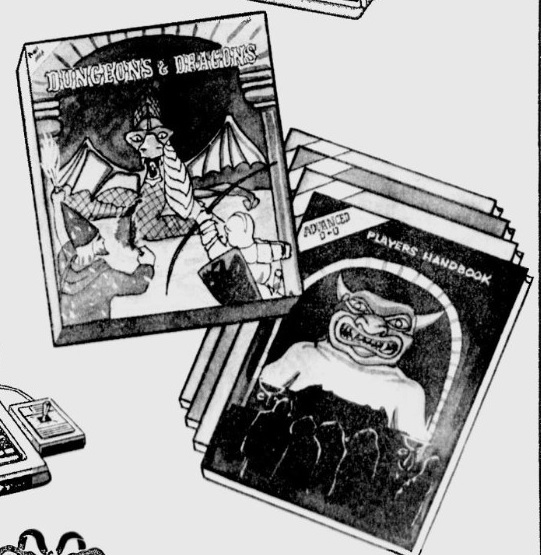
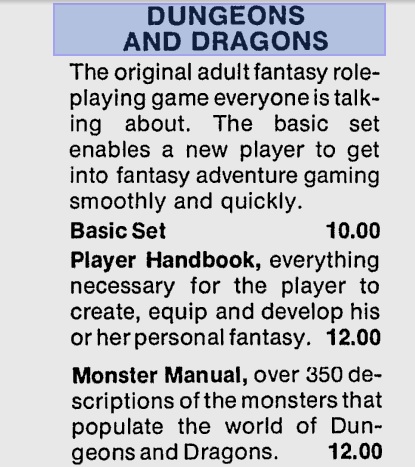
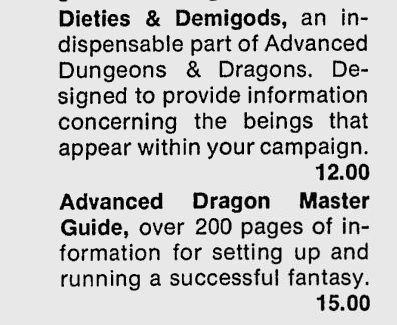
The ad is from the Spokane Daily Chronicle, December 5, 1980. The D&D books appear with the high-ticket electronic handhelds and consoles, including the Atari 2600 and the Intellivision.
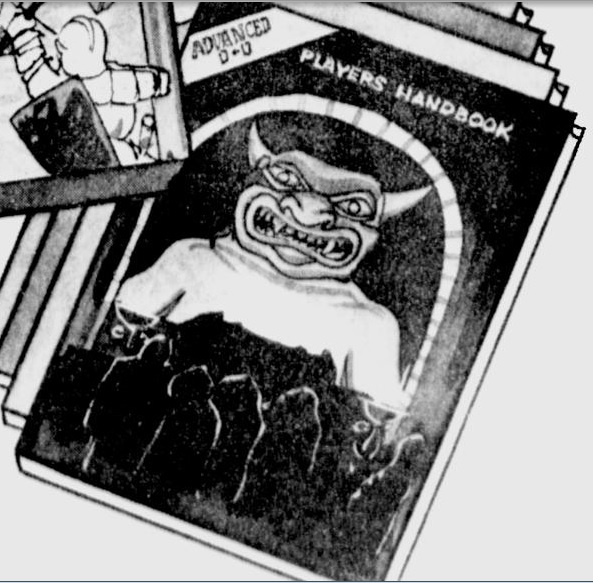
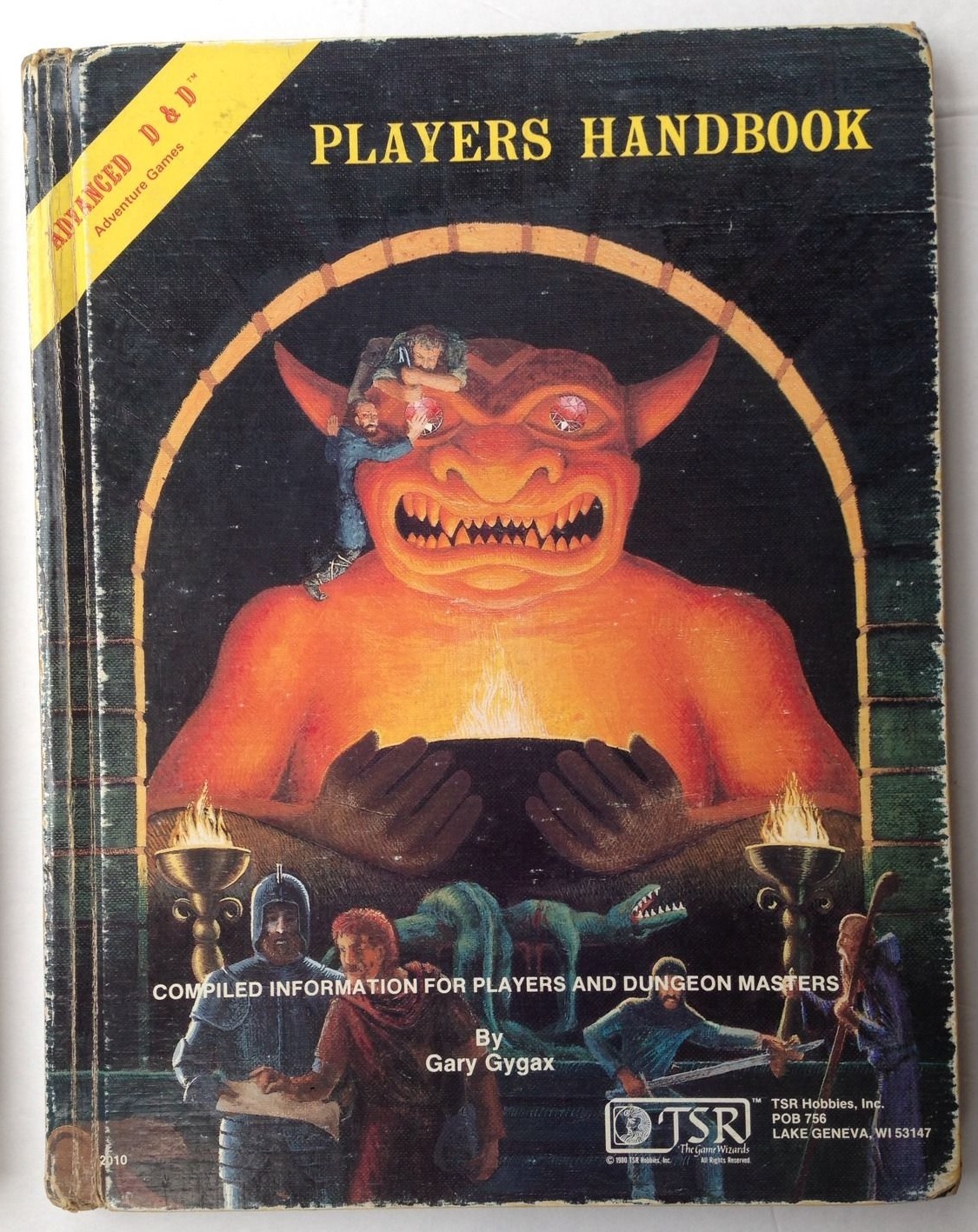
Take a closer look at the pictures in the ad, which are actually an artist’s illustrations of the original Basic Set (David Sutherland) and Players Handbook (David Trampier) covers. The Basic Set is pretty straightforward, the only noticeable difference being the lack of gold. But for the Players Handbook, we see dark, hooded figures seemingly worshiping a demon idol, as opposed to a party of post-battle dungeon raiders, two of whom are attempting to chip the jewels out of the demon idol’s eyes (see below).
The “Satanic Panic” wouldn’t blow up until 1982-1983, but already the game had touched a nerve, and, consciously or not, people saw things in it that weren’t there. Fantasy role-playing was almost impossible for adults of a certain religious temperament to accept. In Trampier’s cover, probably the most distinctive and resonant image in all of D&D, all they could see was their greatest fear: not the reality of the devil, but the reality that their children might not believe what they believed.
The Star Trek Club and the Middle Earth Club of Mira Loma High School merged in 1979 to form the Science Fiction Club, and the Order of Excalibur Club was added in 1980 “to congress around Dungeon and Dragons and other board games revolving around wizards and magic.”
The graphic on the D&D shirt appears to be the same one the kid in this D&D Club is wearing. The letters are iron-on affairs, so my guess is there was a generic dragon shirt on the market at the time, and the kids had mom press on the letters. Another homegrown D&D shirt here. Lots more D&D Clubs here.
PlaGMaDA’s Tim Hutchings, who gave us The Habitation of the Stone Giant Lord, an incredible collection of homemade D&D modules from the early ’80s, is now collecting all five issues of The Oracle in a limited edition print run. Says Tim:
The Oracle was a well realized, very ambitious fanzine put out almost single-handedly by Christopher Bigelow, a Mormon teenager, in 1982 and 83. It is an excellent example of the type and includes original adventures, rules offerings like new character classes, and reviews of other periodicals and rules systems and movies. This project should speak to gamers, nostalgia seekers, game historians, and zine fanatics.
Check out the Kickstarter and read the first issue of The Oracleright here.
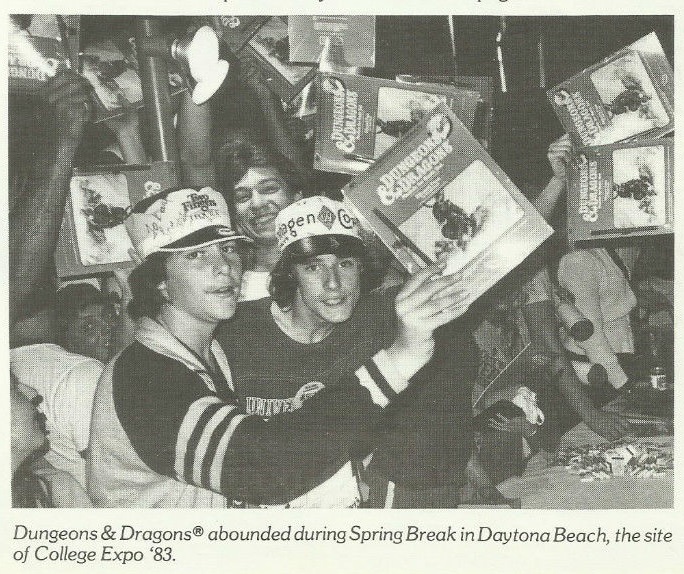
Apparently TSR had a booth at something called “College Expo” during Spring Break of 1983. Apparently TSR gave away lots of swag, including Blizzard Pass, the first solo adventure module. Apparently the TSR booth was sponsored by Casey Kasem’s American Top 40. Apparently 6000 t-shirts featuring both the D&D logo (front) and the American Top 40 banner (back) were made for the event.
Conclusion: somewhere out there, probably covered in 32-year-old beer and puke and unused condoms, is a t-shirt featuring both the D&D logo and the American Top 40 banner.
Random Events was an internal TSR newsletter that ran from 1981 to 1983. I don’t have the second page of this issue, unfortunately, but you can read more at The Acaeum.
If you own the copyright to any of the material on this site and would like said material to be removed, please contact 2warpstoneptune [at] gmail [dot] com.










 2 Warps to Neptune